Understanding When to Seek Specialized Treatment
Most hand or wrist pain that does not improve after 7‑10 days of rest, ice, and over‑the‑counter medication should raise concern. While minor strains often resolve within a week, persistent pain beyond two weeks signals an underlying orthopedic problem such as tendon injury, arthritis, or nerve compression. Red‑flag symptoms that demand immediate evaluation include numbness or tingling (especially at night) in the thumb, index or middle fingers, visible swelling, bruising, or deformity after trauma, sudden loss of grip strength, inability to move a finger or wrist, and signs of infection like redness, warmth, or fever. Early orthopedic assessment allows accurate diagnosis through physical exam, X‑ray, MRI or nerve studies, and timely non‑surgical or surgical treatment. Prompt intervention can prevent permanent nerve damage, joint degeneration, and chronic disability, while preserving hand function and reducing recovery time for daily activities. Patients also benefit from personalized rehabilitation plans that restore strength and dexterity faster.
Red‑Flag Symptoms That Demand Orthopedic Expertise
 Persistent hand pain lasting more than 7-10 days often indicates underlying conditions requiring orthopedic evaluation is a classic red‑flag sign that an underlying orthopedic condition may be present. Equally concerning are Numbness or tingling in fingers can be a sign of nerve compression such as carpal tunnel syndrome —especially in the thumb, index, and middle fingers—that suggest nerve compression such as carpal tunnel syndrome; when these sensory changes are accompanied by weakness in grip strength, early orthopedic evaluation is essential. Visible swelling, bruising, or deformity of the hand after trauma points to possible fractures, ligament tears, or tendon ruptures, all of which require prompt imaging and specialist care. Loss of motion or grip strength, difficulty performing fine‑motor tasks, and a sudden inability to straighten a finger or wrist also flag joint, tendon, or nerve pathology that should be assessed by a hand surgeon. Signs of infection—redness, warmth, fever, or a painful lump indicate a deeper systemic issue and demand urgent medical attention. First‑sign nerve‑damage indicators include intermittent “pins‑and‑needles,” reduced sensation, and early weakness, which may progress if left untreated. If any of these red‑flag symptoms appear, schedule an appointment with an orthopedic hand specialist without delay.
Common Hand and Wrist Conditions: When to Contact a Specialist
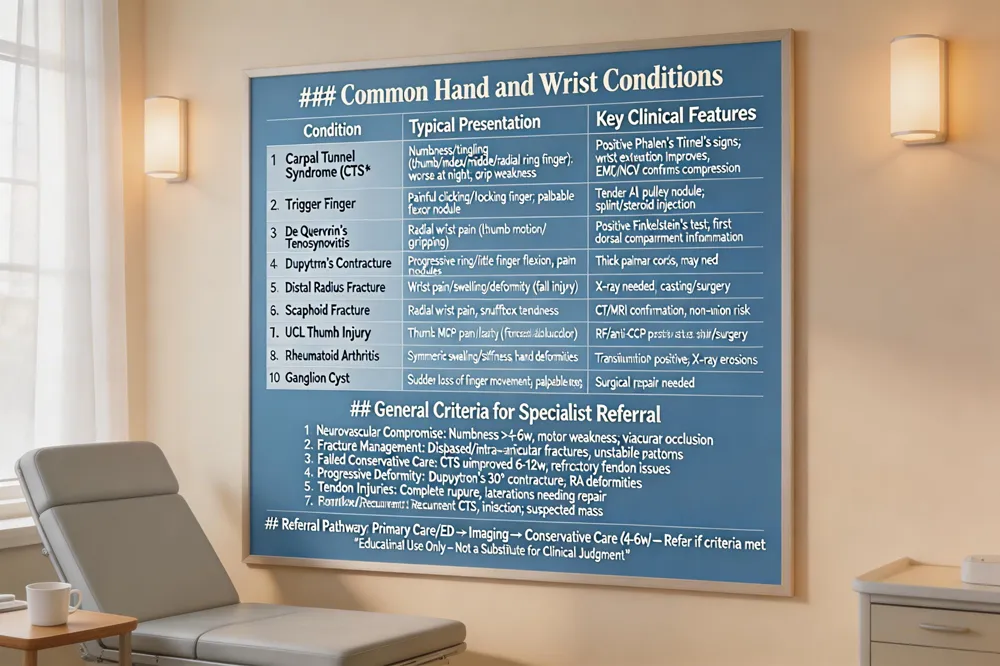 Carpal tunnel syndrome – A common compression of the median nerve in the carpal tunnel causing tingling, numbness, and weakness in the thumb, index, middle and half of the ring finger, especially at night. Repetitive motion, swelling, or anatomical narrowing can provoke it. Initial treatment includes wrist splinting, activity modification, and steroid injections; persistent or progressive cases need surgical release by a hand surgeon such as Dr. Rebecca S. Yu.
Wrist disorders – Encompass Carpal tunnel syndrome, De Quervain’s tenosynovitis, ganglion cysts, fractures (scaphoid, distal radius), sprains, and arthritis. Symptoms are pain, swelling, stiffness, loss of strength, and numbness. Diagnosis relies on history, physical exam, X‑ray, MRI, or ultrasound; management ranges from rest, splinting, NSAIDs, and therapy to injections or surgery.
Osteoarthritis treatment – When conservative care fails, surgical options include joint fusion (arthrodesis), joint replacement (arthroplasty), and osteotomy. Thumb‑base disease may be addressed with trapeziectomy and tendon interposition or total joint arthroplasty; finger joints may receive arthrodesis or prosthetic implants.
Condition limited to hand/wrist – Carpal tunnel syndrome is confined to the wrist‑hand region, with no symptoms beyond the fingers.
Most common hand condition – Carpal tunnel syndrome dominates hand‑and‑wrist clinics worldwide.
Hand surgeon terminology – The specialist is called a hand surgeon (orthopedic hand surgeon or plastic hand surgeon) and is the expert for finger, wrist, and forearm problems.
Referral and local expertise – Most insurers allow direct appointments, though HMOs may require a primary‑care referral. In the Berkeley, CA area, Dr. Rebecca S. Yu, MD, is a board‑certified orthopedic hand specialist offering comprehensive non‑operative and surgical care.
Diagnostic & Treatment Pathway: What to Expect at Your First Visit
 When you walk into Dr. Rebecca S. Yu’s office for your first appointment, the visit follows a clear, step‑by‑step pathway designed to pinpoint the cause of your hand or wrist problem and chart the most effective treatment plan.
Medical history review and symptom documentation – Dr. Yu will ask detailed questions about the onset, duration, and character of your pain, any numbness or tingling, swelling, loss of strength, and how symptoms affect daily tasks such as typing, cooking, or sports. She’ll also note any prior injuries, surgeries, or systemic conditions like diabetes that may influence healing.
Physical examination and specialized tests – A focused exam assesses range of motion, grip strength, nerve function, and any visible deformity or tenderness. Specialized maneuvers (e.g., Phalen’s, Tinel’s) help identify carpal tunnel, trigger finger, or tendon issues.
Imaging options – Based on the exam, Dr. Yu may order X‑rays, MRI, ultrasound, or EMG studies to visualize bones, tendons, ligaments, and nerves.
Non‑surgical treatment options – If the condition is amenable, options include splinting, physical therapy, NSAIDs, corticosteroid injections, or PRP therapy.
Surgical decision‑making and timelines – When conservative care fails or structural damage is evident, Dr. Yu discusses surgical alternatives, expected outcomes, risks, and recovery timelines. Elective hand surgery is typically scheduled within 2–6 weeks; urgent cases such as fractures are addressed within days.
Answers to common questions
- What to expect when seeing a hand specialist? You will receive a thorough history, exam, imaging if needed, and a personalized plan outlining both non‑operative and operative options.
- Does an orthopedic doctor treat wrist pain? Yes—hand and upper‑extremity orthopedists diagnose and manage wrist fractures, tendonitis, carpal tunnel syndrome, and more, using splints, therapy, injections, or surgery.
- How do you know if you need surgery on your hand? Persistent pain, loss of motion, weakness, or deformity despite several weeks of conservative care, plus imaging that shows unrepaired fractures, severe arthritis, or tendon/ligament tears, signals surgery.
- How long do you have to wait for hand surgery? Elective procedures usually within 2–6 weeks after consultation; urgent fractures are treated within days.
- Is there hand surgery for osteoarthritis? Yes—options include joint fusion, joint replacement, or arthroplasty tailored to the affected joint and patient goals.
Stage Advanced Imaging, Early Intervention, and Documentation
 Documenting symptoms, pain intensity, and functional limitations helps the specialist make an accurate diagnosis.
Hand specialists can use advanced imaging and diagnostic techniques to identify issues like tendon injuries, nerve entrapment, and joint degeneration.
MRI, CT, high‑resolution ultrasound, and EMG provide detailed views of bones, ligaments, tendons, and nerve pathways, revealing subtle fractures, TFCC tears, or carpal tunnel compression that plain X‑rays miss.
Early intervention and non‑surgical treatments like PRP therapy can improve outcomes for many hand and wrist conditions by promoting tissue healing and reducing inflammation before surgery is considered.
Tailoring treatment plans to individual needs involves combining symptom documentation, imaging findings, and patient goals to decide between splinting, therapy, injections, or minimally invasive procedures.
The hand and wrist contain 27 bones—eight carpals, five metacarpals, and fourteen phalanges—supported by over 100 ligaments and tendons, 34 intrinsic and extrinsic muscles, and the median, ulnar, and radial nerves, all of which must be evaluated to restore optimal function.
Take the Next Step Toward Pain‑Free Hands
A quick recap of the red‑flag signs that should prompt a hand‑specialist referral includes persistent pain beyond two weeks, nighttime numbness or tingling in the thumb, index or middle fingers, swelling or visible deformity after trauma, loss of grip strength, and difficulty performing fine‑motor tasks such as buttoning a shirt. When any of these warnings appear, timely evaluation by an orthopedic hand surgeon is critical—early diagnosis and treatment (whether non‑surgical options like splinting and PRP therapy or surgical intervention) improve outcomes and help prevent permanent nerve or joint damage. To schedule an appointment with Dr. Rebecca S. Yu, MD, a board‑certified hand surgeon serving Berkeley and the Bay Area, visit the Advanced Bone & Joint website or call (636) 265‑8022. The practice offers an online booking form, and the clinic staff can assist with insurance verification and provide instructions for pre‑visit imaging or symptom documentation.