Introduction
Minimally invasive hand and upper‑extremity surgery uses small incisions, endoscopic or arthroscopic tools, and percutaneous techniques to limit soft‑tissue disruption. By preserving skin, tendons, and neurovascular structures, these approaches reduce postoperative pain, swelling, and scar formation, allowing patients to begin early motion and return to daily activities within days rather than weeks. Evidence from U.S. clinical studies shows 30‑40 % lower pain scores and a 2‑3‑week faster functional recovery compared with traditional open surgery. The five essential rules—(1) detailed pre‑operative imaging and planning, (2) selection of the least invasive approach that still achieves adequate decompression, (3) use of specialized small‑incision instruments and endoscopic systems, (4) meticulous soft‑tissue handling to protect neurovascular bundles, and (5) structured early postoperative rehabilitation—provide a framework that guides surgeons and therapists in delivering safe, efficient care and optimizing outcomes.
Rule 1 – Precise Planning & Evidence‑Based Protocols
 Effective upper‑extremity care begins with high‑resolution pre‑operative imaging—MRI, ultrasound, or CT—to map pathology, confirm that a minimally invasive approach is appropriate, and guide portal placement. Patient‑selection criteria therefore hinge on isolated ligament or tendon lesions, stable fracture fragments, adequate bone quality, and realistic functional goals, as emphasized in the ASHT webinar and multiple ACOEM guidelines.
Professional societies provide downloadable, evidence‑based protocols that translate this planning into bedside practice. The American Academy of Orthopaedic Surgeons (AAOS) and the American Society for Surgery of the Hand (ASSH) host free PDFs of their clinical practice guidelines for hand and upper‑extremity conditions. A comprehensive week‑by‑week manual—“Evidenced Based Hand and Upper Extremity Protocols (Second Edition)”—is available from the Charleston Hand Therapy Center and includes 95 treatment protocols with indications, contraindications, visit frequency, and clinical pearls. Additional hand‑therapy PDFs can be obtained from ASHT and AAOS, covering postoperative splinting, scar management, and progressive strengthening.
Key surgery principles: meticulous technique, sound anatomy, sterility, hemostasis, gentle tissue handling, appropriate anesthesia, and structured postoperative care.
As of 2020, women comprised 6 % of practicing orthopedic surgeons in the U.S., with 19 % of orthopedic residents being female in the 2021‑2022 academic year.
Rule 2 – Minimal Tissue Disruption – Surgical Technique Essentials
 Minimally invasive hand surgery is a technique that treats hand and wrist conditions through very small incisions—often just a few millimeters—using specialized endoscopic or percutaneous instruments and high‑definition imaging. By working through these tiny portals, the surgeon can address problems such as carpal tunnel syndrome, tendon injuries, fractures, and nerve compressions while preserving surrounding tissue. This approach typically results in less postoperative pain, reduced swelling, and a quicker return to daily activities compared with traditional open surgery. Because the trauma to skin and muscles is minimal, patients often experience smaller scars and a lower risk of infection. Overall, minimally invasive hand surgery offers faster functional recovery and improved cosmetic outcomes while delivering the same high‑quality orthopedic care.
Endoscopic, arthroscopic, and percutaneous tools are the cornerstones of this approach. An endoscope or arthroscope provides a high‑resolution video view through a 1‑cm or smaller portal, allowing precise cutting, debridement, or hardware placement. Percutaneous devices, such as fine needles or intramedullary nails, enable fracture fixation or tendon release through millimeter‑sized entry points. Intra‑operative imaging—fluoroscopy, ultrasound, or real‑time MRI—guides instrument navigation and confirms hardware positioning, while nerve monitoring protects the median, ulnar, and radial nerves during delicate decompressions.
The five fundamental surgical principles include meticulous technique, deep anatomical knowledge, strict sterility, reliable hemostasis, careful tissue handling, appropriate anesthesia, and comprehensive postoperative care to ensure optimal outcomes.
Rule 3 – Pain Management & Early Mobilization
 Minimally invasive hand and upper‑extremity surgery produces a milder pain profile than traditional open procedures because the incisions are ≤ 1 cm and soft‑tissue disruption is minimal. Patients usually describe the first‑few‑days discomfort as mild‑to‑moderate, comparable to a sports‑injury bruise, and swelling is limited.
Multimodal analgesia and opioid stewardship – A typical regimen combines a scheduled non‑steroidal anti‑inflammatory drug (e.g., ibuprofen 600‑800 mg q8h) with acetaminophen, and a short, as‑dose opioid (e.g., Percocet 5 mg/325 mg q4‑6h) only if needed. This approach controls pain while the opioid requirement drops sharply after the initial 48‑72 h, aligning with current U.S. opioid‑stewardship guidelines.
Guided early motion to prevent stiffness – Begin gentle active finger and wrist motions within 24‑48 h (as instructed by the hand therapist). Early protected range‑of‑motion promotes tendon gliding, reduces adhesions, and accelerates functional recovery.
Answers to common patient questions
- How painful is minimally invasive surgery? The pain is generally mild‑to‑moderate, far less than open surgery, and often managed with OTC analgesics or a brief opioid course.
- What are the after‑care instructions for hand surgery? Keep the dressing dry for 3 days, wear any prescribed splint until the first follow‑up, take scheduled pain meds, begin gentle finger motions, avoid heavy lifting, and monitor for infection signs.
- How to elevate hand after surgery? Rest the hand on a pillow or Carter pillow above heart level for 15‑20 min every 2‑3 h during the first 48 h, then continue several times daily for the next 3‑5 days.
- Helpful items after hand surgery – Ice packs, pillows for elevation, a supportive splint or removable brace, easy‑to‑open clothing, a medication organizer, and entertainment items within reach to minimize unnecessary movement.
Rule 4 – Vigilant Monitoring for Complications
 Hand still swollen 3 weeks after surgery
Swelling is normal for the first 2‑4 weeks. By week 3 it should be decreasing. If it stays the same or worsens—especially with redness, warmth, fever, increasing pain, or tightness—these are red‑flag signs of infection, hematoma, or vascular compromise. Continue elevation, intermittent ice (15‑20 min, several times daily), and gentle finger‑flexion‑extension exercises. Keep the incision clean, dry, and avoid constricting dressings. Call Dr. Rebecca S. Yu’s office promptly if swelling does not improve after another week or if any concerning symptoms appear.
What are the warning signs after hand surgery?
Watch for sudden pain, warmth, swelling, foul‑smelling drainage, fever ≥ 100.4 °F, chills, blue/white/mottled fingers, numbness, tingling, loss of sensation, excessive bleeding, or a tight dressing that does not respond to elevation. Any of these require immediate medical evaluation.
Complications after hand surgery
Possible issues include hematoma, infection (≈5 % superficial), scar formation, stiffness, nerve or tendon injury, complex regional pain syndrome, and cold intolerance. Early recognition and prompt treatment are essential for optimal recovery.
Rule 5 – Structured Rehabilitation & Return to Function
 Graduated Therapy Phases and Patient Education:
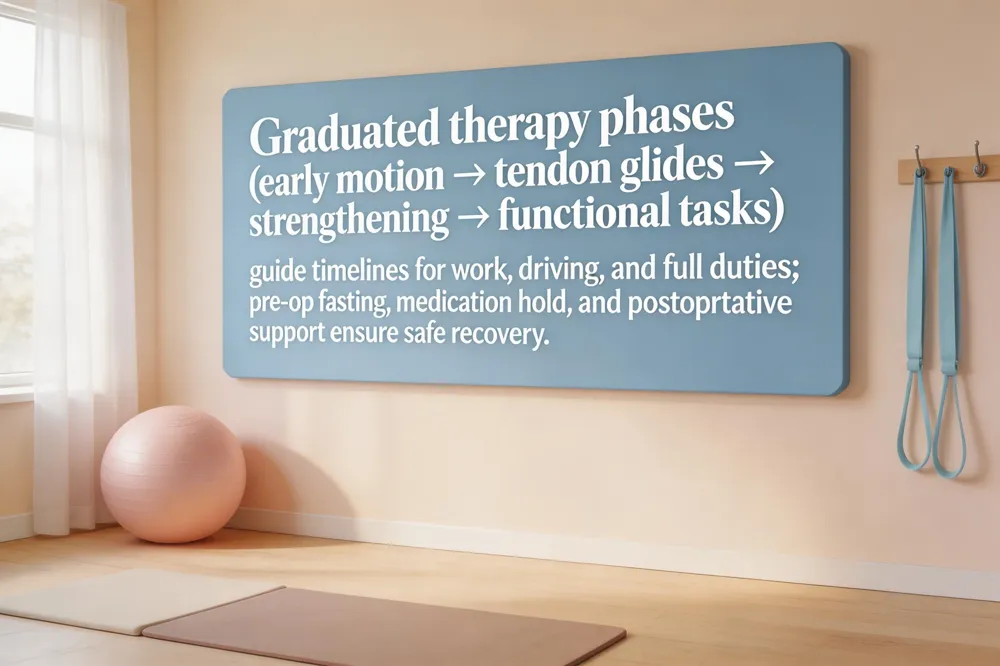
Early postoperative protocols begin with gentle active motion of non‑splinted joints within 24‑48 hours, progressing to protected range‑of‑motion exercises (EAM) during the inflammatory phase (0‑10 days). By days 10‑28, reparative therapy adds tendon glides, joint mobilizations, and gentle strengthening; remodeling (28 days‑12 months) introduces functional tasks and graded resistance. Hand therapists educate patients on elevation, ice (20 min q 2‑3 hrs), splint care, and signs of infection to promote optimal healing.
Graduated Therapy Phases and Patient Education:
Early postoperative protocols begin with gentle active motion of non‑splinted joints within 24‑48 hours, progressing to protected range‑of‑motion exercises (EAM) during the inflammatory phase (0‑10 days). By days 10‑28, reparative therapy adds tendon glides, joint mobilizations, and gentle strengthening; remodeling (28 days‑12 months) introduces functional tasks and graded resistance. Hand therapists educate patients on elevation, ice (20 min q 2‑3 hrs), splint care, and signs of infection to promote optimal healing.
Timeline for Work and Driving Clearance:
- Simple soft‑tissue procedures (carpal‑tunnel release, trigger‑finger excision): light desk work in 7‑14 days; full manual duties by 2‑4 weeks. Driving generally safe after 1‑2 weeks once grip strength and pain control are adequate.
- Moderate‑to‑heavy labor or complex bone/tendon reconstructions: 4‑6 weeks before demanding work; 4‑6 weeks before driving. Full occupational duties may require 3‑6 months for extensive reconstructions.
Pre‑Operative Restrictions and Patient‑Preparedness: Patients must fast after midnight the night before surgery, stop aspirin/NSAIDs at least seven days prior, and refrain from smoking on the day of the procedure. Arrange a responsible adult for transport and post‑operative support; do not drive yourself home.
Helpful Items After Hand Surgery: Keep ice packs, pillows for hand, a supportive splint or removable brace, easy‑to‑open clothing, a medication organizer, water, and entertainment within reach to facilitate compliance and comfort during recovery.
Conclusion
In summary, the five indispensable rules for successful minimally invasive hand and upper‑extremity surgery are (1) meticulous pre‑operative imaging and patient selection, (2) use of small‑incision, endoscopic or arthroscopic instruments, (3) real‑time intra‑operative imaging to protect neurovascular structures, (4) early, structured postoperative rehabilitation, and (5) ongoing patient education and communication. Dr Yu’s board‑certified expertise, combined with her commitment to collaborative care, ensures that each patient receives a personalized plan that respects these principles while addressing individual goals and concerns. If you are ready to experience the benefits of modern, tissue‑sparing hand surgery—reduced pain, faster return to function, and optimized outcomes—schedule a consultation with Dr Yu today. Call the clinic or visit the online portal to book your appointment and take the first step toward a healthier, more functional hand.