Why Telemedicine Matters for Hand and Upper‑Extremity Care
Telemedicine expands access to board‑certified orthopedic expertise for patients in remote, underserved, or mobility‑limited settings, allowing virtual assessments of hand, wrist, elbow and pediatric musculoskeletal conditions. Compassionate communication—active listening, clear explanations, empathy, and “webside manner”—is essential for building trust and improving adherence, especially when physical touch is absent. Secure, HIPAA‑compliant video platforms (HTTPS‑lock icons, Doxy.me, MyChart, etc.) protect privacy and meet .gov guidelines, reassuring patients that their health information is safe. Patient‑centered benefits include reduced travel, faster follow‑up, flexible scheduling, and the ability to involve family members, all of which lower anxiety and enhance satisfaction while maintaining clinical accuracy through high‑resolution video and guided self‑inspection.
Foundations of Compassionate Virtual Orthopedic Visits
Key Elements of Compassionate Virtual Orthopedic Care
| Element | Description |
|---|---|
| Care | Purpose‑driven focus on patient’s health and functional goals. |
| Compassion | Empathy, dignity, and acknowledgment of pain or distress. |
| Competence | Accurate virtual exam using high‑resolution video, guided self‑inspection, and digital tools. |
| Communication | Active listening, eye contact (camera), clear explanations, shared decision‑making. |
| Courage | Clinician advocacy for patient needs despite remote assessment limitations. |
| Commitment | Ongoing personalized follow‑up and rehabilitation support. |
Webside manner checklist:
- Look into the camera for eye contact.
- Minimize background distractions.
- Confirm patient comfort with technology.
- Use patient’s name and pause for questions.
Cultural Sensitivity tips:
- Ask about cultural preferences.
- Use plain language.
- Offer interpreter services when needed.
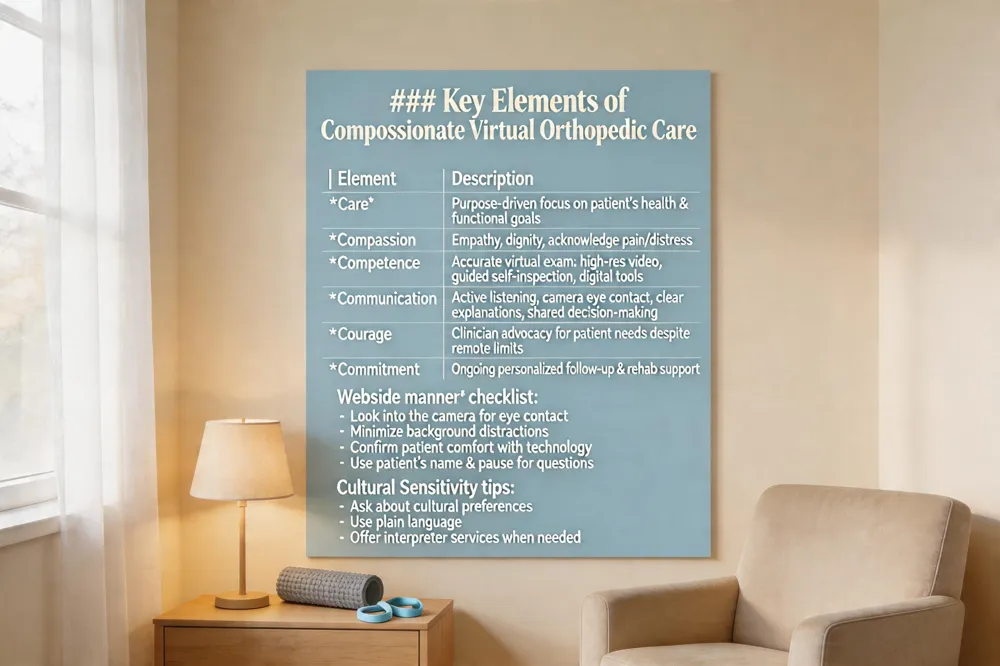 Compassionate care in tele‑orthopedics means recognizing a patient’s pain or distress and taking purposeful actions to relieve it—blending empathy, respect for autonomy, cultural competence, and technical skill. Core elements include active listening, clear explanations, shared‑decision making, and timely, personalized follow‑up. The widely cited 6 C’s framework (Care, Compassion, Competence, Communication, Courage, Commitment) guides clinicians: Care drives the purpose of every encounter; Compassion adds empathy and dignity; Competence ensures accurate virtual examination (high‑resolution video, guided self‑inspection); Communication fuels shared decision‑making; Courage empowers surgeons to advocate for patients even when remote assessment is limited; Commitment reflects ongoing dedication to recovery.
Webside manner—the virtual counterpart of bedside manner—requires clinicians to look into the camera for eye contact, minimize background distractions, and confirm patient comfort with technology. Active listening is demonstrated by summarizing concerns, using the patient’s name, and allowing pauses for questions.
Cultural sensitivity and patient‑centered language are essential; clinicians should ask about cultural preferences, use plain language, and offer interpreter services when needed, creating a psychologically safe space where patients feel heard and respected. Together, these practices foster trust, improve adherence to rehabilitation protocols, and lead to better functional outcomes for hand and upper‑extremity patients.
Technical Essentials for a High‑Quality Tele‑Orthopedic Exam
Technical Requirements & Tools for Tele‑Orthopedic Exams
| Requirement | Details |
|---|---|
| Video Quality | High‑resolution (≥1080p), steady camera positioned 3–6 ft from patient. |
| Lighting | Even, well‑lit environment; avoid backlighting and |
| HIPAA‑Compliant Platform | Secure HTTPS with lock icon (e.g., Doxy.me, MyChart). |
| Patient‑Submitted Media | High‑quality photos, videos of range of motion, self‑inspection images. |
| Digital Measurement Tools | Remote goniometers, ruler for swelling, wearable motion sensors. |
| PROMs | DASH, QuickDASH, pain scales administered before visit. |
Self‑Inspection Steps:
- Measure swelling with a ruler.
- Perform self‑palpation and report tenderness.
- Record range of motion while video‑recorded.
Diagnostic Note: Orthopedic surgeons can identify early rheumatoid arthritis signs virtually but confirm with rheumatology.
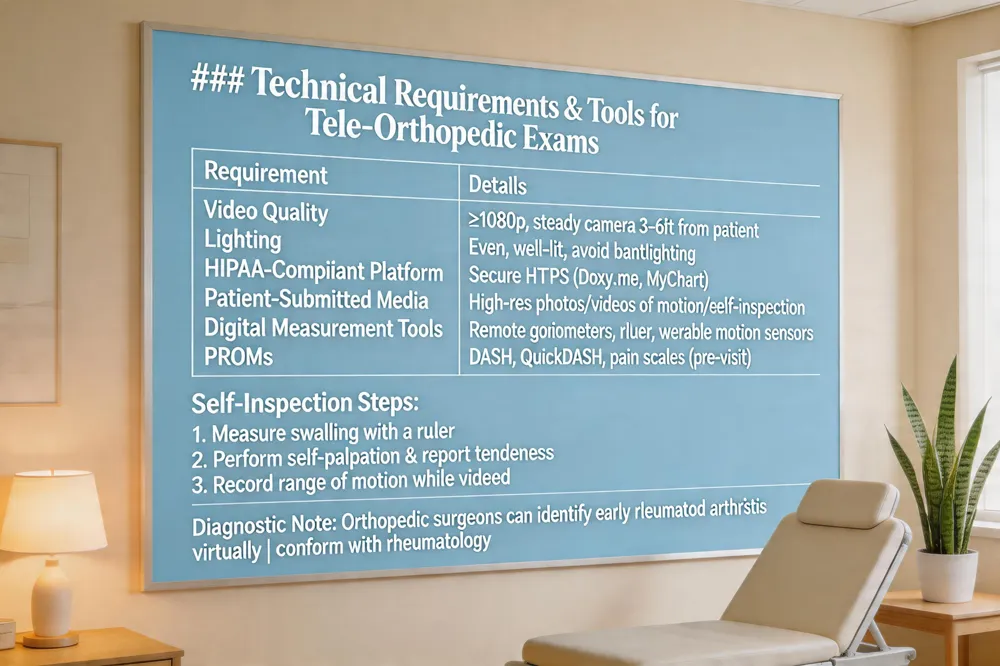 A reliable tele‑orthopedic exam begins with high‑resolution video and proper lighting; a well‑lit, steady camera positioned 3–6 feet away lets the clinician assess swelling, range of motion, and wound healing in hand, wrist, and elbow injuries. All sessions must run on secure, HIPAA‑compliant platforms—such as Doxy.me, MyChart, or any HTTPS‑locked site with a lock icon—to protect patient privacy and comply with federal guidelines. Patients are instructed to submit high‑quality photographs and to perform guided self‑inspection techniques (e.g., measuring swelling with a ruler, self‑palpation) before the visit, which supplements the visual exam. Digital tools further enhance accuracy: remote goniometers provide objective angle measurements, patient‑reported outcome measures (PROMs) like DASH or QuickDASH capture functional status, and wearable sensors can stream motion data for real‑time feedback.
Can an orthopedic doctor diagnose rheumatoid arthritis? Yes. An orthopedic doctor can spot early signs—symmetrical swelling of the hands and wrists, stiffness lasting longer than six weeks, and early erosions on X‑ray—during a virtual exam. They may order initial blood work or imaging, but definitive diagnosis, which requires specific antibody testing and sometimes advanced imaging, is usually confirmed by a rheumatologist. Orthopedic surgeons often initiate evaluation and then refer to rheumatology for comprehensive management.
Compassionate Communication Strategies in Virtual Hand Surgery
Communication Pillars for Virtual Hand Surgery
| Pillar | Practice |
|---|---|
| Active Listening | Summarize concerns, use patient’s name, maintain eye contact via camera. |
| Structured Check‑ins | Assess pain, emotional well‑being, barriers to home exercises each session. |
| Patient Education | Screen‑share imaging, provide concise after‑visit summary with next steps. |
| Mindfulness | Brief breathing exercise at start to reduce anxiety. |
FAQ:
- Hand surgery without anesthesia? Yes – wide‑awake local anesthesia (lidocaine + epinephrine) for many procedures.
- Four P’s of telehealth? Planning, Preparing, Providing, Performance evaluation.
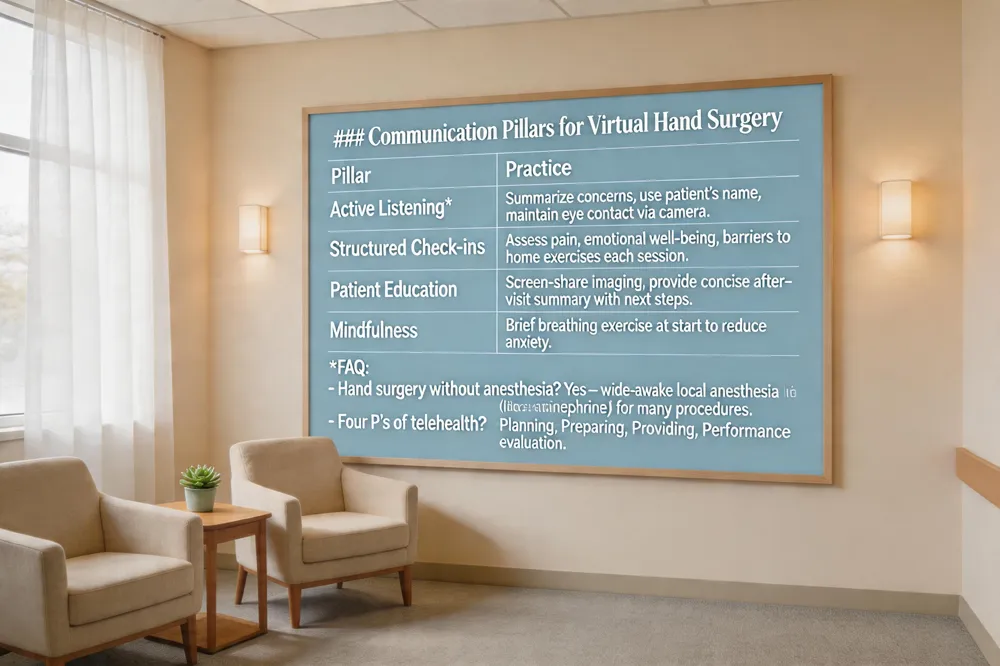 Effective virtual hand surgery visits rely on three core communication pillars. First, clinicians practice active listening, maintain eye‑contact by looking directly at the camera, and use a calm, reassuring tone; these behaviors, shown to raise patient satisfaction and adherence (Johnson et al., 2025; Patient and Provider Experiences 2024). Second, structured check‑ins are built into each session: the surgeon asks about pain levels, emotional well‑being, and any barriers to home‑based exercises, mirroring Dr. Rebecca S. Yu's patient‑centered protocol. Third, patient education is enhanced by screen‑sharing imaging studies in real time, followed by a concise after‑visit summary that outlines next steps, medication instructions, and contact information for urgent concerns. To further reduce anxiety, clinicians can lead a brief mindfulness or breathing exercise at the start of the visit, a practice that has been linked to lower stress and stronger therapeutic rapport (Telemedicine: Is It a Tool for Orthopaedics? 2025).
Can you get hand surgery without anesthesia? Yes. Many hand procedures—carpal‑tunnel release, trigger‑finger release, tendon repairs, and mass excisions—can be performed using a “wide‑awake” technique with local anesthetic (lidocaine + epinephrine). The patient stays fully awake, eliminating anesthesia risks, allowing same‑day eating, and enabling the surgeon to test repairs instantly. Dr. Rebecca S. Yu offers wide‑awake hand surgery for appropriate cases.
What are the four P's of telehealth? The four P's are Planning, Preparing, Providing, and Performance evaluation. Planning schedules the visit and defines goals; Preparing ensures the patient has a quiet, well‑lit space and proper devices; Providing is the actual virtual encounter with compassionate communication; Performance evaluation gathers feedback and outcome data to refine future care.
Cost, Access, and Insurance Considerations for Tele‑Orthopedic Care
Financial & Access Overview for Tele‑Orthopedic Care
| Item | Typical Cost (USD) |
|---|---|
| Carpal‑tunnel release | $2,000 – $5,000 |
| Thumb joint replacement | $8,000 – $15,000 |
| Complex microsurgical reconstruction | $15,000 – $40,000+ |
Insurance:
- Medicare – 20 % copay after Part B deductible for video visits.
- Medicaid – Minimal patient cost; coverage varies by state.
- Private insurers – Parity laws often cover virtual consults at in‑person rates; copays differ.
Workflow:
- Schedule via MyChart or call 757‑422‑8476.
- Receive secure HTTPS link.
- Complete pre‑visit questionnaire (pain, injury mechanism, imaging).
- Follow pre‑visit instructions (quiet, well‑lit space, caregiver present).
Patient Benefits: Reduced travel, lower time off work, lower anxiety, personalized care.
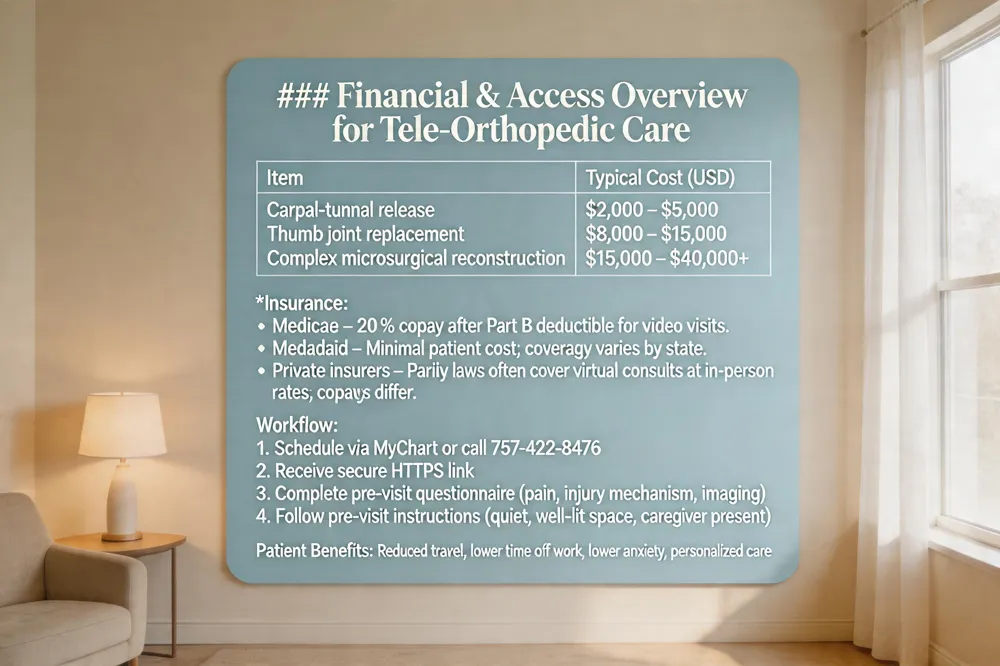 Hand surgery costs in the United States vary widely. Simple procedures such as carpal‑tunnel release typically range from $2,000 to $5,000, thumb joint replacement costs $8,000 to $15,000, and complex microsurgical reconstructions can exceed $15,000 and reach $40,000 or more, depending on the facility, anesthesia, and insurance contract. Dr. Rebecca S. Yu’s OrthoVirginia office provides personalized estimates that reflect each patient’s coverage and any pre‑operative testing required.
Telemedicine reimbursement is now routine. Medicare applies a 20%% co‑insurance after the Part B deductible for video visits, while most Medicaid programs cover eligible telehealth services with minimal patient cost‑ Private insurers have largely adopted parity laws, covering virtual orthopedic consults at the same rate as in‑person visits, though copays and coinsurance may differ by plan and state. Patients are advised to verify their specific benefits before scheduling.
At OrthoVirginia, the appointment‑booking workflow is streamlined: patients use MyChart or call 757‑422‑8476 to request a telehealth slot, receive a secure HTTPS link, and complete a pre‑visit questionnaire that captures pain level, mechanism of injury, and imaging. The platform’s ‑‑visit instructions (quiet, well‑lit space, caregiver present) reduce technical glitches and enhance compassionate communication.
Patient testimonials consistently highlight reduced anxiety and cost savings. Families report that virtual visits with Dr. Yu feel “personal and caring,” lowering travel expenses and eliminating time off work while providing clear explanations that alleviate fear, especially for pediatric patients. These experiences underscore how tele‑orthopedic care can expand access, maintain high‑quality compassionate interaction, and lessen the financial burden of hand and upper‑extremity treatment.
Future Directions: Integrating Technology and Compassion in Orthopedic Telecare
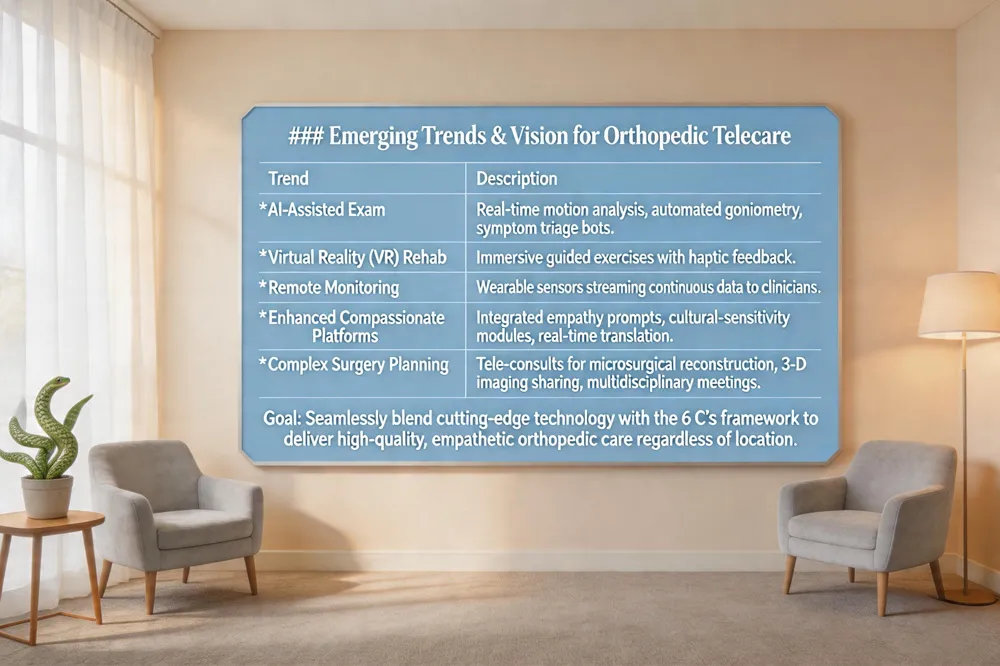
Emerging Trends & Vision for Orthopedic Telecare
| Trend | Description |
|---|---|
| AI‑Assisted Exam | Real‑time motion analysis, automated goniometry, symptom triage bots. |
| Virtual Reality (VR) Rehab | Immersive guided exercises with haptic feedback. |
| Remote Monitoring | Wearable sensors streaming continuous data to clinicians. |
| Enhanced Compassionate Platforms | Integrated empathy prompts, cultural‑sensitivity modules, real‑time translation. |
| Complex Surgery Planning | Tele‑consults for microsurgical reconstruction, with 3‑D imaging sharing and multidisciplinary meetings. |
Goal: Seamlessly blend cutting‑edge technology with the 6 C’s framework to deliver high‑quality, empathetic orthopedic care regardless of location.
 Answering the most complex hand surgery question: The most complicated hand surgery is microsurgical hand reconstruction, including total hand or finger replantation with concurrent nerve and tendon repair, toe‑to‑finger transplantation, and vascular anastomosis. These procedures exceed three hours, require intricate postoperative rehabilitation, and hinge on patient health, tissue availability, and meticulous surgical technique.
Putting Compassion First in Every Virtual Hand Visit
Telemedicine expands access for hand and upper‑extremity patients by eliminating travel, shortening wait times, and allowing rapid visual assessment of swelling, range of motion, and wound healing through high‑resolution video. Remote follow‑up reduces in‑person visits, cuts costs, and supports timely rehabilitation with guided exercises and digital outcome tools. Yet technology alone is not enough; empathetic communication—active listening, clear explanations, and genuine reassurance—creates a psychologically safe space, improves satisfaction, and boosts adherence to treatment plans. Dr. Rebecca S. Yu’s secure, HIPAA‑compliant platform incorporates these compassionate principles. Schedule your virtual consult today to experience personalized, caring orthopedic care from home and peace of mind.