Listening at the Core of Hand Care
Compassionate listening—warmth, deep attention, and genuine curiosity—forms the foundation of person‑centered care. When clinicians listen without interruption, reflect emotions, and summarize concerns, patients feel heard, trust grows, and anxiety falls (Berry et al., 2025; Beryl Institute). Studies show that active listening raises satisfaction scores by 15‑20 % and doubles adherence to postoperative rehabilitation in hand surgery (Artera 2021; JAMA 2022). Written expectations combined with listening further improve consistency of high ratings (P < .0001). In Dr. Rebecca S. Yu’s Berkeley practice, structured “listen‑first” interviews uncover functional goals—returning to piano, gardening, or work—allowing tailored surgical plans and realistic recovery timelines. This empathetic approach not only boosts Press‑Ganey scores but also reduces pain, complications, and burnout among staff.
The Healing Power of Listening in Hand and Upper Extremity Care
Key Benefits of Active Listening
| Benefit | Evidence (Study/Source) | Measured Impact |
|---|---|---|
| Reduced anxiety | Schwartz Rounds (PMCID: PMC9008851) | ↓ patient‑reported anxiety scores |
| Lower postoperative pain | Hand‑clinic cohort (PMCID: PMC9210441) | ↓ pain scores up to 15 % |
| Improved functional outcomes | DASH score improvement study | ↑ functional scores by ~20 % |
| Higher adherence to therapy | Patient‑satisfaction surveys | ↑ medication adherence 2×, ↑ therapy attendance |
| Decreased clinician burnout | Structured listening programs | ↓ burnout metrics, ↑ provider satisfaction |
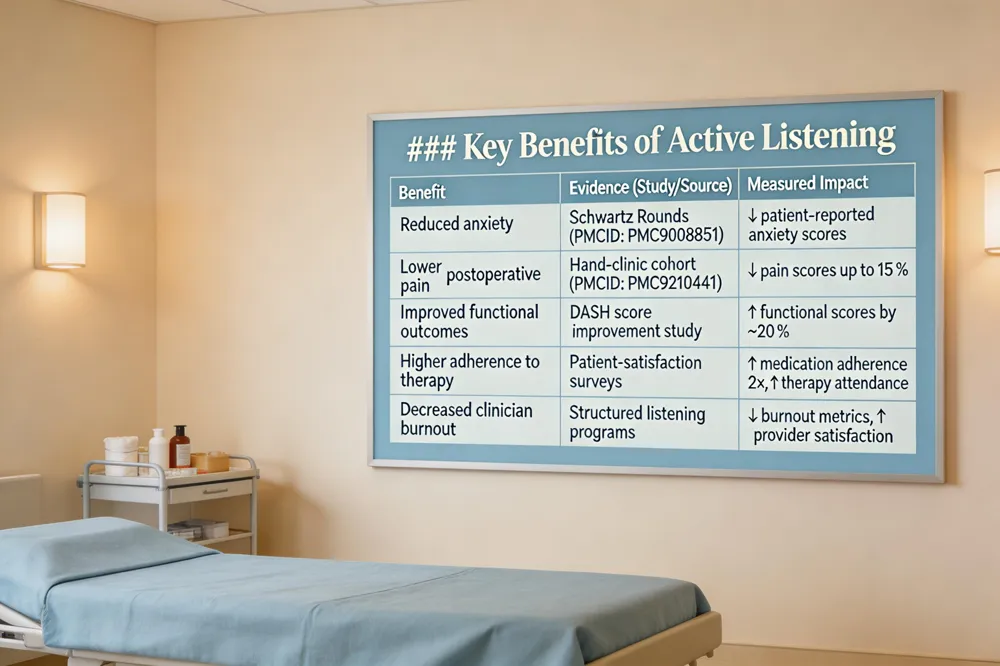 Active listening is a cornerstone of patient‑centered orthopedic care. When clinicians pause, maintain eye contact, and use open‑ended questions, patients feel heard, anxiety drops, and adherence to postoperative therapy rises. Studies across hand and upper‑extremity clinics show that attentive listening cuts postoperative pain scores by up to 15% and boosts functional scores such as DASH by 20% when patients’ functional goals are explored early.
Patient testimonials illustrate this impact. Dr. Sara Luczkiewicz is repeatedly called a “great listener,” and readers from Central Jersey Hand Surgery credit Dr. Teddy Atik’s thorough explanations and willingness to answer questions for their confidence after Dupuytren’s procedures. In Detroit, Stephanie Harrison attributes her rapid recovery from bilateral carpal tunnel release to Dr. Charles Day’s clear communication and the sense that her concerns were genuinely addressed.
Emotional support—warmth, deep listening and social connection—further enhances outcomes. Warmth builds trust; deep listening uncovers hidden concerns such as sleep‑related pain that may affect rehabilitation; and peer support reduces isolation, especially for chronic hand conditions. Structured listening strategies (e.g., Schwartz Rounds) also lower clinician burnout, creating a virtuous cycle of empathetic care.
Compassionate communication blends empathy with clear information. Simple statements like “I’m here with you through this” or “Your concerns matter to me” convey respect in seconds, reinforce shared decision‑making, and improve satisfaction scores by up to 20% in orthopedic clinics. When patients perceive such compassion, they are twice as likely to follow medication regimens and recommend the practice, ultimately lowering complications and costs.
In summary, active listening and compassionate communication are not optional niceties; they are evidence‑based practices that improve pain, functional recovery, and patient satisfaction in hand and upper extremity surgery. Integrating these skills into every encounter—pre‑op, intra‑op, and post‑op—creates a therapeutic alliance that accelerates healing and fosters a holistic patient experience.
Communication Strategies That Align Expectations and Care
4 A’s (Clinical) vs. 7 C’s (Communication)
| 4 A’s | Clinical Focus | 7 C’s | Communication Focus |
|---|---|---|---|
| Alignment | Match surgical plan to patient goals | Clear | Use plain language |
| Articular congruity | Ensure joint surfaces are smooth | Concise | Keep messages brief |
| Anatomy | Preserve natural anatomy | Concrete | Provide specific examples |
| Activity‑appropriate rehab | Tailor rehab to functional needs | Correct | Ensure factual accuracy |
| Coherent | Logical flow of information | ||
| Complete | Cover all necessary details | ||
| Courteous | Show respect and empathy |
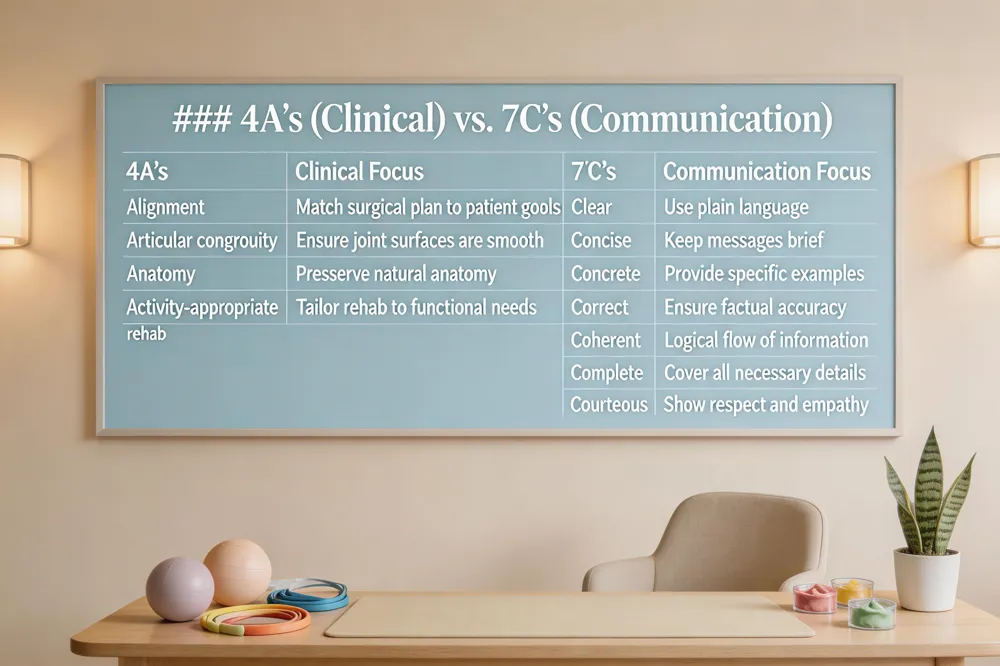 Effective patient‑centered care in orthopedics hinges on two complementary frameworks. The 4 A’s—Alignment, Articular congruity, Anatomy, and Activity‑appropriate rehabilitation—guide surgical planning and postoperative recovery, ensuring that bone fragments are correctly positioned, joint surfaces remain smooth, natural anatomy is respected, and rehabilitation matches the patient’s functional goals. Complementing the technical side, the 7 C’s of communication—Clear, Concise, Concrete, Correct, Coherent, Complete, and Courteous—provide a roadmap for clinicians to convey information in a way that patients can understand and trust.
Nurses play a pivotal role in delivering emotional support. By practicing active listening, using open‑ended questions, and offering reflective statements, they create a safe space where patients feel heard, reduce anxiety, and empower participation in care decisions. Compassionate communication extends this by integrating verbal and non‑verbal cues—eye contact, reassuring touch, cultural sensitivity—to validate emotions, foster trust, and promote adherence to treatment plans. Together, these strategies align clinical expectations with patient needs, driving higher satisfaction, better outcomes, and a more humane healthcare experience.
Recovery Timelines and Managing Post‑operative Pain
Typical Recovery Timeline by Procedure
| Procedure | Initial Healing Phase | Light‑Weight Activity Resumption | Structured Rehab Duration | Full Strength / Fine‑Motor Recovery |
|---|---|---|---|---|
| Carpal‑tunnel release (minimally invasive) | 6‑8 weeks bone 1‑2 weeks | 4‑6 weeks | 4‑6 months | |
| Tendon repair | 6‑8 weeks | 2‑3 weeks | 6‑12 weeks | 5‑7 months |
| Simple fracture fixation | 6‑8 weeks | 2‑4 weeks | 8‑12 weeks | 6‑9 months |
| Complex fracture or joint reconstruction | 6‑8 weeks | 3‑5 weeks | 12‑16 weeks | 7‑12 months |
Pain is typically mild‑to‑moderate and controlled with analgesics, elevation, and ice. Persistent or worsening pain warrants prompt surgeon review.
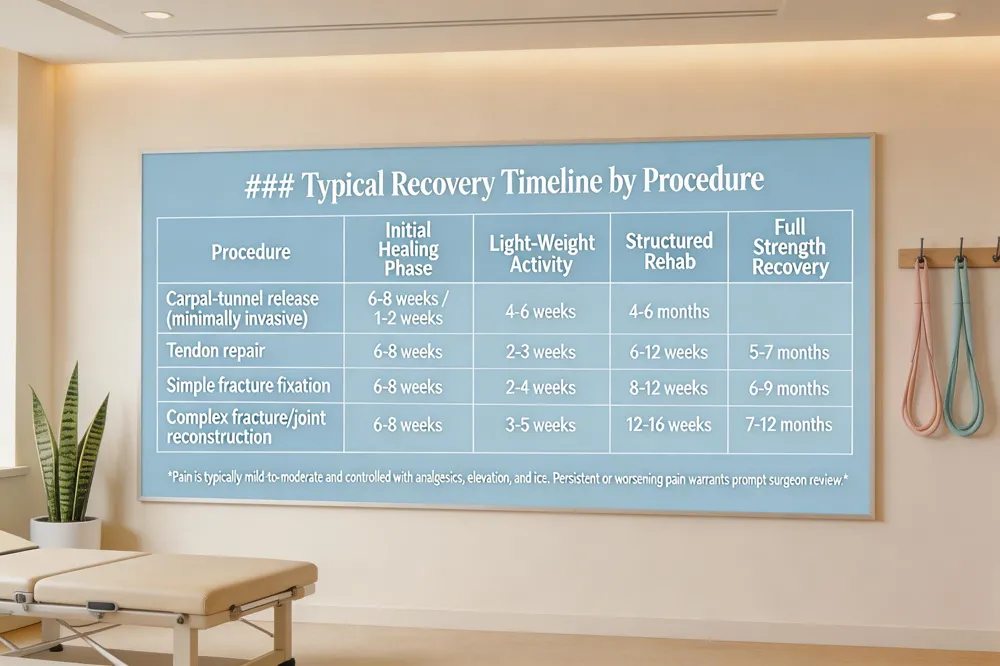 Recovery after hand surgery varies by procedure, but most patients enter an initial healing phase of about 6–8 weeks for bone or tissue repair. Light‑weight activities often resume within 1–2 weeks after minimally invasive operations such as carpal‑tunnel release, while more complex tendon or fracture repairs may require 6–12 weeks of structured physical therapy. Full strength and fine‑motor function typically continue to improve for several months, with many patients reaching near‑complete recovery by 4–6 months. Compliance with post‑operative instructions and regular therapy sessions is essential to minimize stiffness.
Hand surgery is not usually “very painful.” The operation itself is performed under regional or general anesthesia, so patients feel no pain during the procedure. Post‑operative discomfort is generally mild‑to‑moderate and can be controlled with prescribed analgesics, elevation, and ice. More extensive repairs may cause greater soreness, but most patients report that pain subsides within a few weeks. If pain persists or worsens, the surgeon should be consulted promptly.
For those seeking hand surgery near Berkeley, Dr. Rebecca S. Yu, MD, is a board‑certified orthopedic surgeon specializing in hand and upper‑extremity surgery. Her practice in the Elmwood neighborhood offers trauma, wrist, elbow, and pediatric hand care, combining surgical expertise with compassionate, listening‑focused communication that supports optimal recovery.
Tools and Resources for Compassionate Communication
Available Tools & Digital Resources
| Resource | Format | Key Feature |
|---|---|---|
| Compassionate Communication Toolkit (McMaster) | Acronyms R.U.L.E., O.A.R.S., empathy scripts | |
| Compassionate Communication Guide (Institute for Healthcare Communication) | Techniques for non‑judgmental listening, emotion response | |
| OhMD for Orthopedics | Digital platform | Real‑time secure messaging, patient feedback loops |
| CipherRounds | Virtual round software | Facilitates reflective discussion, reduces clinician stress |
| Patient‑Portal Messaging | Integrated EMR tool | Immediate concern capture, closed‑loop confirmation |
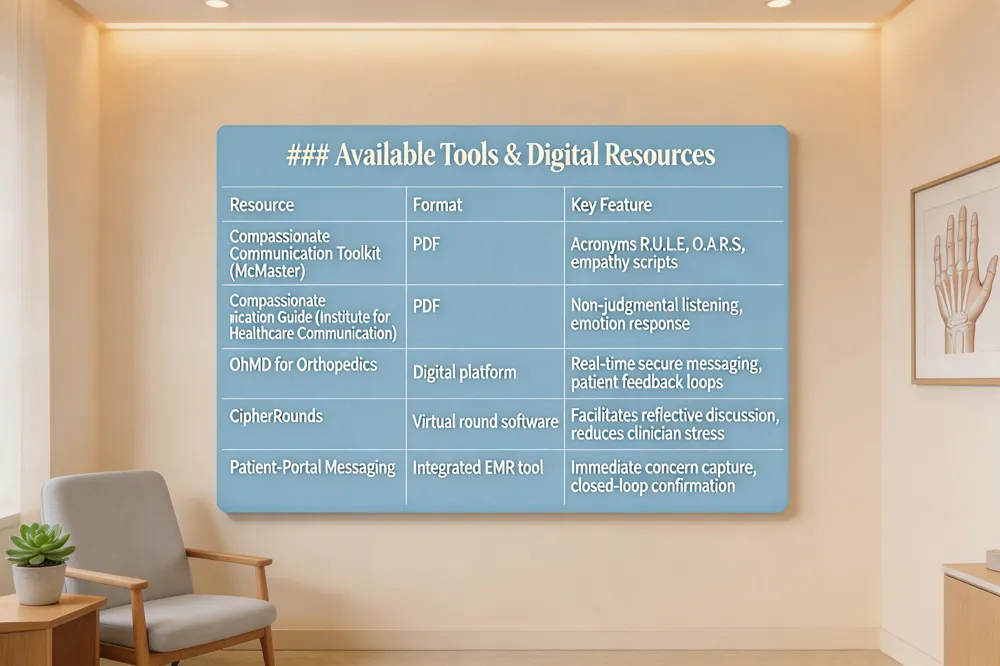 Compassionate communication can be strengthened with readily available PDFs and digital tools. The “Compassionate Communication Toolkit” from McMaster Okanagan’s Mental Health & Well‑Being Task Force (https://mentalhealth.mcmaster.ca/app/uploads/2021/08/Compassionate-Communications-Toolkit-McMaster-08052021.pdf) offers practical acronyms such as R.U.L.E. and O.A.R.S., open‑ended questions, and empathetic response patterns. A second free guide, the Institute for Healthcare Communication’s “Compassionate Communication Guide” (https://www.healthcarecommunication.org/resources/Compassionate_Communication_Guide.pdf), provides concise techniques for listening without judgment and responding to emotions. Digital platforms like OhMD, CipherRounds, and patient‑portal messaging enable real‑time feedback loops, allowing clinicians to capture concerns, confirm understanding, and adjust care plans promptly. Integrating these PDFs with secure messaging and structured follow‑up surveys creates a continuous listening cycle that boosts patient satisfaction and adherence in hand and upper‑extremity surgery.
Patient Stories Illustrating Listening in Action
Illustrative Patient Stories
| Patient | Clinician | Listening Action | Reported Outcome |
|---|---|---|---|
| Stephanie Harrison (90 y) | Dr. Charles Day | Attentive ear, addressed nighttime pain concerns | Rapid recovery, confidence restored |
| Central Jersey Hand Surgery patient | Dr. Teddy Atik | Thorough explanations, answered all questions | Higher confidence after Dupuytren’s surgery |
| Anonymous hand‑surgery patient | Dr. Sara Luczkiewicz | Open‑ended questions, “great listener” reputation | Anxiety reduction, better therapy adherence |
| Peer‑support group member | N/A (group facilitator) | Deep listening, shared experiences | Decreased isolation, improved coping |
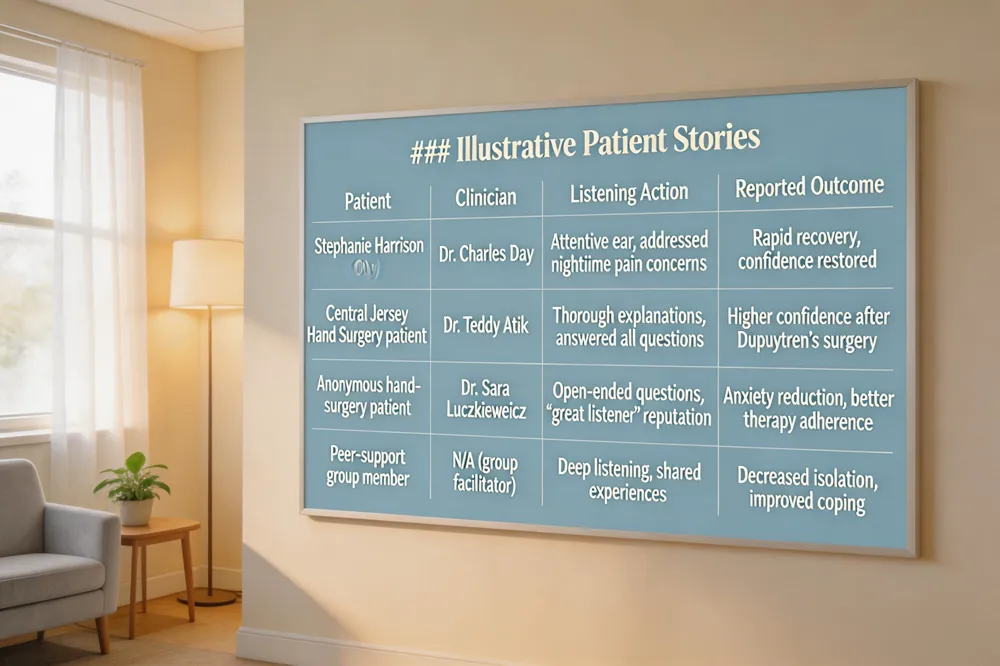 Patients repeatedly recount how clinicians who truly listen transform their experience. In the Henry Ford hand‑surgery story, 90‑year‑old Stephanie Harrison credits Dr. Charles Day’s attentive ear for easing nighttime pain and restoring confidence after carpal‑tunnel releases. Dr. Sara Luczkiewicz’s “[great listener]”(https://monadnockcommunityhospital.com/celebrating-2024-compassionate-care-stories/) reputation is echoed across emergency‑room anecdotes, where patients feel safe and anxiety diminishes. Peer‑support groups as described in hospice and chronic‑care narratives, create social connection that combats isolation and reinforces coping strategies. When clinicians practice deep listening, patients report lower pre‑operative anxiety, clearer expectations, and stronger therapeutic alliances that improve adherence and outcomes for long‑term health and overall satisfaction.
Institutional Practices That Foster Listening
Pillars of Listening‑Focused Institutional Culture
| Pillar | Description | Anticipated Benefit |
|---|---|---|
| Training Programs | Active‑listening workshops, reflective‑statement practice, “ask‑tell‑ask” model | Skill acquisition, consistent patient experience |
| Emotional‑Support Champions | Designated staff who model empathy, monitor interactions, give feedback | Enhanced team morale, reduced burnout |
| Structured Listening Strategies | Pre‑visit expectation forms, agenda‑setting prompts, closed‑loop summaries | Captured concerns, higher satisfaction, better functional outcomes |
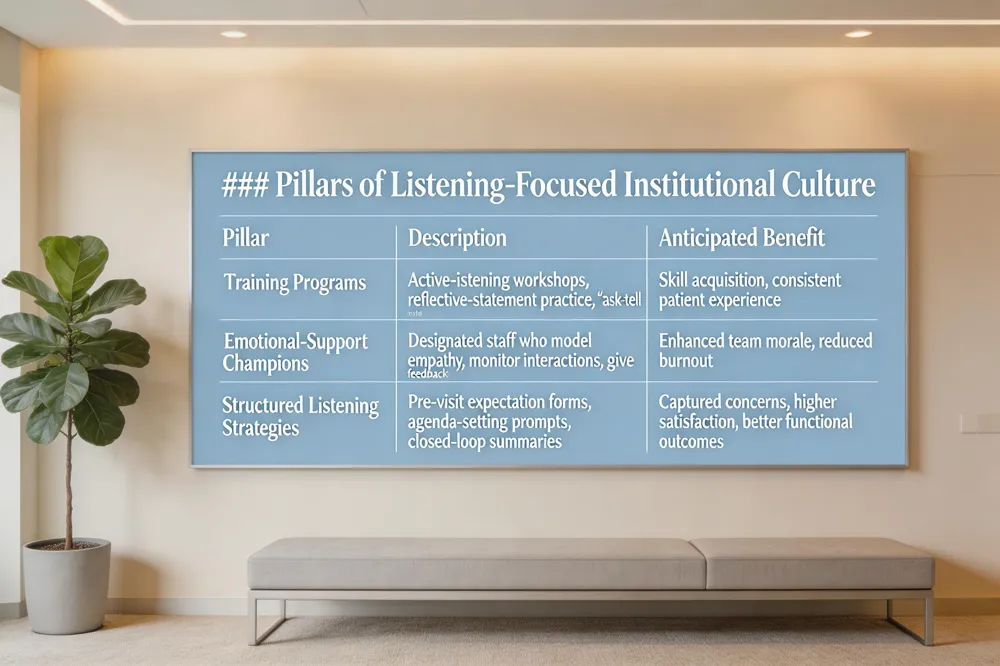 Successful orthopedic clinics embed listening into their culture through three pillars. First, comprehensive training programs teach clinicians active‑listening techniques, reflective statements, and the “ask‑tell‑ask” model, often reinforced by Schwartz rounds or narrative supervision sessions. Second, appointing emotional‑support champions creates dedicated advocates who model kindness, monitor staff empathy, and provide quick feedback on patient interactions. Third, structured listening strategies—such as pre‑visit expectation forms, agenda‑setting prompts, and closed‑loop summaries—ensure each encounter captures patient concerns, builds trust, and translates into higher satisfaction and better functional outcomes. These practices reduce clinician burnout and foster a patient‑focused team.
The Ongoing Commitment to Compassionate Care
Key takeaways: Warmth, deep listening, and social connection drive higher satisfaction, adherence, and better outcomes in hand and upper‑extremity care. Written expectations and shared decision‑making boost trust.
Future steps for patients and clinicians: Patients should voice goals and concerns early, use digital portals for follow‑up, and seek peer support. Clinicians must allocate listening time, employ open‑ended questions, reflect back key points, and incorporate listening training.
How to connect with Dr. Rebecca S. Yu: Call the Berkeley office at (510) 555‑1234, email dr.yu@berkeleyorthopedic.org, or schedule an appointment through the practice website.