Why Structured Elbow Rehab Matters
Early motion is the cornerstone of a successful elbow recovery. Initiating gentle passive and active‑assisted range‑of‑motion within the first week reduces scar tissue formation, preserves cartilage health, and maintains synovial fluid circulation, all of which dramatically lower the risk of long‑term stiffness. Because the surgical repair is still vulnerable, the program is divided into clear phases that balance protection with progressive loading. Phase 1 (0‑2 weeks) focuses on swelling control, pain management, and limited passive flexion‑extension (often 30°‑90°) plus forearm pronation/supination. Phase 2 (2‑6 weeks) introduces active‑assisted movements, light isometric contractions, and gentle stretching to restore full arc of motion. Phase 3 (6‑12 weeks) adds light resistance bands or 1‑3 lb dumbbells, isotonic strengthening, and functional tasks such as wall push‑ups. The surgeon’s role is to define the safe arc, approve each progression, and monitor for red‑flag signs (sharp pain, swelling, numbness). The physical therapist translates those medical parameters into a personalized daily routine, adjusts intensity based on pain‑free performance, and educates the patient on proper ergonomics and home‑exercise compliance. This coordinated, phased approach maximizes tissue healing while minimizing complications, leading to a quicker, safer return to daily activities and sport.
Phase‑Based Rehabilitation Overview
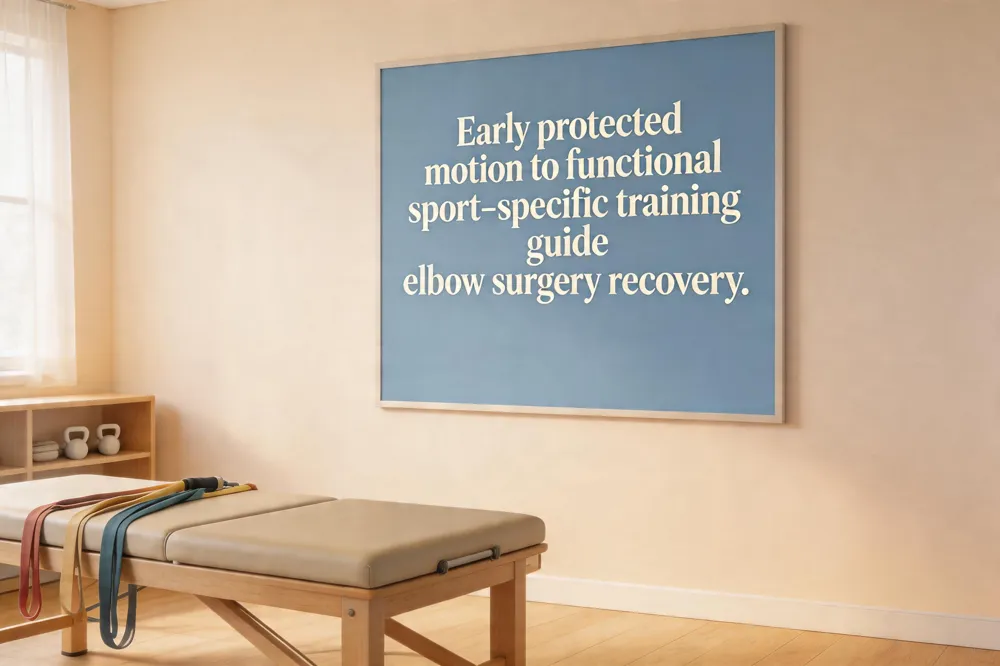 Early protected motion (0‑2 weeks) focuses on gentle passive elbow flexion/extension, wrist‑hand pumps, pendulum swings, and forearm rotations to control swelling and prevent stiffness. Patients should keep the shoulder, wrist, and hand moving and use ice after each session.
Active assisted and active ROM (2‑6 weeks) adds assisted elbow bends, supination/pronation, and isometric biceps/triceps holds—10‑15 reps, 2‑3 times daily—while continuing stretching of forearm flexors/extensors.
Progressive strengthening (6‑12 weeks) introduces light resistance bands, dumbbell curls, wall push‑ups, and grip‑strengthening with a stress ball, progressing 5‑10 % weekly based on pain ≤2/10.
Functional & sport‑specific training (12 weeks –) incorporates tasks such as turning a doorknob, light lifting, and sport drills once full ROM and ≥80% strength are achieved; high‑impact sport clearance typically occurs at 4‑6 months.
Red‑flag symptoms: sharp worsening pain, sudden swelling, loss of motion, numbness/tingling, or inability to perform basic tasks require immediate medical evaluation.
Elbow surgery recovery exercises begin with passive motion in week 1, progress to active‑assisted ROM weeks 2‑6, and add resistance work after week 6, maintaining consistency and therapist guidance.
Timeline for exercising after elbow surgery follows the phases above, with resistance training introduced around week 6 and sport‑specific activities after 4‑6 months.
Rehab generally lasts 6‑12 weeks of structured PT, followed by a home program for another 3‑6 months.
Avoid heavy lifting, submerging the incision, high‑impact sports, and driving until cleared; ignore persistent pain or swelling.
Fracture‑Specific Protocols and ORIF Recovery
 Elbow open‑reduction internal‑fixation (ORIF) with plate and screws requires a carefully staged rehabilitation plan.
Immobilization and hardware protection – Immediately after surgery the arm is placed in a sling or hinged brace for 1–2 weeks to shield the hardware and allow early bone healing. Pain control, ice, elevation and gentle hand‑wrist movements help reduce swelling.
Early passive motion for fracture fixation – Within the first week, gentle passive range‑of‑motion (PROM) exercises begin, typically 3–5 times daily, to prevent capsular contracture. A towel roll under the elbow or a light gravity‑assisted stretch can be used for 30‑second holds, repeated four times.
Progressive ROM and strengthening – At the two‑week mark, supervised physical therapy introduces active‑assisted elbow flexion/extension and forearm rotation, progressing to active motion by week 4. Full straightening is usually allowed around week 4, with many patients achieving active full extension by 6–8 weeks. Strengthening starts with isometric holds (10 seconds, 10 reps) and advances to light dumbbell or Theraband curls (1–2 lb) after 6–8 weeks, aiming for 10–15 repetitions, 1–3 sets daily.
PDF guide resources – Dr. Rebecca S. Yu’s patient portal offers a downloadable PDF that outlines the complete post‑fracture elbow program, including illustrated passive stretches, active ROM drills, strengthening sequences, and home‑exercise schedules.
Key patient points – Follow the surgeon’s timeline, report sharp pain, swelling, numbness, or infection signs promptly, and avoid heavy lifting until cleared. Consistent adherence to the therapist‑guided protocol typically yields functional use by 6–12 weeks and full strength by 4–6 months.
Strengthening, Extension, and Functional Return
 Elbow rehabilitation follows a structured progression from gentle motion to functional return. Early on, passive‑assisted stretching (using a towel roll or the opposite hand) holds each extension stretch for 15‑20 seconds, 2‑3 times daily, while isometric biceps and triceps contractions protect the repair without joint movement. As pain decreases, active wall‑slide or wall‑push‑up drills encourage elbow straightening with proper shoulder positioning. By weeks 4‑6, isotonic work begins with low‑load resistance bands and 1‑2 lb dumbbells for biceps curls, triceps extensions, and forearm supination/pronation, advancing in 5‑10 % weekly increments when pain stays ≤2/10. Extension‑focused drills—pendulum swings, straight‑arm raises, and resisted wall‑push‑ups—build endurance and joint stability. Functional activities such as turning a doorknob, gripping a stress ball, and light object lifting are introduced after near‑full passive range is achieved (typically 8‑12 weeks). Driving after tennis elbowel surgery is usually cleared once the patient can extend the elbow pain‑free, grip the steering wheel without discomfort, and perform emergency‑stop maneuvers safely; most surgeons give clearance after 1‑2 weeks for arthroscopic repairs and up to 2 weeks for open procedures, provided the incision is healed, pain is controlled, and the patient is off sedating analgesics. All steps should be supervised by a qualified physical therapist and aligned with the surgeon’s personalized rehabilitation plan.
Returning to Work, Daily Life, and Managing Side Effects
 How long after elbow surgery can I return to work?
Most patients can resume light, sedentary desk duties within 2–4 weeks if pain is minimal and the incision is healing. Jobs that involve lifting, overhead reaching, or repetitive arm motions usually require 6–12 weeks or longer before full duties are tolerated. Simple arthroscopic debridement or tendinitis release often permits an earlier return, while tendon‑repair, ligament reconstruction, or open arthroplasty may need 6 weeks to 3 months of protection. A splint or hinged brace is typically worn during the early weeks, and elevation plus ice help control swelling before returning to your surgeon’s personalized plan before any heavy work.
How long after elbow surgery can I return to work?
Most patients can resume light, sedentary desk duties within 2–4 weeks if pain is minimal and the incision is healing. Jobs that involve lifting, overhead reaching, or repetitive arm motions usually require 6–12 weeks or longer before full duties are tolerated. Simple arthroscopic debridement or tendinitis release often permits an earlier return, while tendon‑repair, ligament reconstruction, or open arthroplasty may need 6 weeks to 3 months of protection. A splint or hinged brace is typically worn during the early weeks, and elevation plus ice help control swelling before returning to your surgeon’s personalized plan before any heavy work.
Duration of physical therapy after elbow surgery Physical therapy starts within the first post‑operative week, focusing on pain control, edema reduction, and passive ROM. From weeks 5–12 patients progress to active strengthening, resistance‑band curls, and functional drills, with 2–3 supervised sessions per week. Most surgeons recommend a home‑exercise program for an additional 3–6 months to achieve full strength and endurance. Overall supervised therapy usually lasts 6–12 weeks, after which maintenance exercises are performed independently.
Post‑elbow surgery side effects Typical early side effects include swelling, bruising, and mild‑to‑moderate pain that improve over the first 2–4 weeks, as well as temporary stiffness or tingling in the forearm/hand. Fluid accumulation can be managed with elevation and intermittent ice. Less common but serious concerns are infection, hardware irritation, nerve irritation, or a persistent loss of motion that may need additional therapy or, rarely, revision surgery. Any sudden increase in pain, redness, drainage, or loss of function should prompt immediate evaluation by the surgeon.
Finding Expert Care in the Bay Area
Hand surgeon in Oakland, CA
Dr. Rebecca S. Yu, MD is a board‑certified orthopedic surgeon specializing in hand and upper‑extremity surgery. While her primary clinic is in Berkeley, she sees patients throughout Oakland, treating trauma, carpal‑tunnel syndrome, tendon injuries, and pediatric hand disorders with microsurgical precision and personalized care. Appointments can be booked online, by phone, or via tele‑medicine.
Best orthopedic surgeons in the Bay Area
Dr. Rebecca S. Yu, MD leads the region in hand and upper‑extremity surgery. Other top providers include Dr. James A. Andrews (sports‑medicine shoulder/knee), Dr. Michael L. Reddel (spine), Dr. Stephen Chen (sports‑medicine, Walnut Creek), and Dr. Michael Burns (Saint Francis Memorial Hospital). Together they cover trauma, joint replacement, and elite‑athlete care.
Orthopedic care in Berkeley, CA
Dr. Rebecca S. Yu, MD offers advanced hand and elbow care in Berkeley, supported by on‑site imaging and same‑day appointments. Complementary services are available through Sutter Health’s orthopedic team and the UCSF Berkeley Outpatient Center, providing joint‑replacement, spine, and sports‑medicine options close to BART and parking.
Best hand surgeon in the Bay Area
Dr. Yu’s fellowship‑trained expertise, minimally invasive techniques, and coordinated hand‑therapy services make her the premier hand surgeon in the Bay Area. She consistently earns high patient‑satisfaction scores for clear communication and compassionate bedside manner.
Hand surgeon in Berkeley, CA
Dr. Rebecca S. Yu, MD treats a full spectrum of hand, wrist, elbow, and pediatric conditions using surgical and minimally invasive methods. Same‑day appointments, a dedicated support team, and an easy online booking system ensure convenient access to world‑class care.
Putting It All Together for a Speedy Return
A successful elbow recovery hinges on following the surgeon‑directed phase progression—early passive ROM (0‑2 weeks), active‑assisted motion (2‑6 weeks), then isometric and progressive resistance training (6‑12 weeks). Stick to the home‑exercise schedule prescribed by your therapist, performing each routine 3‑5 times daily with the recommended repetitions to maintain flexibility and build strength. Vigilantly monitor for red‑flag symptoms such as sharp pain, sudden swelling, loss of motion, or numbness, and contact your orthopedic surgeon immediately if they arise. Leverage Dr. Rebecca S. Yu’s expertise and resources at Hand & Wrist Orthopaedic Specialists for personalized guidance, education, and timely adjustments to your plan.