Why a Structured Rehab Matters
The ligaments of the elbow consist of dense collagen fibers that undergo three overlapping phases after injury: inflammation, proliferation, and remodeling. In the first days, inflammatory cells clear debris while fibroblasts lay down a provisional matrix; early motion stimulates synovial fluid circulation, delivering nutrients and preventing adhesions. Controlling swelling with ice, elevation, and compression limits excess fluid that can stretch the healing tissue and increase pain. A phased rehabilitation program respects these biology phases. Phase I protects the repair with limited motion and isometrics, while gentle wrist‑hand ROM keeps the joint mobile. Subsequent phases gradually increase elbow flexion‑extension, forearm rotation, and resistance, allowing the new collagen to mature without overload and thereby preserving stability for long‑term function and safe return to activity.
Phase 1 – Immediate Post‑Op Control & Gentle Motion
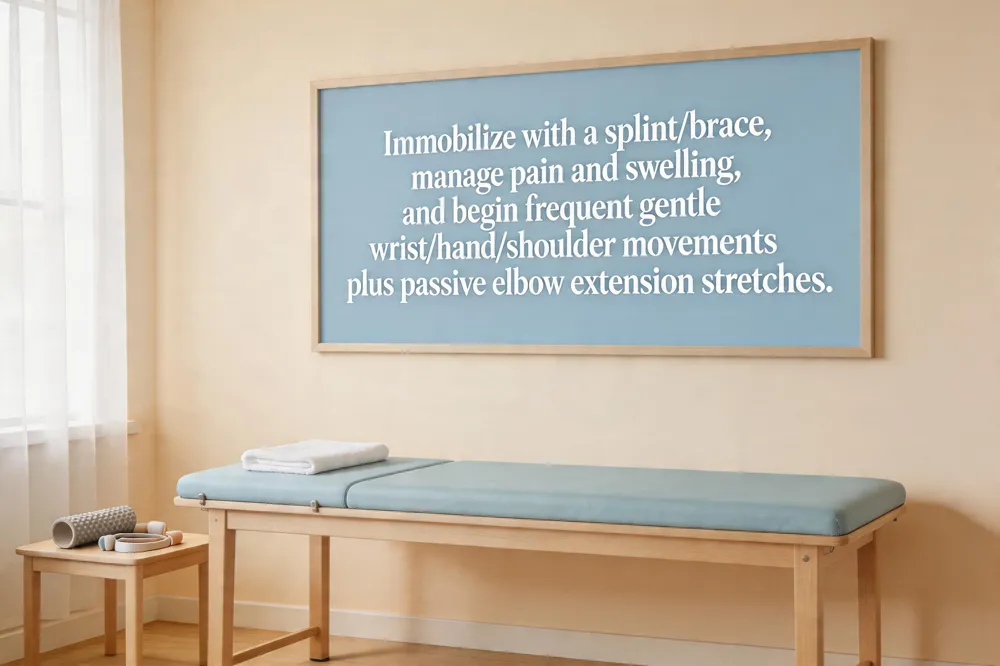 During the first two weeks after elbow surgery or fracture, the primary goals are immobilization, pain control, and prevention of stiffness. A posterior splint or hinged brace is worn while ice, compression and NSAIDs manage inflammation. Early wrist and hand movements—active range of motion (AROM) for flexion/extension, grip exercises, and shoulder isometrics—are performed five times daily to keep adjacent joints supple.
Passive elbow‑extension stretches are initiated as soon as the surgeon allows. Place a towel roll under the elbow and let gravity straighten the arm with the palm up; hold 30 seconds, repeat four times. Once pain subsides, progress to active extension: sit with the elbow on a towel roll or table edge, straighten the arm, hold three seconds, repeat ten repetitions three times a day. Light resistance can be added later once the motion is pain‑free.
Answering common concerns:
- Elbow extension after fracture: Begin with passive towel‑roll stretches, advance to active extension, then add light resistance as tolerated.
- Fastest way to heal a torn ligament: For partial tears, rest, cryotherapy, brief immobilization, and a supervised PT program restore function in 4‑6 weeks. Complete tears often require early surgical repair followed by an accelerated rehab protocol.
- When can you straighten the arm after surgery?: Most patients achieve full extension around week 4, with brace removal near week 6.
- Post‑fracture elbow physiotherapy: Early gentle active‑ and passive‑motion, dynamic splints, scar massage, and low‑load resistance prevent stiffness and restore ROM.
- Duration of physical therapy: Initial ROM work for 2‑6 weeks, then strengthening for 8‑12 weeks, with maintenance up to 6 months; full return to heavy activities may take 9‑12 months.
Adhering to these gradual steps under surgeon and therapist supervision promotes a safe, pain‑free recovery.
Phase 2 – Structured Strengthening for Ligament Repairs
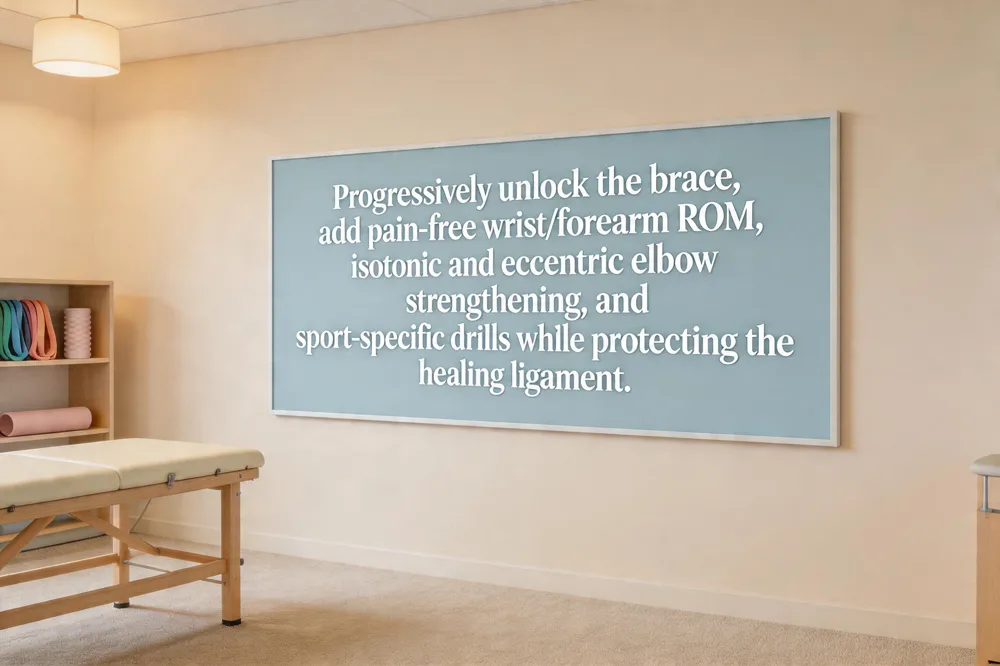 Early postoperative care for elbow ligament surgery focuses on protection, pain control, and gentle mobility. For UCL reconstruction, the first 21 days use a posterior splint or hinged brace locked at 90°; weeks 2‑4 gradually unlock the brace (30‑100° then 15‑110°) while adding painless wrist ROM, sub‑maximal shoulder and biceps/isometrics, scar massage, and edema compression. By weeks 4‑8 the brace is set to 10‑120° (later 0‑130°), allowing full elbow motion and light resistance wrist curls, forearm pronation‑supination, and rotator‑cuff work, with resisted external rotation delayed until week 6. Weeks 9‑13 introduce eccentric elbow flexion/extension, plyometrics, and sport‑specific drills such as the Thrower’s Ten; full throwing program begins after week 13 and most athletes return to sport between 5‑8 months, contingent on strength and functional criteria.
LCL and radial ligament repairs follow a similar phased approach. Immobilization in a posterior splint or brace (fully pronated) for 0‑2 weeks is followed by passive/active‑assisted ROM, progressing to active motion by week 4 while avoiding varus stress. Light wrist, forearm, and elbow resistance starts weeks 4‑8; eccentric strengthening and functional kinetic‑chain drills continue weeks 9‑13, with unrestricted activities expected by 14 weeks and full return to sport by 9 months.
General strengthening principles apply to all elbow ligaments: begin with isometric holds (10‑15 seconds, 3‑5 reps), advance to low‑load dynamic resistance (light dumbbells or bands, 2‑3 sets of 12‑15 reps), incorporate forearm and wrist work, and progress gradually under therapist supervision to protect the healing tissue while promoting collagen remodeling and joint stability.
Phase 3 – Restoring Full Extension, Flexion and Functional Use
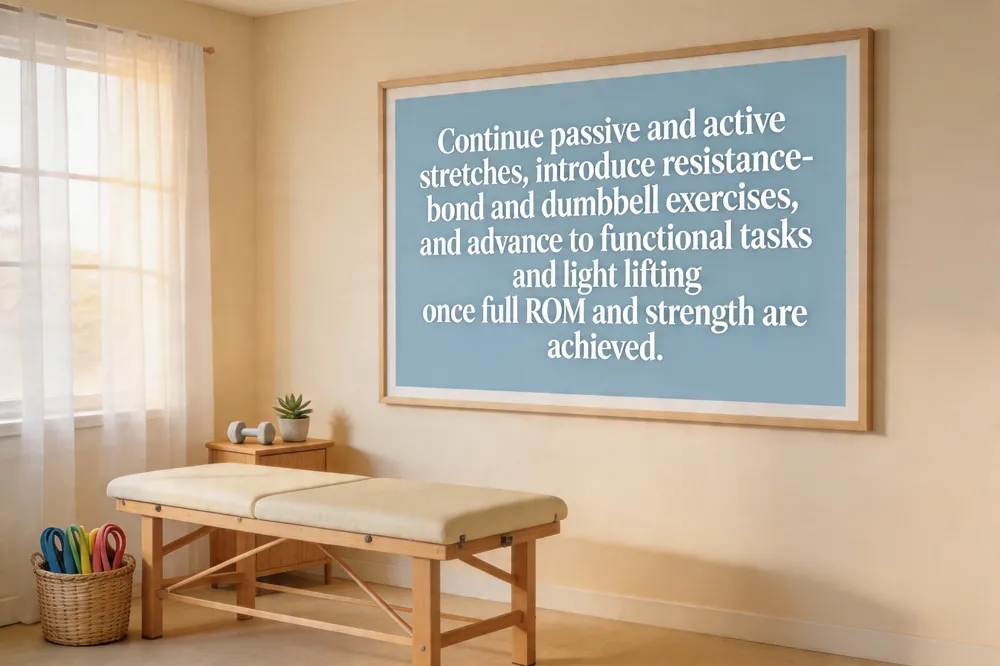 Improving elbow extension after surgery begins with gentle passive stretches and mobilizations. In the first two weeks use pendulum swings, isometric biceps/triceps contractions, and light wrist/hand movements to control swelling. From weeks 2‑6 perform assisted flexion‑extension and forearm rotations, holding each stretch 20‑30 seconds and progressing only pain‑free. After six weeks introduce resistance‑band curls, wall push‑ups and functional tasks while continuing daily passive stretches to consolidate the gained extension.
To regain full extension, start with passive forearm rotations: with the elbow bent, use the opposite hand to turn the forearm into supination and pronation, holding 3‑5 seconds, ten repetitions, five times daily. Follow with active resisted extension—place the elbow on a table, thumb up, straighten the arm, hold five seconds, then resist with the good hand for another five seconds; repeat ten times, five times a day. Add the active resisted flexion pattern to keep flexion‑extension strength balanced, maintaining unrestricted shoulder, wrist and hand motion throughout the day.
Elbow flexion physiotherapy begins with passive stretching using a towel roll or opposite hand, holding the end‑range for 30‑60 seconds, 4‑5 repetitions. Progress to active flexion without assistance, three‑second holds, three sets of ten repetitions three times daily. Strengthen with light dumbbell or hammer curls (10‑15 reps, 1‑3 sets) and incorporate supination‑pronation drills (10 reps, three times daily). Grip‑squeeze exercises and wrist‑forearm stretches are added to support overall elbow stability.
Heavy lifting is delayed until at least three months post‑operation, with initial loads no greater than one pound. Full weight‑bearing typically resumes between four to six months, after pain‑free range of motion, strength ≥80 % of the contralateral side, and surgeon clearance.
Special Situations, Resources & Practical Tips
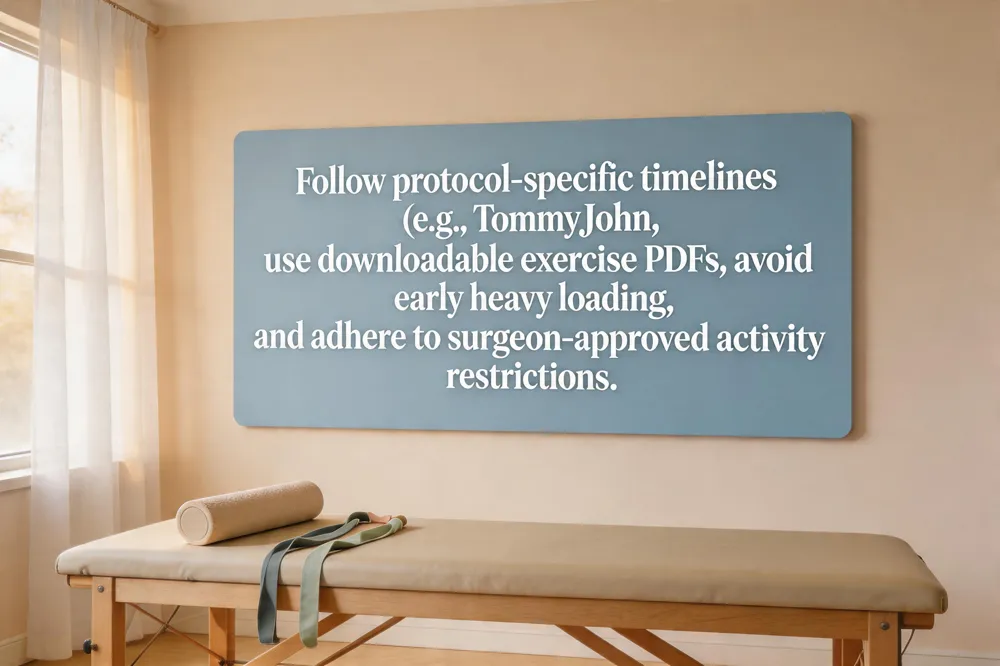 Tommy John surgery protocol Phase I (0‑3 weeks) – posterior splint or hinged brace at 90° flexion, pain control, ice, gentle hand‑wrist and shoulder isometrics. Phase II (weeks 4‑6) – brace opens gradually (up to ~125°), active‑assisted elbow ROM, light forearm/wrist strengthening, scapular work. Phase III (weeks 6‑12) – brace discontinued, full elbow motion, unrestricted flexor‑pronator and resistive wrist drills. Phase IV (3‑12 months) – avoid valgus stress, initiate structured throwing program (short toss → full‑speed throws), progressive sport‑specific conditioning.
Elbow strengthening exercises PDF Downloadable guides are available from the American Academy of Orthopaedic Surgeons (Therapeutic Exercise Program for Epicondylitis), OAHCT “Elbow Exercises” (OAHCT Elbow Exercises), and NHS “Tennis Elbow Exercises.” (NHS Tennis Elbow Exercises). They outline daily frequency (5‑7 days), sets (10‑30 reps), and progressive loading (light dumbbells → bands) with safety tips.
Physical therapy after tennis‑elbow surgery Weeks 0‑2: pendulum swings, wrist/hand ROM, isometric biceps/triceps. Weeks 3‑6: active elbow flexion/extension, forearm pronation‑supination, passive towel stretches (10‑15 reps, 3‑4×/day). Weeks 6+: light band curls, wall push‑ups and functional tasks (doorknob turning). All work within pain‑free limits.
What not to do after elbow surgery? Do not bathe or soak the elbow until cleared; avoid heavy lifting, varus stress, and driving until you can safely use the arm. Showering is permissible after 48‑72 hours with gentle soap.
Putting It All Together
Recovery after an elbow ligament repair follows a phased plan. Phase I (0‑2 weeks) protects the repair with immobilization, pain control and gentle wrist/hand motion. Phase II (2‑6 weeks) adds active elbow flexion‑extension, forearm rotation and light wrist strengthening while a hinged brace gradually opens. Phase III (6‑12 weeks) introduces resisted elbow and forearm work, isotonic rotator‑cuff exercises and sport drills. Phase IV (12‑26 weeks) builds full strength, plyometrics and a structured functional program before unrestricted return. Throughout every stage a therapist or surgeon must supervise to ensure technique, adjust load and watch for pain or swelling. Resources such as the Brigham & Women’s Hospital UCL protocol, Orthopaedic Medical Group handouts and Nova Scotia Health PDFs are online; patients can request copies from their clinician or download them from the cited sites.