Why Prompt First‑Aid Matters for Hand Injuries
The hand contains 27 bones, dozens of tendons, nerves and vessels packed into a small space, so even a minor trauma can damage structures needed for grip, sensation and motor control. Early first‑aid preserves blood flow, prevents swelling from compressing neurovascular bundles, and reduces the risk of permanent stiffness, tendon retraction or compartment syndrome. Prompt care also limits infection and makes definitive treatment—splinting, imaging or surgery—more effective. Home‑care steps are: (1) ensure scene safety and wear gloves, (2) apply direct pressure to stop bleeding, (3) gently irrigate open wounds with clean water or saline, (4) immobilize the hand with a splint or buddy‑tap, (5) elevate above heart level, (6) use a cold pack wrapped in a cloth for 15‑20 minutes every 2‑3 hours, and (7) seek professional evaluation promptly.
Assess Safety, Wear Protection, and Control Bleeding
| Step | Action | Details |
|---|---|---|
| 1 | Scene Safety | Verify that the environment is safe for you and the victim. |
| 2 | Personal Protection | Wear disposable gloves if available. |
| 3 | Direct Pressure | Apply firm pressure with a clean dressing for 5‑10 min for heavy hand bleeding. |
| 4 | Elevation | Raise the hand above heart level after pressure is applied. |
| 5 | Red‑Flag Monitoring | Look for uncontrolled bleeding, bone protrusion, pale/blue fingertip, loss of sensation, severe pain. |
| 6 | PRICE/RICE | Continue care using Protection, Rest, Ice, Compression, Elevation (or RICE) – do NOT attempt to realign displaced bones. |
| 7 | Seek Help | Call 911 or obtain professional evaluation if bleeding persists, wound is deep, or neuro‑vascular compromise is suspected. |
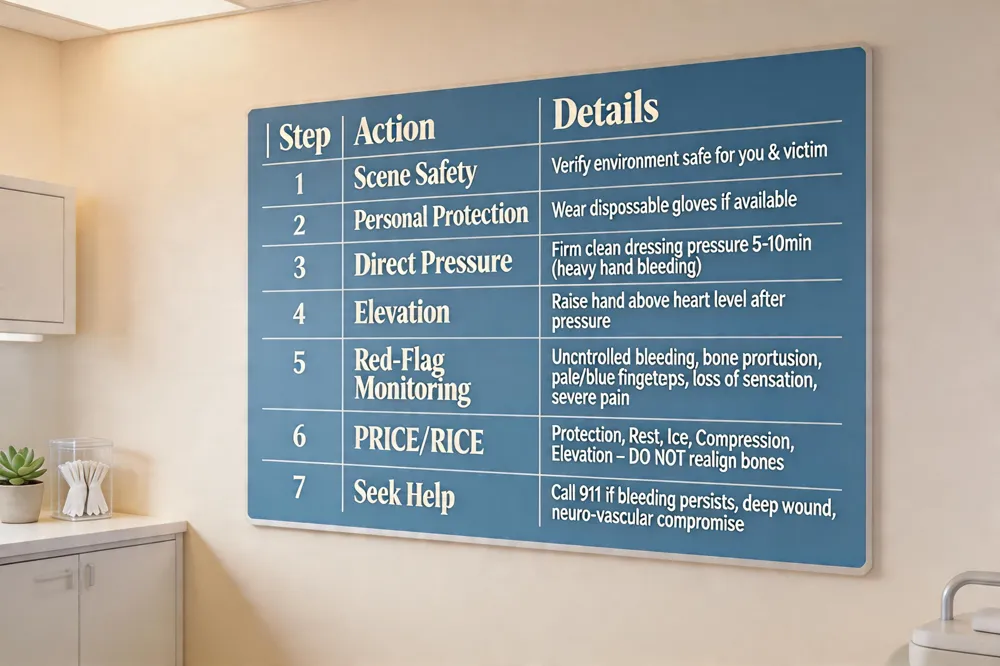 Begin by confirming the scene is safe for you and the injured person; wear disposable gloves if available. For heavy hand bleeding, apply firm direct pressure with a clean dressing or cloth for at least 5‑10 minutes, then elevate the hand above heart level to lessen blood flow. Monitor for red‑flag signs such as uncontrolled bleeding, a bone protruding, a pale or blue fingertip, loss of sensation, or severe pain—these warrant immediate emergency services (call 911). The PRICE (Protection, Rest, Ice, Compression, Elevation) or RICE (Rest, Ice, Compression, Elevation) principles guide subsequent care, but do not attempt to straighten displaced bones or tendons. Promptly seek professional evaluation if bleeding persists, the injury looks deep, or any vascular or nerve compromise is suspected.
Cleaning, Irrigating, and Dressing Open Wounds
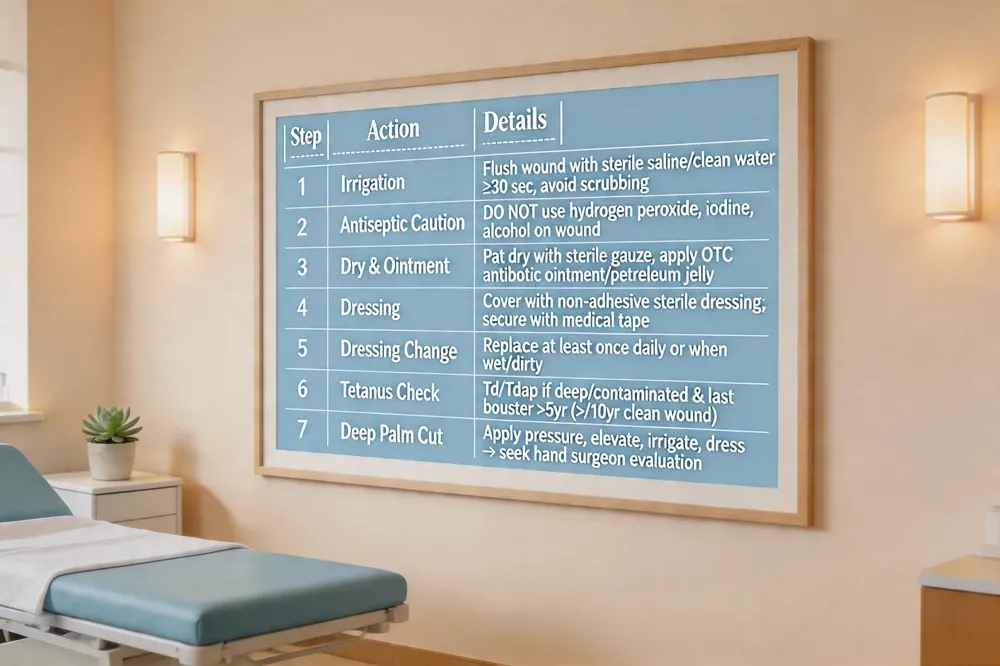
| Step | Action | Details |
|---|---|---|
| 1 | Irrigation | Flush wound with sterile saline or clean running water for ≥30 sec; avoid scrubbing. |
| 2 | Antiseptic Caution | Do NOT use hydrogen peroxide, iodine, or alcohol directly on wound. |
| 3 | Dry & Ointment | Pat dry with sterile gauze; apply thin layer of OTC antibiotic ointment (e.g., bacitracin) or petroleum jelly. |
| 4 | Dressing | Cover with non‑adhesive sterile dressing; secure with medical tape. |
| 5 | Dressing Change | Replace at least once daily or when wet/dirty. |
| 6 | Tetanus Check | Administer Td/Tdap if wound is deep/contaminated and last booster >5 yr (or >10 yr for clean wound). |
| 7 | Deep Palm Cut | Apply pressure, elevate, irrigate, dress, and seek urgent hand‑surgeon evaluation. |
 Gentle Irrigation
Use sterile saline solution or clean running water to flush out debris from the wound. Let the water flow gently over the area for at least 30 seconds; avoid scrubbing, which can damage delicate hand tissue.
Gentle Irrigation
Use sterile saline solution or clean running water to flush out debris from the wound. Let the water flow gently over the area for at least 30 seconds; avoid scrubbing, which can damage delicate hand tissue.
Avoid Harsh Antiseptics Do not apply hydrogen peroxide, iodine, or alcohol directly to the wound, as these agents irritate skin and impair healing. A mild soap can be used on surrounding skin, but keep it out of the wound itself.
Antibiotic Ointment & Sterile Dressing After irrigation, pat the area dry with sterile gauze. Apply a thin layer of over‑the‑counter antibiotic ointment (e.g., bacitracin or mupirocin) or petroleum jelly if allergic. Cover with a non‑adhesive sterile dressing and secure with medical tape. Change the dressing at least once daily or when it becomes wet or dirty.
Tetanus Prophylaxis Check the patient’s immunization record. If the wound is deep, contaminated, or the last tetanus booster was >5 years ago (or >10 years for a clean wound), administer a Tdap or Td booster per CDC guidelines.
Deep Cut on Palm of Hand Apply firm pressure and elevate the hand, then gently irrigate with saline. Cover with a sterile dressing and seek urgent evaluation by a hand surgeon; deep palm lacerations often involve tendons, nerves, or vessels and may need suturing or surgical repair.
How to Treat a Deep Cut on Hand Control bleeding with direct pressure, keep the hand elevated, rinse with clean water, avoid harsh antiseptics, apply antibiotic ointment, dress the wound, and verify tetanus status. Prompt medical assessment is essential for wounds >¼ inch, gaping, or with persistent bleeding.
Cut in Hand Palm Images Clinical photographs of palm lacerations are available from medical image libraries (e.g., Getty Images, Alamy) and can aid education, but they do not replace a professional hand‑surgeon assessment for depth, structural involvement, and repair planning.
Immobilization, Splinting, and Positioning
| Position | Joint Angle | Reason |
|---|---|---|
| Wrist | Slight extension (10‑20°) | Maintains perfusion, protects ligaments. |
| MCP | 90° flexion | Stabilizes metacarpal heads. |
| IP | Extension | Prevents flexion contracture. |
| Splint Types | Rigid board, commercial finger splint, buddy‑tape | Chosen based on injury location & severity. |
| Application | Pad skin, secure without compromising circulation | Re‑evaluate neuro‑vascular status after placement. |
| When to Avoid Manipulation | Suspected fracture/crush injury | Stabilize with padded splint, obtain X‑ray, refer urgently. |
| Follow‑up | Early imaging & specialist referral if pain, deformity, or loss of motion persists | Ensures proper alignment and healing. |
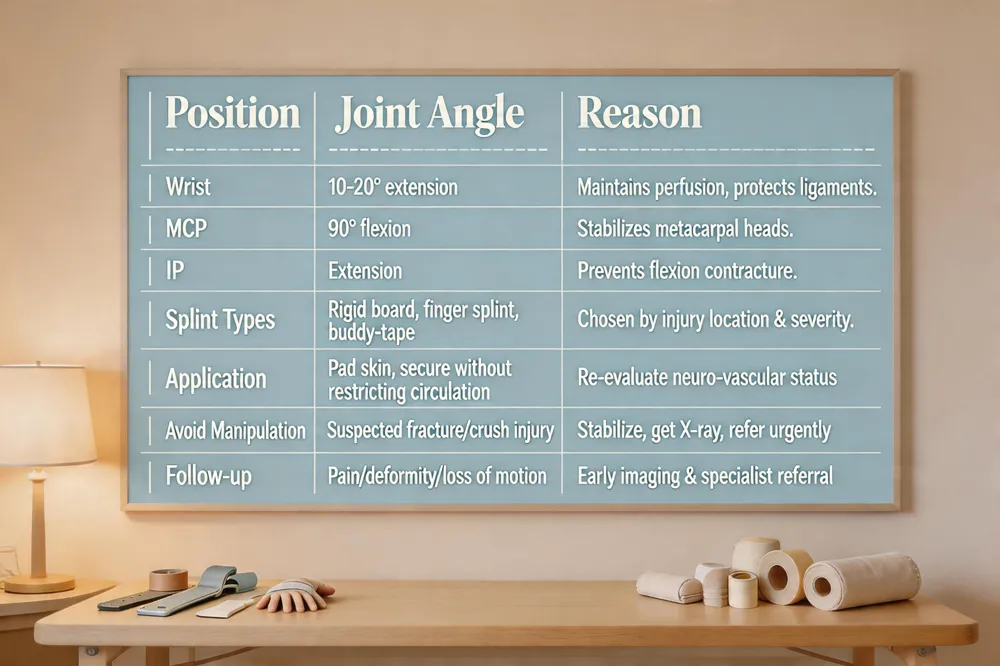 Neutral joint positioning is the cornerstone of hand immobilization: the wrist is held in slight extension, metacarpophalangeal (MCP) joints at 90° flexion, and interphalangeal (IP) joints in extension to protect ligaments while preserving perfusion. Common splints include a rigid board for wrist or forearm injuries, commercial finger splints for isolated digit trauma, and buddy‑taping (soft bandage) to bind an injured finger to an adjacent healthy one. When a fracture or severe crush mechanism is suspected, avoid any manipulation; instead, stabilize the hand with a padded splint or board and seek urgent professional care. Splinting also serves crush or high‑energy injuries to prevent further soft‑tissue damage while monitoring for compartment‑syndrome signs.
Fell and landed on palm of hand treatment – Apply ice 10‑15 min every 2 h, elevate, and protect with a splint. If bruising, deformity, loss of motion, or severe pain is present, obtain X‑rays promptly; a hand surgeon can determine if reduction, casting, or surgery is needed. Mild sprains may be managed with brief immobilization followed by gentle range‑of‑motion exercises.
Hand injury from fall – FOOSH injuries can involve bruising, sprains, metacarpal or scaphoid fractures, and soft‑tissue damage. Look for swelling, numbness, or loss of motion. Early RICE, splinting, and imaging prevent stiffness and chronic pain. Specialist evaluation ensures proper immobilization or surgical repair.
Swollen hand injury treatment – Follow PRICE: protect with a splint, rest, ice 10‑15 min every 2‑3 h, compress with an elastic bandage, and elevate above heart level. Use NSAIDs for pain unless contraindicated. Persistent swelling or loss of function after 72 h warrants imaging and specialist referral.
Hand injury treatment – Begin with splint‑based protection, RICE for inflammation, and OTC NSAIDs. If symptoms persist, a hand therapist can guide stretching and strengthening; severe cases may need corticosteroid injections or minimally invasive fixation. Regular follow‑up ensures alignment and functional recovery.
Cold Therapy, Elevation, and the PRICE/RICE Principles
| Component | Recommendation | Details |
|---|---|---|
| Ice | 10‑20 min every 1‑2 h (first 24‑48 h) | Use thin towel barrier; avoid frostbite. |
| Elevation | Keep hand above heart level, especially during rest & sleep | Promotes venous return, reduces edema. |
| Compression | Elastic bandage, snug but not restrictive | Check color, temperature, capillary refill every few hours. |
| Rest | Limit hand use; protect with splint if needed | Prevents further tissue damage. |
| Ice vs Warm | Ice for acute inflammation; warm soak 15‑20 min for chronic stiffness | Alternate based on symptom phase. |
| Home Remedies | NSAIDs (ibuprofen), topical agents (diclofenac, capsaicin) | Use as needed for pain control. |
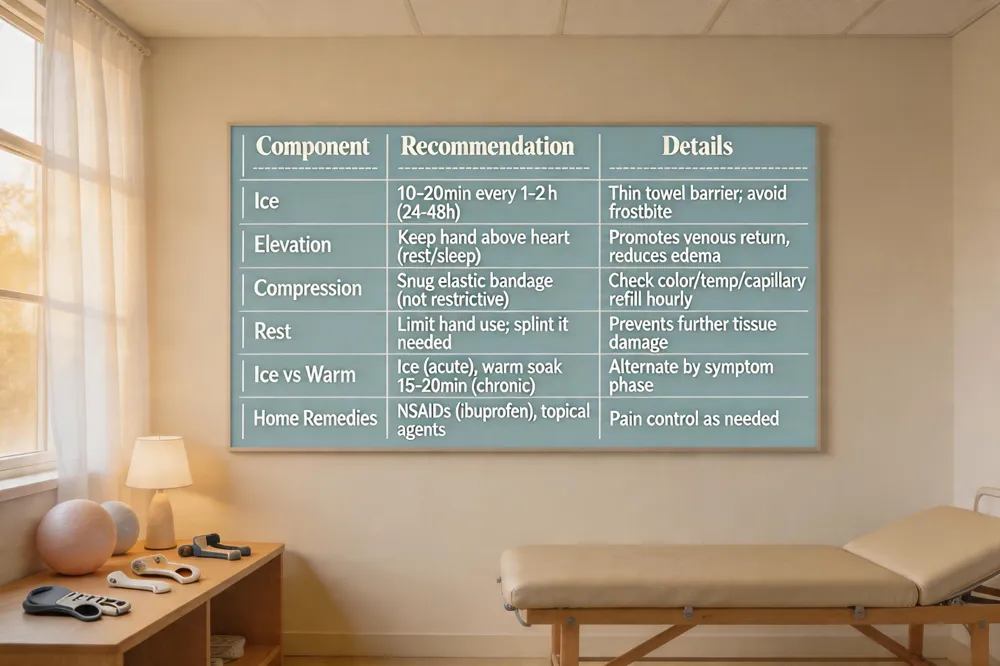 Ice application timing and duration – For acute hand trauma, apply a cold pack wrapped in a thin towel for 10‑20 minutes every 1‑2 hours during the first 24‑48 hours. This limits inflammation and pain without risking frostbite.
Avoiding direct skin contact – Never place ice directly on the skin (always use a cloth barrier or commercial cold pack to protect superficial tissues.
Elevation strategies for edema control – Elevate the injured hand above heart level as often as possible, preferably on a pillow or cushion, to promote venous return and reduce swelling. Keep the hand elevated during rest periods and while sleeping if comfort allows.
Compression bandaging best practices – Use an elastic bandage (not rigid tape) to provide gentle, uniform pressure. The bandage should be snug but not impede circulation; check color, temperature, and capillary refill every few hours.
Home remedies for hand pain and swelling – Begin with temperature therapy: a warm soak or heating pad for 15‑20 minutes to improve circulation, or an ice pack for 10‑15 minutes to curb inflammation during flare‑ups. NSAIDs such as ibuprofen and topical agents (capsaicin, diclofenac) provide further relief, while gentle stretching and elevation keep joints mobile.
How to relieve hand pain at night – Perform light finger and wrist stretches before bed, apply a cold pack after activity and a warm compress before sleep, and consider a comfortably fitted splint to maintain neutral joint alignment. Elevate the hand on a pillow and use OTC anti‑inflammatory medication if needed.
Right hand muscle pain – Often due to overuse, tendonitis, or nerve entrapment. Initial care includes rest, ice, supportive splinting, and NSAIDs. Persistent symptoms warrant evaluation by a hand specialist for imaging, targeted therapy, or possible injection or surgical intervention.
Pain Management, Medications, and Red‑Flag Symptoms
| Intervention | Dosage/Method | Indications |
|---|---|---|
| NSAIDs (Ibuprofen) | 400‑600 mg PO q6‑8 h | Acute inflammation & pain control. |
| Topical Analgesics (Diclofenac gel, Lidocaine patch) | Apply to affected area q4‑6 h | When oral NSAIDs contraindicated or localized pain. |
| Red‑Flag Signs | Uncontrolled bleeding, obvious deformity, loss of motion, numbness, pale/blue nail bed, compartment‑syndrome signs | Call emergency services (911) and seek immediate evaluation. |
| Infection Signs | Progressive redness, warmth, purulent drainage, fever | Prompt clinician assessment, possible antibiotics. |
| Tetanus Booster | Td/Tdap if immunization unknown or >5 yr (clean) / >10 yr (dirty) | Contaminated or deep puncture wounds. |
| Follow‑up | Hand specialist referral if red‑flags present or pain persists >72 h | Prevent chronic dysfunction. |
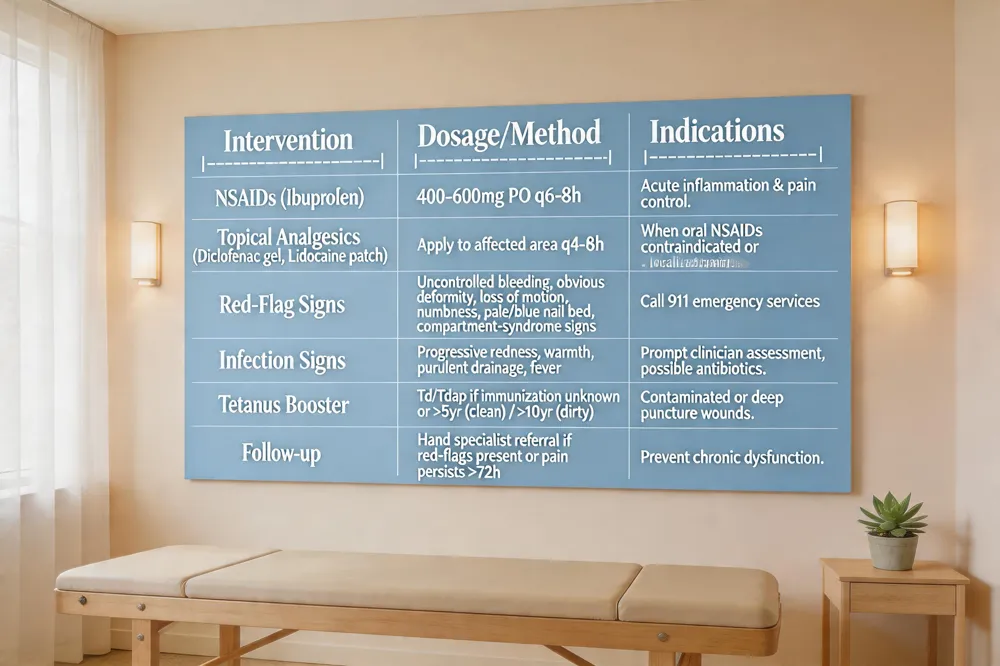 Effective pain control after an acute hand injury begins with non‑steroidal anti‑inflammatory drugs (NSAIDs) such as ibuprofen 400‑600 mg every 6‑8 hours, which diminish inflammation and swelling. Topical analgesics (e.g., diclofenac gel or lidocaine patches) provide localized relief without systemic side effects and are useful when oral NSAIDs are contraindicated.
Red‑flag signs that warrant immediate medical evaluation include uncontrolled bleeding, obvious deformity, loss of finger motion, numbness, or a pale/blue nail bed suggesting vascular compromise. Monitor for compartment syndrome—pain out of proportion, tense swelling, paresthesia, pallor, or pulselessness—and call emergency services if any develop. Signs of infection (progressive redness, warmth, increasing pain, purulent drainage, fever) also demand prompt clinician assessment.
A tetanus booster is recommended for contaminated or puncture wounds when the patient’s immunization status is unknown or the last dose was >5 years ago (or >10 years for clean wounds).
Why my hand is hurting without any reason
Hand pain without an obvious injury often stems from underlying conditions such as arthritis, carpal‑tunnel syndrome, or tendon inflammation (e.g., de Quervain tenosynovitis). Repetitive motions, awkward wrist positions, or hormonal changes can over‑stress tendons and nerves, producing dull ache or tingling. Early evaluation by a board‑certified orthopedic hand specialist, such as Dr. Rebecca S. Yu, is essential to prevent progression and guide treatment.
What diseases start with hand pain
Initial hand pain may signal carpal‑tunnel syndrome, cubital tunnel syndrome, de Quervain tenosynovitis, osteoarthritis, rheumatoid arthritis, Dupuytren’s contracture, trigger finger, or even acute fractures. Recognizing these early can expedite appropriate therapy.
Hand injury Bandage
For sprains, tendon strains, or small lacerations, a breathable elastic compression bandage (4‑inch‑wide, latex‑free) with self‑adhesive closure provides gentle compression without restricting circulation. Deeper wounds may require gauze covered with a self‑adhesive wrap (e.g., Band‑Aid® TOUGH WRAP™). Always have a qualified orthopedic specialist, such as Dr. Rebecca S. Yu, assess the injury to ensure proper bandaging and rule out fractures or ligament damage.
Diagnostic Tools, Red‑Flag Evaluation, and Follow‑up Care
| Tool | Use | Key Findings |
|---|---|---|
| Physical Exam | Vascular (color, temperature, capillary refill, pulses) | Panicor, coolness, delayed refill = red‑flag. |
| Nerve Testing | Light touch, pinprick, two‑point discrimination (median, ulnar, radial) | Sensory loss or motor weakness indicates neuro‑vascular injury. |
| Tendon Screening | Active finger flexion/extension against resistance | Inability or “snap” suggests tendon rupture. |
| X‑ray (AP, Lateral, Oblique) | Suspected fracture, dislocation, foreign body | Determines bony injury. |
| Ultrasound / MRI | Soft‑tissue (tendon, ligament) assessment when X‑ray negative | Provides detailed anatomy for surgical planning. |
| Ten Test | Bedside sensory threshold (10 graded stimuli) | Abnormal scores quantify sensory loss. |
| Referral Criteria | Any red‑flag, positive Ten Test, tendon tear, fracture | Hand surgeon evaluation within 24‑48 h. |
| Rehabilitation | Early range‑of‑motion, hand therapy, NSAIDs as needed | Prevent stiffness, optimize functional recovery. |
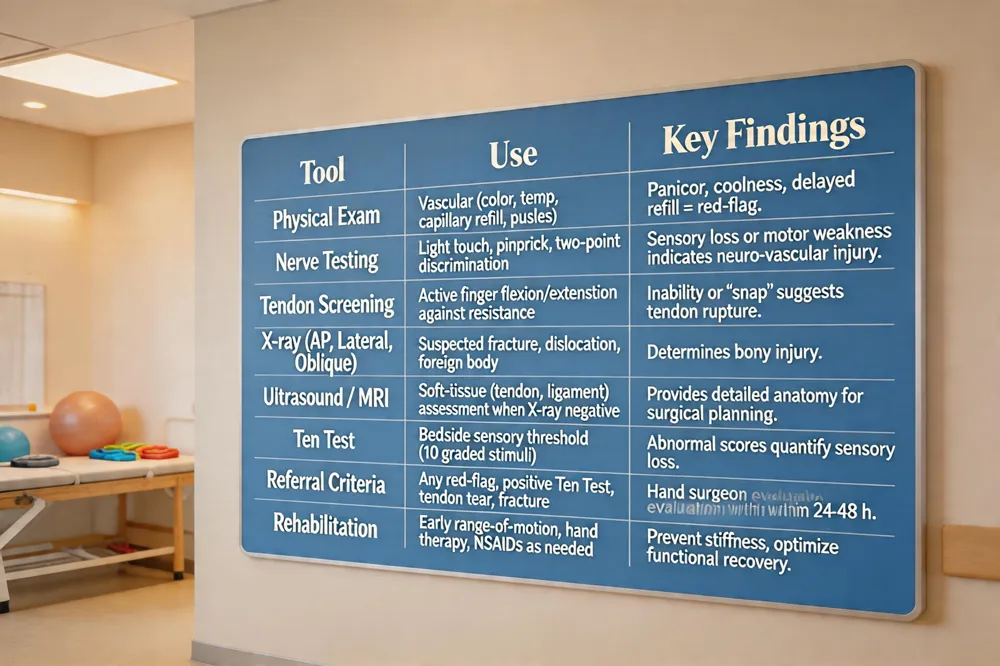 A thorough physical exam is the first step after initial first‑aid. Assess vascular status by checking skin color, temperature, capillary refill, and radial/ulnar pulses; any pallor, coolness, or delayed refill is a red‑flag. Test nerve function of the median, ulnar, and radial distributions with light touch, pinprick, and two‑point discrimination; loss of sensation or motor weakness may indicate neurovascular injury. Tendon integrity is screened by asking the patient to flex and extend each finger against resistance; an inability to move a digit or a “snap” sensation suggests a tendon rupture.
Imaging follows the exam. Plain radiographs (AP, lateral, oblique) are ordered for suspected fractures, dislocations, or foreign bodies. If bone injury is ruled out but tendon or ligament damage is suspected, high‑resolution ultrasound or MRI provides detailed soft‑tissue evaluation.
Sensory bedside tools include the Ten Test, a simple touch‑threshold assessment that compares the injured finger to the contralateral side using a series of ten graded stimuli; abnormal scores help quantify sensory loss. Other bedside tests such as the Froment’s sign (ulnar nerve) and tendon‑glide drills aid in early diagnosis.
Referral to a hand surgeon is recommended when any red‑flag is present—uncontrolled bleeding, obvious deformity, loss of sensation, or a positive Ten Test indicating significant nerve injury. Even isolated tendon tears or fractures should be seen within 24–48 hours to plan splinting, possible surgery, and early rehabilitation, preventing stiffness and optimizing functional recovery.
Take Action Early—Don’t Let Hand Injuries Slip Away
First, protect the hand: stop bleeding with firm direct pressure, clean the wound with sterile saline or running water, and cover with a sterile dressing. Apply ice (wrapped in a cloth) for 10‑20 minutes every 1‑2 hours for the first 48 hours, elevate the hand above heart level, and immobilize any suspected fracture or severe sprain with a splint or buddy‑tape. Use the PRICE/PEACE protocol (Protection, Rest, Ice, Compression, Elevation) and avoid heat, tourniquets, or self‑reduction. Prompt specialist evaluation is critical because hidden fractures, tendon ruptures, nerve injury, or compartment syndrome can worsen without proper imaging and treatment. Dr. Rebecca S. Yu, a board‑certified hand surgeon, can assess vascular and neural status, order X‑rays or MRI, provide definitive splinting or surgical repair, and guide evidence‑based rehabilitation to restore strength and function.