Why Hand and Wrist Health Matters for Active Seniors
After age 60, hand‑strength loss and reduced dexterity become common as muscle mass declines and joint cartilage thins. Osteoarthritis, carpal tunnel syndrome, and osteoporosis‑related fractures are the three most frequent problems that seniors face. Osteoarthritis causes pain, stiffness, and swelling that limit grip; carpal tunnel compresses the median nerve, producing numbness and weakened thumb strength; fractures, even from low‑impact falls, can shatter brittle bones and permanently impair function. Because daily activities—opening jars, buttoning shirts, using phones, and holding railings—depend on reliable hand and wrist function, any decline quickly threatens independence, increases fall risk, and may force reliance on caregivers or adaptive devices. Low‑impact hand therapy, tools, and strengthening can preserve grip, reduce pain, and support safe mobility, keeping seniors active.
Upper‑Extremity Home Exercise Resources
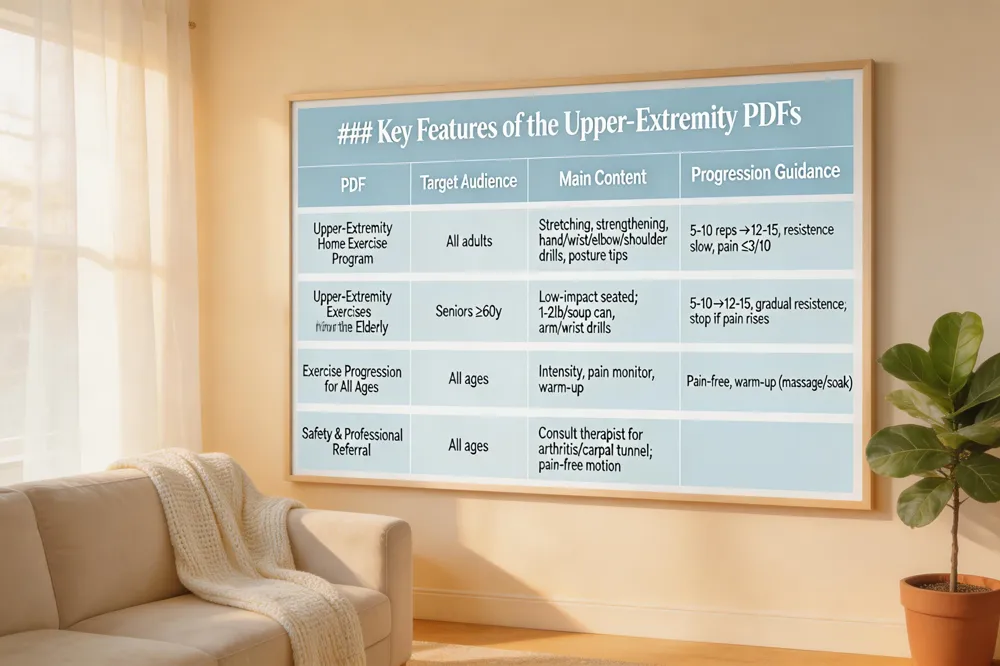
Key Features of the Upper‑Extremity PDFs
| Target Audience | Main Content | Progression Guidance | |
|---|---|---|---|
| Upper‑Extremity Home Exercise Program | All adults | Stretching, strengthening, functional drills for hand, wrist, elbow, shoulder; posture tips; when to seek professional help | Start 5‑10 reps → 12‑15 reps; upgrade light resistance slowly; monitor pain ≤3/10 |
| Upper‑Extremity Exercises for the Elderly | Seniors (≥60 y) | Low‑impact seated program; uses 1‑2 lb wrist weight or soup can; includes shoulder, elbow, forearm, wrist movements and functional drills (Scissors, Angels, etc.) | Begin 5‑10 reps, progress to 12‑15; increase resistance gradually; stop if pain rises |
| Exercise Progression for All Ages | All ages | General guidelines on intensity increase, pain monitoring, warm‑up | Same as above – pain‑free motion, warm‑up (hand massage or warm water soak) |
| Safety & Professional Referral | All ages | Pain‑free motion, warm‑up, consult therapist/physician for arthritis, osteoporosis, recent surgery; early hand‑specialist referral for carpal tunnel, tendonitis |
 Upper extremity home exercise program PDF free download
Dr. Rebecca S. Yu offers a free, downloadable PDF that outlines a complete upper‑extremity home exercise program, covering the hand, wrist, elbow, and shoulder. The guide provides step‑by‑step instructions for stretching, strengthening, and functional drills that are evidence‑based and safe for adults of all ages and activity levels. It includes posture tips, progression cues, and clear signals for when to seek professional evaluation. The PDF can be accessed directly from Dr. Yu’s website by clicking the “Download Upper‑Extremity Exercise Program (PDF)” button—no registration or payment required.
Upper extremity home exercise program PDF free download
Dr. Rebecca S. Yu offers a free, downloadable PDF that outlines a complete upper‑extremity home exercise program, covering the hand, wrist, elbow, and shoulder. The guide provides step‑by‑step instructions for stretching, strengthening, and functional drills that are evidence‑based and safe for adults of all ages and activity levels. It includes posture tips, progression cues, and clear signals for when to seek professional evaluation. The PDF can be accessed directly from Dr. Yu’s website by clicking the “Download Upper‑Extremity Exercise Program (PDF)” button—no registration or payment required.
Upper extremity exercises for the elderly PDF A senior‑friendly PDF is also available, describing a low‑impact, joint‑protective program designed for older adults. Recommended movements are performed once daily while seated, using light resistance such as a 1–2 lb wrist weight or a soup can. Exercises include shoulder flexion, abduction, rotation, circumduction, and horizontal adduction; elbow flexion/extension; forearm pronation/supination; and wrist flexion/extension. Functional drills—Scissors, Angels, Elevens, Diagonals, X’s, Punches, Scarecrow, Double Sevens, biceps curls, triceps extensions, and wrist “motorcycles”—are listed with slow, controlled repetitions. Each exercise is performed with a straight elbow unless otherwise noted, promoting strength, endurance, circulation, and range of motion while minimizing fall risk.
Exercise progression for all ages Both PDFs stress a gradual increase in intensity—start with 5‑10 repetitions, then progress to 12‑15 as comfort allows. Light resistance can be upgraded slowly, and the guide advises monitoring pain (≤3/10) and stopping if discomfort rises.
Safety and professional referral Safety notes highlight pain‑free motion, proper warm‑up (e.g., gentle hand massage or warm water soak), and the importance of consulting a therapist or physician before beginning, especially for those with arthritis, osteoporosis, or recent surgery. Early referral to a hand specialist ensures timely management of conditions such as carpal tunnel syndrome or tendonitis, preventing chronic loss of function.
Hand Skin Health and Rejuvenation
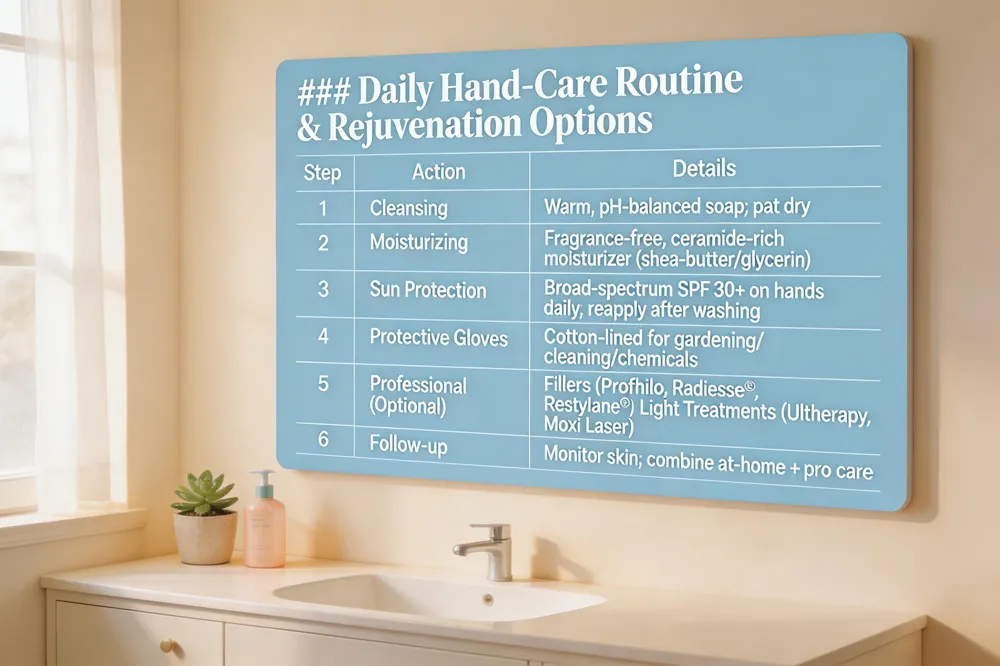
Daily Hand‑Care Routine & Rejuvenation Options
| Step | Action | Details |
|---|---|---|
| 1 | Cleansing | Warm, pH‑balanced soap; pat dry |
| 2 | Moisturizing | Fragrance‑free, ceramide‑rich moisturizer (shea‑butter or glycerin) – apply several times daily, especially after washing and before bed |
| 3 | Sun Protection | Broad‑spectrum SPF 30+ sunscreen on dorsal hands every morning; reapply after washing or outdoor exposure |
| 4 | Protective Gloves | Cotton‑lined gloves for gardening, cleaning, chemical handling |
| 5 | Professional Rejuvenation (optional) | Hyaluronic‑acid fillers (Profhilo, Radiesse®, Restylane® Skinboosters) – restore volume & collagen; Light‑based treatments (Ultherapy, Moxi Laser) – tighten skin & reduce veins |
| 6 | Follow‑up | Monitor skin texture; combine at‑home care with minimally invasive procedures for optimal results |
 Wrinkly hands are a common sign of age‑related loss of skin elasticity, volume, and hydration. Effective management begins with diligent daily skin care. Seniors should wash hands with warm, pH‑balanced soap, pat dry, and immediately apply a fragrance‑free, ceramide‑rich moisturizer (e.g., shea‑butter or glycerin‑based cream) several times a day, especially after washing and before bedtime. Broad‑spectrum sunscreen with at least SPF 30 must be applied every morning to the dorsal hands, even on cloudy days, and re‑applied after washing or outdoor exposure. Wearing cotton‑lined gloves during gardening, cleaning, or chemical handling protects the skin from drying and irritants while preserving moisture.
For deeper texture improvement, non‑surgical rejuvenation procedures are available. Hyaluronic‑acid‑rich fillers such as Profhilo, Radiesse®, or Restylane® Skinboosters restore lost volume and stimulate collagen production, smoothing fine lines. Light‑based treatments—including Ultherapy ultrasound and Moxi Laser fractionated resurfacing—tighten skin, reduce visible veins, and enhance overall tone. These options complement at homecare, offering measurable visible even without surgery.
Combining consistent moisturization, vigilant sun protection, and appropriate minimally invasive procedures creates a personalized plan that can significantly smooth, hydrate, and rejuvenate wrinkly hands, helping seniors maintain both functional grip and a youthful appearance.
Strengthening the Arms, Wrists and and Grip
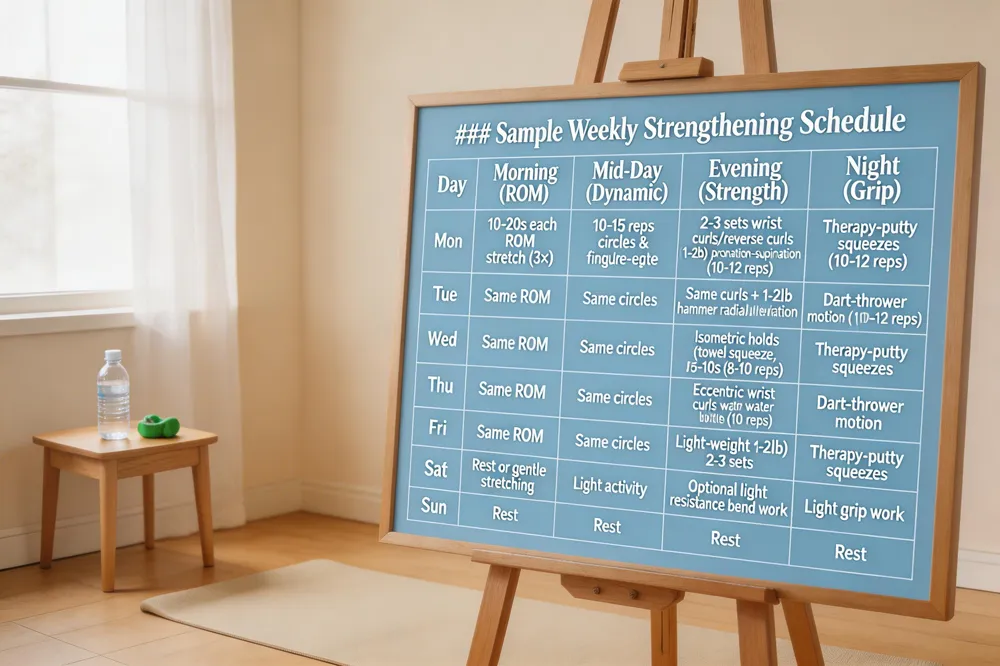
Sample Weekly Strengthening Schedule
| Day | Morning (ROM) | Mid‑Day (Dynamic) | Evening (Strength) | Night (Grip) |
|---|---|---|---|---|
| Mon | 10‑20 s each ROM stretch (3×) | 10‑15 reps circles & figure‑eight | 2‑3 sets wrist curls/reverse curls (1‑2 lb) + pronation‑supination (10‑12 reps) | Therapy‑putty squeezes (10‑12 reps) |
| Tue | Same ROM | Same circles | Same curls + 1‑2 lb hammer radial/ulnar deviation (10 reps) | Dart‑thrower motion (10‑12 reps) |
| Wed | Same ROM | Same circles | Isometric holds (towel squeeze, fist‑hold) 5‑10 s (8‑10 reps) | Therapy‑putty squeezes |
| Thu | Same ROM | Same circles | Eccentric wrist curls with water bottle (10 reps) | Dart‑thrower motion |
| Fri | Same ROM | Same circles | Light‑weight curls (1‑2 lb) 2‑3 sets | Therapy‑putty squeezes |
| Sat | Rest or gentle stretching | Light activity | Optional light resistance band work | Light grip work |
| Sun | Rest | Rest | Rest | Rest |
 Maintaining functional upper‑extremity health after age 60 requires a combined focus on arm tone, wrist stability, and grip endurance.
Flabby‑arm rehabilitation – Sarcopenia and loss of muscle mass begin around age 60 and can leave the upper arm appearing soft. Low‑impact, joint‑safe exercises such as seated biceps curls, overhead triceps extensions, wall push‑ups, and arm circles performed 2–3 times per week rebuild muscle while a modest caloric deficit and adequate protein reduce over‑fat. Dr. Rebecca S. Yu advises supervised programs to protect the shoulder and elbow and to ensure proper form; most seniors notice visible tightening after 9–12 weeks.
Weak‑wrist strengthening protocols – Gentle range‑of‑motion (ROM) stretches (forearm/elbow stretch, prayer stretch, wrist flexion/extension) should be done first, holding each for 30 seconds, three repetitions. Follow with pronation/supination cycles (10 reps × 3 sets) and radial/ulnar deviation drills using a light hammer or 1‑lb dumbbell. Isometric holds (towel squeeze, fist‑hold) for 5–10 seconds, 8–10 repetitions in all directions, build endurance without overloading fragile joints. Progress to eccentric wrist curls with a small water bottle or canned good (10 reps × 3 sets) and grip‑squeeze exercises with a stress ball or rubber band.
Daily wrist‑exercise routine – A practical daily schedule includes:
- Morning ROM stretches (10‑20 seconds each, three times).
- Mid‑day dynamic circles and “figure‑eight” motions (10‑15 reps).
- Evening strengthening: 2‑3 sets of wrist curls/reverse curls (1‑2 lb) and pronation‑supination drills (10‑12 reps).
- Nightly grip work – therapy‑putty squeezes or a “dart‑thrower” motion (10‑12 reps).
Answers to common questions
- Can a 70‑year‑old get rid of flabby arms? Yes – targeted strength training combined with a healthy diet can significantly improve arm tone within 9–12 weeks.
- Free wrist exercises for active older adults? Dr. Yu’s handout recommends the ROM stretches, pronation/supination cycles, light‑weight curls, and stress‑ball squeezes outlined above, performed 3–4 times daily.
- How to strengthen extremely weak wrists? Begin with ROM circles, static stretches, then isometric holds, progressing to light‑resistance curls (1‑2 lb) and band work 2–3 sessions per week.
- Best wrist exercises for active older adults? A balanced mix of flexor/extensor stretches, light‑weight curls, pronation‑supination drills, and functional grip work (therapy‑putty, dart‑thrower) performed every other day.
- Best exercises to improve wrist mobility? Pronation‑supination, radial‑ulnar deviation circles, wrist flexion/extension stretches, and dynamic figure‑eight motions, all done daily with gradual progression.
Consistent, pain‑free practice of these movements preserves mobility, reduces injury risk, and supports independence in everyday tasks.
Fall Prevention and Safety for Older Adults
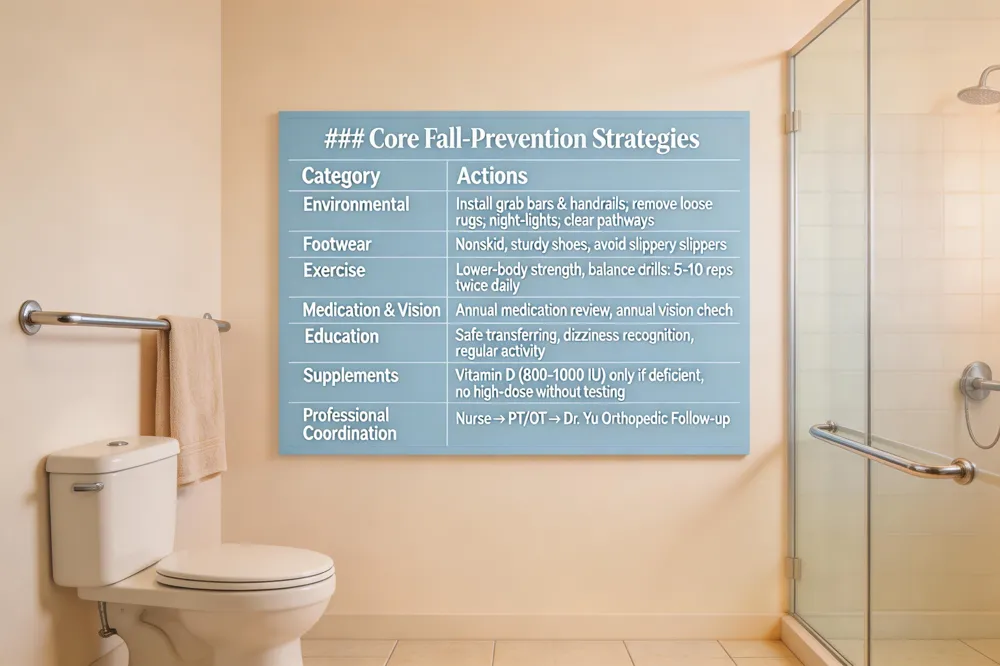
Core Fall‑Prevention Strategies
| Category | Actions |
|---|---|
| Environmental | Install grab bars & handrails (bathroom, stairs); remove loose rugs; use night‑lights; keep pathways clear of cords/shoes |
| Footwear | Nonskid, sturdy shoes; avoid slippers with slippery soles |
| Exercise | Lower‑body strength (seated leg lifts, chair‑stand), upper‑body resistance bands; balance drills (single‑leg stance, side‑stepping) – 5‑10 reps, progress to 10‑15 reps twice daily |
| Medication & Vision Review | Annual medication review for dizziness‑inducing drugs; vision check for glasses or cataract updates |
| Education | Teach safe transferring, dizziness recognition, importance of regular activity |
| Supplements | Vitamin D only if deficient (800‑1,000 IU); avoid routine high‑dose without testing |
| Professional Coordination | Nurse assessment → PT/OT referral → orthopedic follow‑up (Dr. Yu) for surgical precautions |
 ### Nursing interventions to prevent falls in older adults
Nurses should start with a comprehensive fall‑risk assessment that includes gait and balance testing, medication review, vision and hearing checks, and evaluation of chronic conditions such as diabetes or cognitive impairment. Identifying tripping hazards, securing loose rugs, installing grab bars and night‑lights, and ensuring sturdy, nonskid footwear are essential environmental modifications. Education is key: nurses teach patients and caregivers safe transferring techniques, the importance of regular physical activity, and how to recognize dizziness or weakness. Coordinating with physical therapists to implement individualized strength‑training and balance exercises (e.g., tai chi, resistance bands) further reduces risk. Finally, nurses document and communicate any status changes to the orthopedic team so that Dr. Yu can integrate surgical precautions into a holistic fall‑prevention plan.
### Nursing interventions to prevent falls in older adults
Nurses should start with a comprehensive fall‑risk assessment that includes gait and balance testing, medication review, vision and hearing checks, and evaluation of chronic conditions such as diabetes or cognitive impairment. Identifying tripping hazards, securing loose rugs, installing grab bars and night‑lights, and ensuring sturdy, nonskid footwear are essential environmental modifications. Education is key: nurses teach patients and caregivers safe transferring techniques, the importance of regular physical activity, and how to recognize dizziness or weakness. Coordinating with physical therapists to implement individualized strength‑training and balance exercises (e.g., tai chi, resistance bands) further reduces risk. Finally, nurses document and communicate any status changes to the orthopedic team so that Dr. Yu can integrate surgical precautions into a holistic fall‑prevention plan.
### What is the most common injury for the elderly? Falls are the leading cause of injury among older adults. The injuries that result most often are fractures, with hip fractures being the most common and serious, accounting for a large proportion of hospitalizations and mortality in people age 65 and older. Wrist (distal‑radius) fractures are the second most frequent fracture after a fall, especially in women with osteoporosis. Traumatic brain injuries, including concussions and more severe head trauma, also occur frequently when an older adult hits their head during a fall. Together, hip, wrist, and head injuries represent the bulk of fall‑related morbidity in the elderly population.
### Free wrist exercises for active older adults A free handout from Dr. Yu lists easy, equipment‑light wrist exercises ideal for active seniors. Begin each day with gentle range‑of‑motion stretches—forearm/elbow stretch, prayer stretch, and standing wrist flexion/extension—holding each for 30 seconds, three repetitions. Follow with pronation/supination cycles (10 reps, three sets) and radial/ulnar deviation drills using a light hammer or dumbbell (10 reps, three sets). Strengthen the wrist with eccentric flexion and extension lifts using a small water bottle or canned good (10 reps, three sets) and finish with grip‑squeeze or finger‑spring exercises with a stress ball or rubber band (10 reps, daily). Perform the routine every 1–2 hours for flexibility and 3–4 times a day for strength, staying within a pain‑free range.
### Can vitamin D help prevent falls? Moderate supplementation with vitamin D (800–1,000 IU daily) can modestly improve muscle strength and balance in deficient older adults, and some meta‑analyses report a small reduction in fall risk in this group. However, large trials such as STURDY found no additional benefit—and a possible increase in falls—when doses exceed 1,000 IU daily. The USPSTF now recommends against routine vitamin D for fall prevention in community‑dwelling adults who are not deficient. Therefore, vitamin D should be used only after checking serum levels and confirming a deficiency or another medical indication. Dr. Yu advises individualized supplementation based on testing rather than universal high‑dose use.
### How to prevent falls in the elderly at home Install sturdy grab bars and handrails in the bathroom, near the toilet, inside the shower, and on both sides of any stairs, keeping them free of clutter. Remove loose or throw rugs, secure floor coverings, and keep cords and shoes off walkways. Ensure adequate lighting by adding nightlights, motion‑activated bulbs, and easily reachable switches, especially in hallways, stairs, and bedrooms. Store frequently used items at waist height, use a step stool with a handrail instead of a chair, and encourage regular balance‑training exercises under professional guidance. Annual medication and vision reviews are also essential to address factors that affect stability.
### Fall‑prevention exercises for seniors A comprehensive program combines lower‑body strength moves (seated leg lifts, heel‑to‑toe walks, chair‑stand repetitions) with upper‑body resistance‑band work. Balance drills—standing with feet shoulder‑width apart, single‑leg stance, side‑stepping, backward walking—should be performed near a sturdy support. Begin with 5–10 repetitions, holding a counter for balance, and gradually increase to 10–15 reps twice daily as strength improves. Progression can include adding light hand‑weights to the sit‑to‑stand, extending single‑leg holds to 30 seconds, and incorporating dynamic walking patterns. Dr. Yu emphasizes obtaining brief medical clearance, exercising on non‑slippery surfaces, and listening to the body to avoid pain.
### Consequences of falls in the elderly Falls frequently result in serious injuries such as hip, wrist, ankle, and vertebral fractures, as well as traumatic brain injuries. These events dramatically increase the risk of long‑term disability and death. Approximately one in ten falls leads to an injury that restricts activity for a day or more, and nearly 4.5 % of elderly patients die after a low‑level fall compared with 1.5 % of younger adults. Fractures and head trauma often require emergency‑department visits, hospital admissions, and prolonged rehabilitation, eroding independence and increasing healthcare costs. Even minor injuries can foster a fear of falling, leading to activity avoidance, muscle weakness, and further balance decline—a vicious cycle. Prompt orthopedic assessment and a multidisciplinary fall‑prevention program are essential to reduce morbidity, preserve function, and improve quality of life for older patients.
Common Hand Injuries and Targeted Rehabilitation
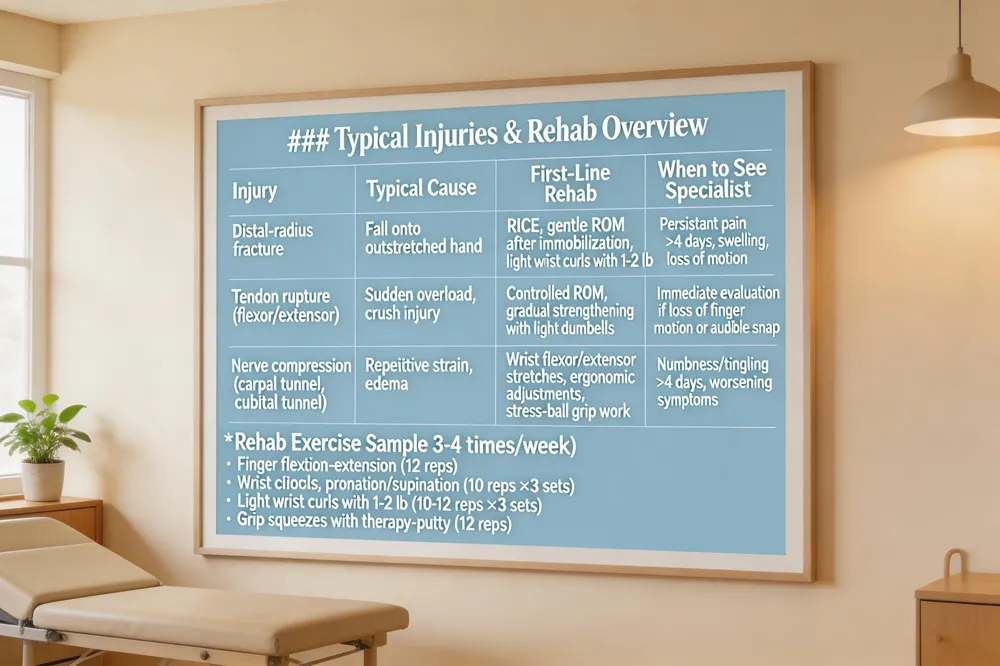
Typical Injuries & Rehab Overview
| Injury | Typical Cause | First‑Line Rehab | When to See Specialist |
|---|---|---|---|
| Distal‑radius fracture | Fall onto outstretched hand | RICE, gentle ROM after immobilization, light wrist curls with 1‑2 lb | Persistent pain >4 days, swelling, loss of motion |
| Tendon rupture (flexor/extensor) | Sudden overload, crush injury | Controlled ROM, gradual strengthening with light dumbbells, therapy‑putty | Immediate evaluation if loss of finger motion or audible snap |
| Nerve compression (carpal tunnel, cubital tunnel) | Repetitive strain, edema | Wrist flexor/extensor stretches, ergonomic adjustments, stress‑ball grip work | Numbness/tingling >4 days, worsening symptoms |
Rehab Exercise Sample (3‑4 times/week):
- Finger flexion‑extension (12 reps)
- Wrist circles, pronation/supination (10 reps ×3 sets)
- Light wrist curls with 1‑2 lb (10‑12 reps ×3 sets)
- Grip squeezes with therapy‑putty (12 reps)
 Top hand injuries in seniors
The three most frequent hand problems in older adults are (1) distal‑radius (wrist) fractures, usually from falls; (2) tendon ruptures, especially flexor or extensor tendons after a sudden overload or crush injury; and (3) nerve‑compression syndromes such as carpal tunnel and cubital tunnel, which cause pain, numbness, and loss of grip. Early diagnosis by a primary‑care physician and referral to a hand surgeon (e.g., Dr. Rebecca S. Yu) is essential to prevent long‑term functional loss.
Top hand injuries in seniors
The three most frequent hand problems in older adults are (1) distal‑radius (wrist) fractures, usually from falls; (2) tendon ruptures, especially flexor or extensor tendons after a sudden overload or crush injury; and (3) nerve‑compression syndromes such as carpal tunnel and cubital tunnel, which cause pain, numbness, and loss of grip. Early diagnosis by a primary‑care physician and referral to a hand surgeon (e.g., Dr. Rebecca S. Yu) is essential to prevent long‑term functional loss.
Therapeutic exercises for wrist and finger health Gentle range‑of‑motion work—finger flexion‑extension, wrist circles, pronation/supination—improves joint mobility. Hand‑therapy putty or a soft stress ball (12 repetitions per movement daily) builds grip strength. Wrist‑flexor/extensor stretches (hold 10‑20 seconds, three times daily) maintain flexibility. Strengthening with light dumbbells (1‑2 lb) or a canned good for wrist curls, radial/ulnar deviation drills, and eccentric lifts protect the kinetic chain that underlies hand function. Performing these moves 3‑4 times a week reduces stiffness, pain, and the risk of overuse injuries.
When to seek specialist care Consult a hand specialist if pain persists >4 days, swelling does not improve with RICE, there is loss of motion, or you notice numbness/tingling suggestive nerve compression. Immediate evaluation is also warranted after a fall, suspected fracture, or tendon rupture. Early orthopedic or occupational‑therapy intervention can prevent chronic arthritis, deformity, and loss of independence.
Free wrist exercises for active older adults Begin each day with forearm/elbow stretch, prayer stretch, and standing wrist flexion/extension (30 seconds, three reps). Add pronation/supination (10 reps, three sets) and radial/ulnar deviation using a light hammer or water bottle (10 reps, three sets). Finish with grip‑squeeze or finger‑spring exercises using a stress ball or rubber band (10 reps, daily). Perform the routine every 1–2 hours for flexibility and 3–4 times a day for strength.
Best wrist exercises for active older adults Combine gentle stretches (flexor/extensor holds 10‑20 seconds, three times daily) with light‑weight wrist curls and reverse curls (1‑2 lb, 2‑3 sets of 10‑15 reps, 3‑4 times weekly). Include pronation/supination drills with a hammer or resistance band, and functional grip work such as therapy‑putty squeezes or a “dart‑thrower” motion (10‑12 reps). Consistency preserves wrist function and reduces injury risk.
What are the best exercises to improve wrist mobility? Start with active pronation/supination and radial‑ulnar deviation circles (10‑15 reps each). Follow with static flexor and extensor stretches (20‑30 seconds hold). Add dynamic wrist circles, figure‑eight motions, and resisted rotations using a light dumbbell or band. Perform these drills daily, progressing slowly to maintain flexibility while gradually building strength.
Specialized Occupational‑Therapy and Supine Exercise Guides
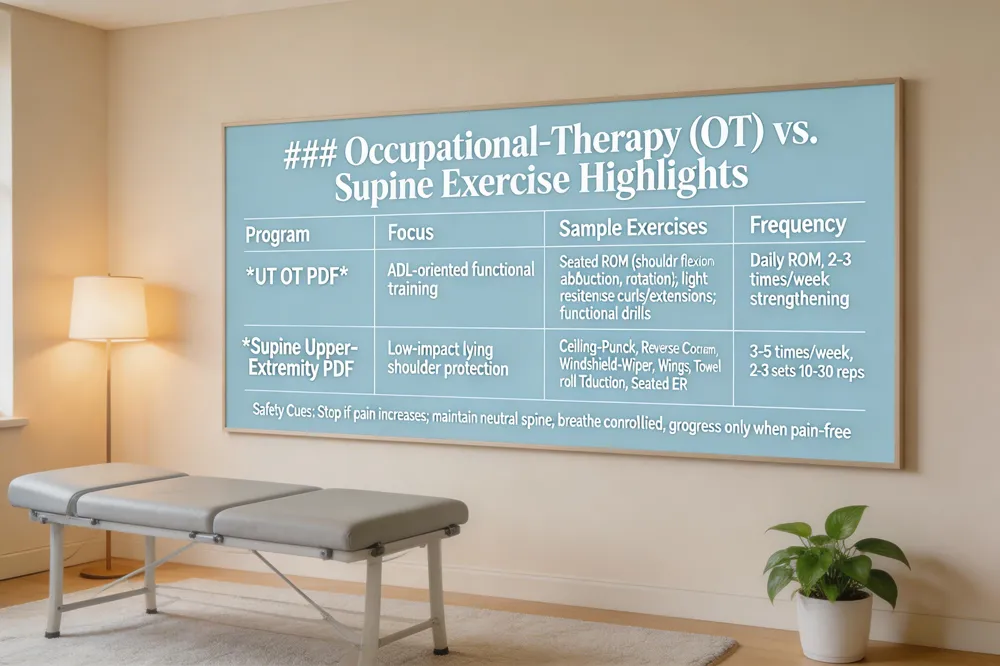
Occupational‑Therapy (OT) vs. Supine Exercise Highlights
| Program | Focus | Sample Exercises | Frequency |
|---|---|---|---|
| UT OT PDF | ADL‑oriented functional training | Seated ROM (shoulder flexion, abduction, rotation); light resistance biceps curls, triceps extensions; functional drills (scissors, angels, diagonals) | Daily ROM; 2‑3 times/week strengthening |
| Supine Upper‑Extremity PDF | Low‑impact lying drills to protect shoulder | Ceiling‑Punch, Reverse Codman pendulums, Windshield‑Wiper external rotation, Wings, Tduction with towel roll, Seated External Rotation | 3‑5 times/week, 2‑3 sets of 10‑30 reps |
Safety Cues: Stop if pain increases; maintain neutral spine; breathe controlled; progress only when pain‑free |
 Upper extremity occupational therapy PDF
The PDF presents a structured upper‑extremity occupational‑therapy program that moves from passive range‑of‑motion drills to active‑assistive movements and finally to functional, ADL‑focused tasks such as buttoning a shirt or lifting objects. Early sections detail seated ROM exercises—shoulder flexion, abduction, rotation, circumduction, elbow flexion/extension, forearm pronation/supination, and wrist flexion/extension—performed slowly once a day, one arm at a time. Strengthening is introduced with light resistance (1–2 lb wrist weights or canned goods) and progresses through shoulder, elbow, and wrist‑specific drills like biceps curls, triceps extensions, and wrist “motorcycles.” Later stages incorporate coordinated patterns (scissors, angels, diagonals, X‑s) and functional simulations (punches, scarecrow, double sevens) to improve endurance, proprioception, and real‑world hand use. Proper posture, controlled breathing, and stopping any activity that causes pain are emphasized throughout.
Upper extremity occupational therapy PDF
The PDF presents a structured upper‑extremity occupational‑therapy program that moves from passive range‑of‑motion drills to active‑assistive movements and finally to functional, ADL‑focused tasks such as buttoning a shirt or lifting objects. Early sections detail seated ROM exercises—shoulder flexion, abduction, rotation, circumduction, elbow flexion/extension, forearm pronation/supination, and wrist flexion/extension—performed slowly once a day, one arm at a time. Strengthening is introduced with light resistance (1–2 lb wrist weights or canned goods) and progresses through shoulder, elbow, and wrist‑specific drills like biceps curls, triceps extensions, and wrist “motorcycles.” Later stages incorporate coordinated patterns (scissors, angels, diagonals, X‑s) and functional simulations (punches, scarecrow, double sevens) to improve endurance, proprioception, and real‑world hand use. Proper posture, controlled breathing, and stopping any activity that causes pain are emphasized throughout.
Supine upper extremity exercises PDF The “Supine Upper Extremity Exercises” PDF offers a step‑by‑step handout of low‑impact, lying‑on‑your‑back drills that target the rotator cuff, scapular stabilizers, and wrist extensors while minimizing shoulder strain. Core movements include the Ceiling‑Punch (a bench‑press‑style push‑up for the shoulders), Reverse Codman pendulums (side‑to‑side and circular motions for joint mobility), and the “Windshield‑Wiper” external rotation that rotates the forearm outward to a perpendicular position. Additional exercises such as Wings, Adduction with a towel roll, and Seated External Rotation provide progressive strengthening and proprioception. Each exercise is prescribed in 2‑3 sets of 10‑30 repetitions, performed three to five times per week, with clear safety cues to stop if pain increases. The Dr. Yu’s guide integrates these steps for a safe, home‑based rehabilitation of hand and upper‑extremity injuries.
Key Take‑aways for Active Seniors
Integrate short hand‑wrist routines each day—12 repetitions of therapy‑putty squeezes, finger spreads, wrist circles, and forearm curls—to keep grip strength and joint mobility. Protect skin with daily moisturizers, broad‑spectrum SPF 30+ sunscreen, and wear padded or ergonomic tools (large‑handle jar openers, garden gloves) to lessen joint stress. Reduce fall risk by maintaining balance with tai‑chi or heel‑to‑toe walks, keeping home surfaces clear, and using non‑slip footwear; strong hands help catch oneself safely. Finally, schedule prompt evaluations with a hand specialist or orthopedic surgeon when pain, numbness, or loss of function appears, allowing early non‑surgical or surgical treatment and rehabilitation support.