Welcome to Dr. Rebecca S. Yu’s Elbow Arthritis Center
Elbow arthritis, whether osteo‑ or rheumatoid‑type, causes pain, swelling, and loss of motion that interferes with everyday tasks such as dressing, cooking, and writing. Traditional open surgery can be invasive, but minimally invasive arthroscopy—small‑incision “keyhole” surgery using a fiber‑optic camera—offers precise removal of bone spurs, inflamed synovium, and loose bodies while preserving surrounding soft tissue. This approach reduces postoperative pain, lowers infection risk, and speeds the return to function. In this guide you will learn the basics of elbow arthritis, why Dr. Rebecca S. Yu prefers arthroscopic and other minimally invasive techniques, and what to expect during evaluation, imaging, the out‑patient procedure, and early rehabilitation. Our goal is to empower you with clear, evidence‑based information so you can make an informed decision about managing your elbow arthritis.
Understanding Elbow Arthritis and Its Presentation
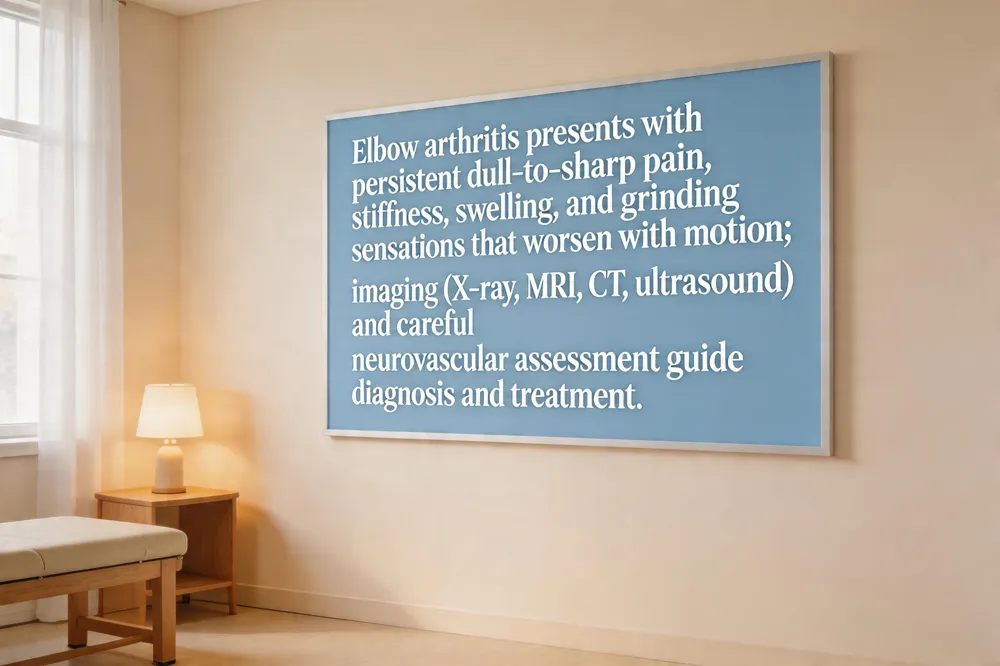 Elbow arthritis usually presents with persistent dull‑to‑sharp pain that worsens with flexion, extension, or forearm rotation and may awaken the patient at night. Stiffness after periods of rest, swelling, warmth, and a gritty grinding or catching sensation are common, often limiting the arc of motion. Pain is typically felt on the medial or lateral sides of the joint, deep within the elbow, and can radiate down the forearm; in rheumatoid disease the lateral aspect may be more prominent, while osteoarthritis often hurts the outer elbow during extension.
Diagnostic imaging starts with plain X‑rays (AP and lateral) showing joint‑space narrowing, osteophytes, and subchondral sclerosis. MRI adds detail of cartilage loss, labral tears, and soft‑tissue pathology; CT with 3‑D reconstruction clarifies bony deformities, and ultrasound evaluates effusion and synovial hypertrophy.
During elbow arthroscopy the surgeon visualizes the joint capsule, synovial membrane, cartilage of the trochlea, capitellum, radial head and olecranon, and key ligaments (UCL, LCL, annular ligament). The neurovascular structures at risk include the ulnar nerve medially, the radial nerve laterally, and the median nerve and brachial artery anteriorly. Standard portals—soft‑spot lateral view and medial working portal—provide comprehensive inspection.
Early rheumatoid elbow arthritis is symmetrical, with pain, swelling, warmth, and morning stiffness, often accompanied by hand or wrist involvement. Laboratory inflammatory markers and early erosions on imaging guide prompt disease‑modifying therapy.
Tendonitis (e.g., tennis elbow) produces sharp, localized lateral pain that worsens with gripping and wrist extension, whereas arthritis causes deep, aching pain, stiffness, and reduced motion. Imaging (X‑ray or MRI) and clinical pattern help differentiate the two, directing treatment toward physical therapy and anti‑inflammatories for tendonitis and joint‑protective measures, injections, or Arthroscopic debridement for arthritis.
Non‑Surgical Strategies for Pain Relief
 What is the best pain relief for arthritis in the elbow?
Short‑term NSAIDs (ibuprofen, naproxen) are the first line to curb inflammation and pain. If NSAIDs are unsuitable, a physician‑guided corticosteroid injection can provide several months of relief. Topical agents (capsaicin, diclofenac cream) give localized effect without systemic side‑effects. Combine with gentle stretching, heat or ice, and a supervised strengthening program to preserve motion.
What is the best pain relief for arthritis in the elbow?
Short‑term NSAIDs (ibuprofen, naproxen) are the first line to curb inflammation and pain. If NSAIDs are unsuitable, a physician‑guided corticosteroid injection can provide several months of relief. Topical agents (capsaicin, diclofenac cream) give localized effect without systemic side‑effects. Combine with gentle stretching, heat or ice, and a supervised strengthening program to preserve motion.
Can elbow arthritis be cured? Arthritis is chronic and cannot be cured, but symptoms are controllable. Anti‑inflammatory drugs, activity modification, physical therapy, splinting, and a healthy diet often achieve significant relief. When these fail, injections or arthroscopic debridement improve function. In advanced disease, total elbow arthroplasty may be considered.
How do you get rid of arthritis pain in your elbow? Protect the joint by avoiding heavy or repetitive loading and use a brace if needed. Apply heat for stiffness and ice after activity for swelling. OTC NSAIDs or acetaminophen control pain; corticosteroid injections are an option for persistent inflammation. Regular gentle stretching and light strengthening (wrist turns, elbow bends) maintain range of motion.
What are the first signs of bursitis in the elbow? Early swelling over the olecranon tip, a feeling of fullness, and mild ache with movement or pressure are typical. Redness, warmth, and increased pain suggest infection.
Elbow bursitis? Olecranon bursitis presents as a painful, swollen posterior elbow. Conservative care includes rest, ice, compression, NSAIDs, and protective padding. Aspiration relieves pressure and yields fluid for culture if infection is suspected; septic cases need antibiotics, and recurrent aseptic cases may benefit from corticosteroid injection.
Elbow bone sticking out no pain? A painless bump is usually a benign olecranon prominence or small osteophyte from age‑related changes. Evaluation with an X‑ray is advised to rule out fracture or early arthritis; if asymptomatic, no treatment is required beyond avoiding chronic pressure.
Tennis elbow? Lateral epicondylitis causes outer elbow pain radiating into the forearm. Initial treatment: rest, ice, NSAIDs, ergonomic adjustments, and targeted physical therapy. Persistent pain may warrant corticosteroid injection or, rarely, surgical debridement.
Golfer’s elbow? Medial epicondylitis produces inner elbow ache and weakness. Management mirrors tennis elbow: rest, ice, NSAIDs, activity modification, and progressive strengthening. Refractory cases may need injection therapy or limited surgery.
Cubital tunnel syndrome? Ulnar nerve entrapment leads to tingling, numbness, and weakness in the little finger. Conservative measures include elbow splinting, activity modification, NSAIDs, and nerve‑glide exercises. Failure of these strategies often leads to surgical decompression or ulnar nerve transposition.
Minimally Invasive Surgical Options
 Elbow arthroscopy is a key‑hole procedure performed through 2‑3 mm portals using a 30‑degree arthroscope and specialized shavers, graspers, or radio‑frequency devices. Indications include osteoarthritis debridement, loose‑body removal, synovectomy, capsular release, and evaluation of ligament injury. Pre‑operative MRI or X‑ray guides portal placement and identifies neurovascular structures (ulnar, radial, median nerves). The patient may be positioned supine, prone, or in lateral decubitus; the arm is supported on a padded board, a tourniquet applied, and the elbow flexed 70–90° to distend the joint and protect nerves. After saline insufflation through the soft‑spot portal, viewing and working portals are created using a “nick‑and‑spread” technique. Loose bodies are extracted with graspers or suction, and osteophytes are shaved to smooth irregular cartilage surfaces.
Post‑operative rehab follows three phases: Phase I (days 1‑14) – pain control, ice, gentle active‑assisted ROM; Phase II (weeks 2‑6) – light resistance, forearm strengthening, proprioceptive drills; Phase III (weeks 6‑12) – progressive strengthening, sport‑specific training, return to full activity by 8‑12 weeks. A sling is typically worn during sleep for the first 1‑2 weeks to protect the joint.
Pain after arthroscopy is usually mild to moderate, manageable with oral analgesics and ice; most patients feel reduced soreness by the end of week 1. Procedure time averages 45‑90 minutes, with total visit time of 2‑3 hours. In the United States, out‑of‑pocket costs range from $5,000 to $15,000 after insurance, varying by facility and region.
Advanced Procedures and Emerging Treatments
 Elbow arthroscopy has become the preferred minimally invasive option for arthritic elbows, allowing debridement of inflamed synovium, removal of loose bodies, and capsular release through 2‑3 small incisions. This technique reduces soft‑tissue trauma, postoperative pain, and recovery time compared with open surgery, and it can be performed in an outpatient setting under regional or local anesthesia.
What is the new elbow joint operation? The newest operation is elbow arthroplasty, offered as either a partial (unicondylar) or total replacement. Damaged bone and cartilage are removed and a metal‑on‑plastic prosthesis—linked or unlinked—is implanted, restoring motion and relieving pain for advanced arthritis or post‑traumatic damage.
What is the fastest way to heal tendons in the elbow? Immediate rest, ice, and a short NSAID course are essential, followed by early supervised eccentric loading and forearm stretches. Adjunctive therapies such as platelet‑rich plasma injections , needle fenestration, or extracorporeal shock‑wave treatment can accelerate healing, while chronic cases may require arthroscopic debridement and structured rehab.
What are the alternatives to elbow surgery? Conservative care—including activity modification, NSAIDs, physical therapy, bracing, and corticosteroid injections, PRP or stem‑cell injections—remains first line. When these fail, minimally invasive arthroscopic debridement, synovectomy, or interpositional arthroplasty provide joint‑preserving alternatives.
Arthroscopic elbow surgery cost in the United States? Out‑of‑pocket costs range from roughly $5,000 to $15,000 after insurance, with cash prices averaging $10,709 at outpatient hospitals and $6,100 at freestanding centers in California; nationwide cash prices vary from $4,900 to $11,600 for surgery‑center services and $8,600 to $10,700 for hospital‑based care.
Patient Journey: From Diagnosis to Full Recovery
 Elbow problems often resolve without an operation. Non‑operative care—including rest, activity modification, bracing, NSAIDs, physical therapy, and, when needed, ultrasound‑guided corticosteroid or PRP injections—can relieve pain and restore motion for mild sprains, tendonitis, bursitis, and early‑stage arthritis (OPA Ortho; Harvard Health). Surgery is reserved for displaced fractures, complete ligament tears, persistent instability, or arthritis that fails conservative measures (HSS; Cedars‑Sinai).
When arthroscopic surgery is indicated, the procedure is typically performed under regional or general anesthesia and lasts about 45–60 minutes (average operative time reported in multiple sources). Patients are observed for 1–2 hours after the case and usually go home the same day, making the total facility time roughly three to four hours.
Recovery follows a structured timeline. Light daily activities often resume within 1–2 weeks, and desk‑type work may be possible in just a few days. Early passive range of motion is started within days, followed by progressive strengthening. Full return to heavy lifting, throwing, or sports generally requires 6–8 weeks, though more extensive debridement may extend to 2–3 months. The overall journey—from initial consultation, imaging, decision‑making, possible arthroscopy, and postoperative rehabilitation—typically spans 2–3 months before the patient regains pre‑injury function.
Take the Next Step Toward Pain‑Free Elbow Function
Minimally invasive elbow procedures include arthroscopic debridement, loose‑body removal, synovectomy, capsular release, radiofrequency ablation, PRP injection, and brisement. These techniques use small 5‑10 mm portals, reducing tissue trauma, infection risk, and scarring while allowing quicker rehabilitation. Early evaluation with Dr. Rebecca S. Yu, a board‑certified hand and upper‑extremity surgeon in Berkeley, CA, ensures precise imaging, a personalized treatment plan, and access to state‑of‑the‑art arthroscopic equipment, which lowers the risk of nerve injury and speeds return to daily activities. To schedule an appointment, call (510) 555‑1234 or visit her website to use the online patient portal. New‑patient requests are answered within 24 hours, and the office can arrange same‑day imaging if needed. Early intervention maximizes joint preservation and pain‑free function.