Understanding Pediatric Hand Surgery
Pediatric hand and upper‑extremity care focuses on congenital differences, traumatic injuries, and growth‑plate disorders unique to children’s developing bones, nerves and muscles. Specialized expertise matters because surgeons must protect growth plates, use microsurgical techniques, and tailor rehabilitation to a child’s developmental stage. Dr. Rebecca S. Yu is board‑certified in orthopedic surgery, fellowship‑trained in hand and upper‑extremity surgery, and practices in Berkeley, CA, offering both adult and pediatric care. Her practice follows HSS’s family‑centered model: honest age‑appropriate explanations, child‑life specialists, pre‑admission testing with parent accompaniment, clear fasting guidelines, and coordinated discharge planning with therapists and case managers to support families every step of the journey.
Finding the Right Pediatric Hand Surgeon
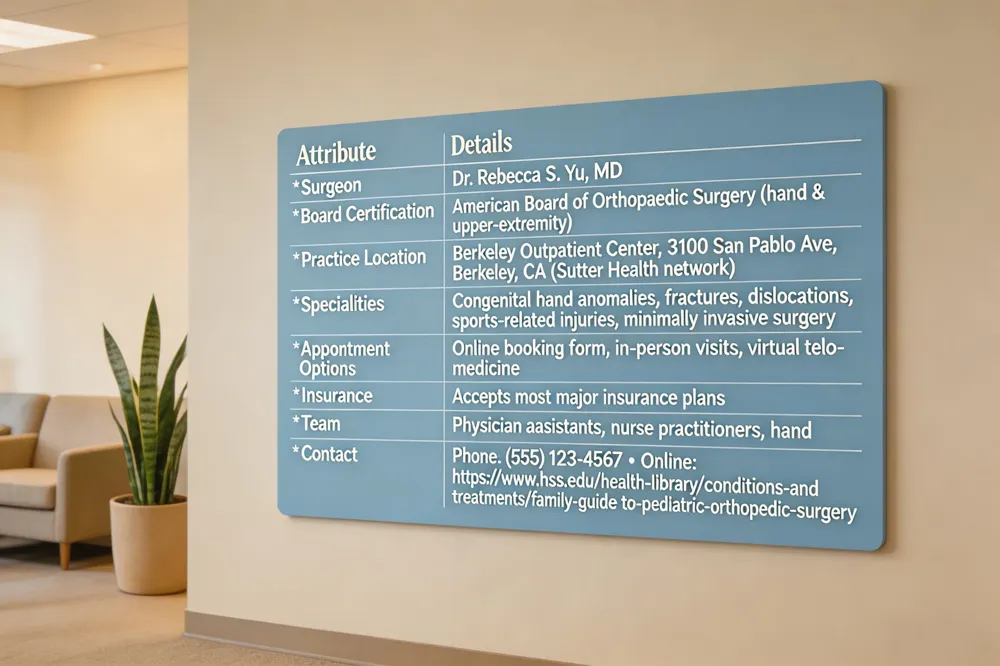
| Attribute | Details |
|---|---|
| Surgeon | Dr. Rebecca S. Yu, MD |
| Board Certification | American Board of Orthopaedic Surgery (hand & upper‑extremity) |
| Practice Location | Berkeley Outpatient Center, 3100 San Pablo Ave, Berkeley, CA (Sutter Health network) |
| Specialties | Congenital hand anomalies, fractures, dislocations, sports‑related injuries, minimally invasive surgery |
| Appointment Options | Online booking form, in‑person visits, virtual tele‑medicine |
| Insurance | Accepts most major insurance plans |
| Team | Physician assistants, nurse practitioners, hand therapists |
| Contact | Phone: (555) 123‑4567 • Online: https://www.hss.edu/health-library/conditions-and-treatments/family-guide-to-pediatric-orthopedic-surgery |
 Pediatric hand specialist near me
Dr. Rebecca S. Yu, MD, is a board‑certified orthopedic surgeon specializing in hand and upper extremity surgery for children and adults in Berkeley, California. She treats congenital hand anomalies, fractures, dislocations, and sports‑related injuries with both non‑operative and minimally invasive techniques. The practice offers an easy online appointment‑booking form and accepts most major insurance plans, making it convenient for families throughout the Bay Area.
Pediatric orthopedic Doctors near me
Dr. Rebecca S. Yu, MD, provides pediatric orthopedic care for hand, wrist, elbow, and other upper‑extremity conditions. Her clinic offers in‑person and virtual visits, treating fractures, traumatic injuries, and congenital hand deformities while emphasizing minimally invasive surgery when possible. An online booking system and dedicated patient‑service team streamline scheduling for Bay Area residents.
Best hand surgeon Bay Area
Recognized as a top hand surgeon in the Bay Area, Dr. Rebecca S. Yu, MD, completed a fellowship in hand surgery and is board‑certified by the American Board of Orthopaedic Surgery. She collaborates with hand therapists and utilizes state‑of‑the‑art facilities, delivering precise, compassionate care for pediatric and adult patients.
Orthopedic Berkeley
Practicing at the Berkeley Outpatient Center (3100 San Pablo Avenue) within the Sutter Health network, Dr. Rebecca S. Yu, MD, offers comprehensive trauma, sports‑injury, and congenital hand care. The multidisciplinary team includes physician assistants and nurse practitioners, and appointments can be booked online or by phone.
Best orthopedic surgeons Bay Area
Among the Bay Area’s leading orthopedic surgeons, Dr. Rebecca S. Yu, MD, stands out for her expertise in hand, wrist, elbow, and pediatric orthopedics. Her practice combines advanced surgical techniques with personalized rehabilitation plans, earning high patient satisfaction and accessibility.
Best orthopedic surgeons in East Bay
The East Bay benefits from board‑certified specialists such as Dr. Rebecca S. Yu, MD, who focuses on hand and upper extremity surgery, alongside surgeons like Dr. Michael Krosin, Dr. Steven Zourabian, and Dr. Virginia Lieu, who provide comprehensive orthopedic trauma and reconstruction services.
Common Hand and Wrist Conditions in Children
| Condition | Typical Presentation | First‑Line Treatment |
|---|---|---|
| Carpal Tunnel Syndrome | Numbness/tingling in thumb‑index‑middle‑ring fingers; weakness | Wrist splinting, activity modification → steroid injection → surgical release if refractory |
| Distal‑Radius Buckle (Torus) Fracture | Localized swelling, pain after fall; X‑ray shows cortical buckling | Brief immobilization with a splint or cast (usually 3‑4 weeks) |
| Green‑Stick Fracture (Distal Radius) | Incomplete fracture in growing bone; pain, tenderness | Immobilization; monitor for displacement |
| Ganglion Cyst / Fibroma | Hard, painless lump on hand/wrist; may be tender if inflamed | Observation; if painful or enlarging → ultrasound → aspiration or surgical excision |
| Unexplained Wrist Pain | Overuse, occult fracture, early arthritis; swelling, limited motion | Rest, ice, NSAIDs, repeat imaging; refer to orthopedic specialist if persistent |
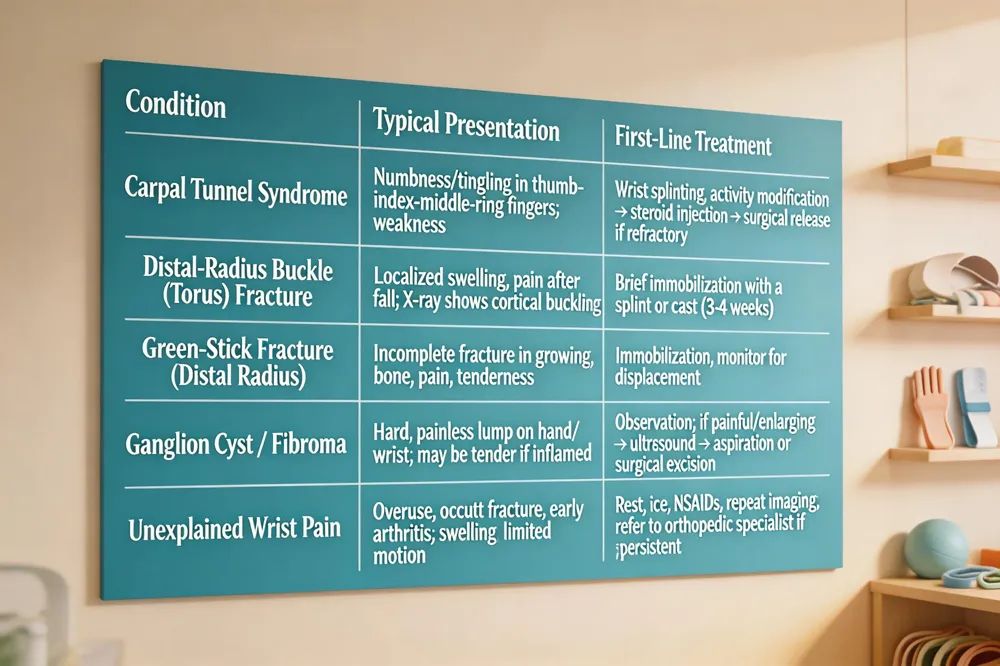 Carpal tunnel syndrome is the only condition that exclusively involves the hand and wrist. It occurs when the median nerve is compressed within the carpal tunnel, causing numbness, tingling and weakness in the thumb, index, middle and ring fingers. Treatment begins with wrist splinting and activity modification, progressing to steroid injections or surgical release if needed.
The most common wrist injury in children is a distal‑radius fracture, especially the buckle (torus) fracture that occurs when the growing bone buckles rather than breaks. These injuries account for 20 %–36 % of all pediatric fractures and heal quickly with brief immobilization.
Hand and wrist masses such as ganglion cysts or fibromas appear as hard lumps. A painless lump on a hand is often a benign cyst that may resolve on its own, but any painful, enlarging, or symptomatic mass warrants imaging (ultrasound or X‑ray) and possible aspiration or surgical excision.
Unexplained wrist pain in a child may stem from overuse, an occult fracture, or early inflammatory arthritis. A thorough history, repeat imaging and conservative care (rest, ice, NSAIDs) are initial steps; persistent pain requires prompt orthopedic evaluation to prevent long‑term dysfunction.
Injury Types and Immediate Care
| Injury Type | Key Features | Immediate Care (RICE +) |
|---|---|---|
| Buckle (Torus) Fracture | Bone buckles, no complete break; common in kids | Rest, ice, compression, elevation; splint/cast for 3‑4 weeks |
| Green‑Stick Fracture | Partial fracture through metaphysis; may displace | RICE; immobilize; follow‑up X‑ray to ensure no displacement |
| Displaced Distal‑Radius Fracture | Visible deformity, loss of alignment | RICE; urgent orthopedic reduction; possible surgical fixation |
| Scaphoid Fracture | Pain near thumb base; limited blood supply | RICE; immobilization for 6‑12 weeks or surgery if displaced |
| Salter‑Harris (Growth‑Plate) Fracture | Involves physis; risk of growth disturbance | RICE; orthopedic evaluation; accurate reduction; monitor growth |
| Sprain | Ligament stretch/tear; swelling, bruising | RICE; after 48 h, splint/brace; gentle ROM exercises; analgesics as needed |
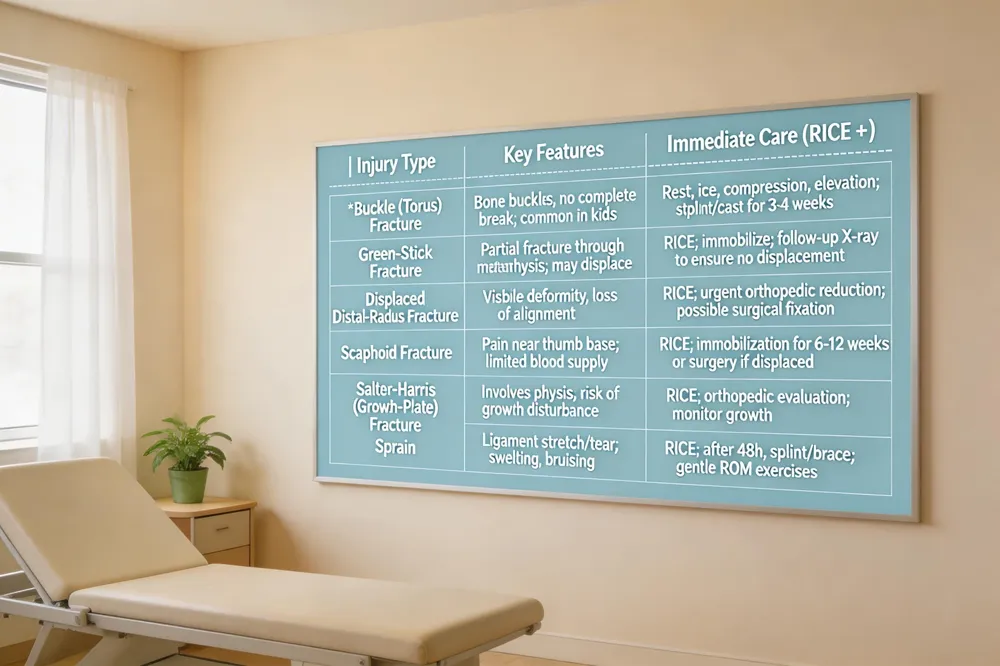 Pediatric wrist injuries most often involve the distal radius, which can present as a simple buckle (torus) fracture, a green‑stick fracture, or a displaced fracture that may require reduction. Less common scaphoid fractures near the thumb demand prolonged immobilization or surgery because of limited blood supply. Growth‑plate involvement is classified as Salter‑Harris fractures and must be monitored to avoid growth disturbance, while intra‑articular fractures need precise alignment.
When a child sprains a wrist, the RICE protocol is the first line of treatment: Rest the joint, apply Ice for 10‑20 minutes every few hours, use a Light elastic bandage for Compression, and keep the Wrist Elevated above heart level. After 48 hours, protect the wrist with a splint or brace and begin gentle range‑of‑motion exercises once pain subsides. Acetaminophen or ibuprofen can be given according to dosing guidelines, and a follow‑up visit should be scheduled to confirm the absence of fracture and to receive a personalized rehab plan. Seek medical care promptly if pain worsens, swelling persists, or numbness/tingling develops.
In toddlers, wrist injuries may appear as guarding behavior, crying on touch, swelling, or bruising. The child may be reluctant to bend, grasp, or use the wrist, and a visible deformity signals a possible fracture. Even without obvious swelling, pain on movement, tenderness, or an inability to move the wrist can indicate a buckle or green‑stick fracture, which are common in children’s softer bones. An X‑ray performed by a pediatric orthopedic specialist such as Dr. Rebecca S. Yu is essential to rule out a fracture and determine the need for a cast, splint, or brace.
A pediatric wrist brace is a breathable, adjustable device with Velcro straps and may include malleable stays or a thumb‑spica option for added stability. Proper sizing based on wrist circumference ensures effective immobilization for infants, toddlers, and older children. For any wrist pain or post‑operative support, consult Dr. Yu to select the appropriate brace and develop a safe recovery plan.
What to Expect During the Surgical Journey
| Phase | What Happens |
|---|---|
| Pre‑Admission Testing & Fasting | Weekday visit (8 am‑4 pm) with parent; bring immunization record & meds; liquids up to 3 h, breast milk 3 h, formula 6 h, solids 8 h before surgery |
| Hospital Admission | Same‑day or night before; parents stay until OR staff asks them to leave; family atrium waiting area; optional sleep‑over parent in sleeper chair |
| Intra‑operative Care | Anesthesia, surgery performed by board‑certified hand specialist; child‑life specialists present for emotional support |
| Post‑operative Monitoring | Recovery in PACU → Pediatric Unit (5 East); pain control, age‑appropriate activities, child‑life support |
| Recovery & Rehabilitation | Home same day; ice, elevation, analgesics 48‑72 h; hand/occupational therapy within 1 week; full school return 1‑2 weeks; sports 3‑6 months |
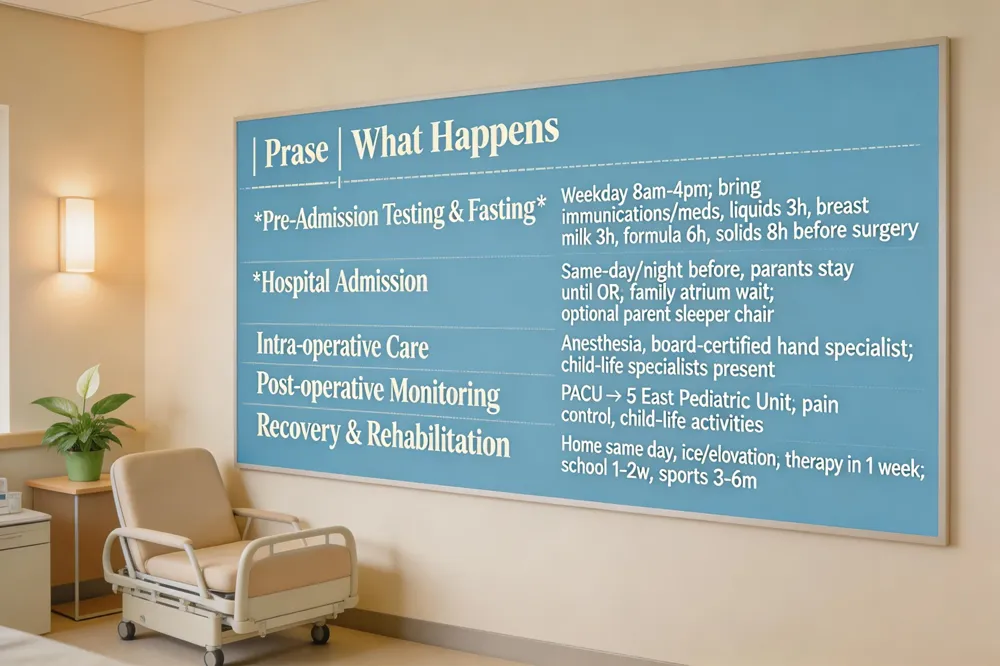 At a pediatric orthopedic appointment, the surgeon—often a board‑certified hand specialist Dr. Rebecca S. Yu—reviews the child’s medical history, asks about the injury or pain, and performs a focused physical exam. Imaging (X‑ray, MRI, ultrasound) may be ordered, and the team explains the diagnosis, non‑operative options (splinting, therapy) and, if needed, surgical plans.
Pre‑admission testing and fasting – HSS requires a weekday pre‑admission visit (8 am‑4 pm) with a parent, immunization record, and medication list. Fasting guidelines are clear: liquids up to 3 hours before, breast milk up to 3 hours, infant formula/non‑human milk up to 6 hours, and solid foods up to 8 hours.
Hospital admission and family presence – Children may be admitted the same day or the night before. Parents stay until the OR staff asks them to leave, then wait in the Family Atrium (TV, coffee, phone). A sleep‑over parent can use a sleeper chair beside the bed.
Post‑operative monitoring and child‑life support – After anesthesia, the child is observed in the PACU, then transferred to the Pediatric Unit (5 East) where nurses and child‑life specialists provide pain control, emotional reassurance, and age‑appropriate activities.
Recovery timeline and rehabilitation – Most kids go home the same day; ice, elevation, and analgesics are used for the first 48‑72 hours. Hand/occupational therapy begins within a week, progressing to strength and fine‑motor exercises. Full return to school is typical in 1‑2 weeks, with sports after 3‑6 months.
Do Shriners Hospitals for Children only treat children? Yes. Shriners Hospitals for Children are dedicated exclusively to pediatric patients, offering orthopedic, burn, spinal‑cord, and other specialty care only to children and adolescents.
Choosing Care and Understanding the Field
| Aspect | Details |
|---|---|
| Fellowship Competitiveness | Pediatric orthopedic fellowships: 30‑40 % match first‑choice; overall match 70‑80 %; 16‑20 candidates interviewed per program |
| Regional Specialist Options | Dr. Rebecca S. Yu (Berkeley, Oakland, East Bay) – hand & upper‑extremity surgery; Dr. Michael Krosin, Dr. Steven Zourabian, Dr. Virginia Lieu – broader orthopedic trauma & reconstruction |
| Patient‑Support Resources | Child‑life specialists at HSS & Children’s Healthcare of Atlanta; interactive waiting areas; age‑appropriate explanations |
| Access & Convenience | Online appointment booking; same‑day visits; multidisciplinary team (physician assistants, nurse practitioners, hand therapists) |
| FAQs for Parents | Competitive nature of fellowships; Hand surgeon in Oakland; Orthopedic surgeon in Oakland – all addressed by Dr. Yu’s practice |
 Competitive nature of pediatric orthopedic fellowships: Pediatric orthopedic surgery fellowships are among the most competitive orthopaedic subspecialties. In recent San Francisco matches, only 30‑40 % of applicants secured their first‑choice program and overall match rates are 70‑80 %. Programs interview 16‑20 candidates and expect strong academics, mentorship, and clinical skills.
Regional specialist options: Dr. Rebecca S. Yu, MD, a board‑certified orthopedic surgeon specializing in hand and upper‑extremity surgery, serves children and adults from Berkeley, Oakland, and the wider East Bay. Her practice offers minimally invasive, microsurgical techniques for congenital hand differences, fractures, tendon injuries, and growth‑plate disorders. Online appointment booking and same‑day visits make access easy for families across the region.
Child‑life resources and support: Hospital for Special Surgery (HSS) and Children’s Healthcare of Atlanta provide child‑life specialists, interactive waiting areas, and age‑appropriate explanations to reduce anxiety before hand surgery. Parents are encouraged to use honest, age‑appropriate language and address common questions about the procedure and recovery.
FAQs for parents:
- How competitive is pediatric orthopedic surgery? Pediatric orthopedic surgery fellowships are highly competitive, with roughly 30‑40 % of candidates matching their top choice and overall match rates of 70‑80 %.
- Hand Surgeon Oakland: Dr. Rebecca S. Yu treats Oakland patients with a full range of hand and wrist conditions using advanced techniques.
- Orthopedic surgeon Oakland: Dr. Yu also offers comprehensive orthopedic care for wrist fractures, carpal tunnel, and tendon injuries to Oakland residents.
Final Takeaways for Parents
Key points: pediatric hand surgery protects growth plates, early referral improves outcomes, and a multidisciplinary team (surgeon, therapist, child‑life staff) guides recovery. Next steps: arrange pre‑admission testing at HSS or local center, bring immunizations and medication list, fast according to guidelines, and schedule the first appointment online or by phone with Dr. Yu’s office. Resources: HSS Family Atrium, child‑life specialists, occupational therapy, case‑manager support, and online portals for insurance verification and follow‑up. Confirm transportation and sibling accommodations early today.