Why Multidisciplinary Care Matters
The upper extremity – hand, wrist, forearm, elbow and shoulder – contains 29 bones, 29 joints, 123 ligaments and 34 muscles that work together to provide both strength and fine motor control. Because injuries or disease can involve bone, tendon, nerve or vascular structures, a patient‑centered approach that integrates orthopedic surgeons, hand therapists, radiologists, pain specialists and occupational therapists is essential. Multidisciplinary teams begin with coordinated imaging and shared decision‑making, allowing the patient to understand all nonsurgical and surgical options before a personalized plan is chosen. This collaboration shortens the time from diagnosis to treatment, reduces unnecessary procedures, and aligns postoperative rehabilitation with the exact surgical repair. Evidence from programs such as Broward Health, the University of Florida, and Dr. Rebecca S. Yu’s practice shows lower complication rates, faster return to work or sport, and higher satisfaction scores when care is delivered through a unified team rather than isolated providers. Patient education resources, pre‑operative classes, and tele‑rehabilitation follow‑ups keep patients engaged, reinforce therapy goals, and enable early identification of complications, further enhancing outcomes. Overall, this model reflects modern evidence‑based orthopedic practice.
Anatomy and Common Upper Extremity Conditions
 The term “upper extremity” refers to the entire limb extending from the shoulder to the fingertips. It is commonly divided into four major anatomical regions. First, the upper arm (brachium) runs from the shoulder joint down to the elbow. Second, the forearm extends from the elbow to the wrist. Third, the wrist (carpus) connects the forearm to the hand. Finally, the hand (manus) comprises the palm, fingers, and thumb. These four sections together enable the wide range of movements and functions of the upper limb.
An example of an upper‑extremity structure is the forearm, which lies between the elbow and the wrist. It contains two long bones—the radius on the thumb side and the ulna on the little‑finger side—that allow pronation and supination of the hand. The forearm houses major nerves, blood vessels, and muscles; injuries such as fractures, tendon repairs, or nerve compressions often require specialist orthopedic care. Dr. Rebecca S. Yu, a board‑certified hand surgeon, routinely treats forearm conditions within a multidisciplinary team that includes hand therapists and radiologists.
Hand surgery for arthritis generally yields excellent outcomes. Clinical studies report that 90‑96 % of patients achieve significant pain relief and functional improvement after procedures such as joint replacement, fusion, or resurfacing. Success rates are highest (≈95‑96 %) when the operation is performed by a board‑certified hand surgeon like Dr. Yu and when patients adhere to structured postoperative rehabilitation. Even more complex surgeries such as synovectomy or tendon transfer report success in the 85‑90 % range, with most patients regaining useful hand function. Overall, patients can expect a very high likelihood of a positive result, often exceeding 90 % when proper surgical technique and after‑care are followed.
Complex Surgeries and Success Rates
 The most demanding procedures in hand and upper‑extremity care are those that combine intricate microsurgical reconstruction with extensive postoperative rehabilitation. Among these, hand and arm transplantation stands out as the most difficult hand surgery. The operation requires more than 12 hours of microsurgical work to fixate bone, reconnect arteries, veins, tendons, and multiple nerves, and then manage lifelong immunosuppression and intensive therapy. Success hinges on seamless coordination among orthopedic, vascular, and plastic surgeons, as well as rigorous pre‑operative screening and vigilant post‑operative monitoring for rejection. While complex tendon repairs and nerve transfers are technically challenging, the scale, complexity, and need for nerve regeneration in a transplant make it the pinnacle of surgical difficulty, even for board‑certified specialists such as Dr. Rebecca S. Yu. Evidence from multidisciplinary hand centers (e.g., Broward Health, UT Southwestern, and HCA Healthcare) shows that coordinated care—integrating surgeons, hand therapists, radiologists, and pain‑management experts—results in lower complication rates, faster functional recovery, and higher patient‑satisfaction scores. Published outcome data indicate that multidisciplinary teams achieve higher success percentages for both conventional hand surgeries and advanced procedures like microsurgical reconstruction, underscoring the value of a collaborative, evidence‑based approach.
Principles of Orthopedic Care and Spinal Expertise
 What are the 4 A's of orthopedics?
The four A’s are Alignment, Articulation, Ambulation, and Activity. Alignment restores proper bone‑and‑joint positioning for stability; Articulation ensures smooth, pain‑free joint movement; Ambulation enables safe walking or limb use after injury or surgery; and Activity returns the patient to daily tasks, sports, and functional use, completing the recovery cycle.
Can an orthopedic surgeon help with scoliosis?
Yes. Orthopedic spine specialists diagnose and treat scoliosis in children and adults. Non‑surgical options include custom braces for growing adolescents, physical‑therapy programs, and pain‑relieving injections for mature spines. When curvature progresses or causes pain or functional limitation, surgical correction—such as spinal fusion or vertebral‑modulation—is recommended. Treatment is tailored to age, scoliosis type (idiopathic, congenital, neuromuscular), and overall health, providing comprehensive, evidence‑based care from start to finish.
How can a patient tell if an orthopedic surgeon is good?
A good surgeon is board‑certified, fellowship‑trained in the relevant subspecialty, e.g., hand and upper‑extremity surgery. Look for referrals from trusted providers, membership in professional societies (AAHS, AAHKS), and positive patient testimonials. Published outcomes and research signal commitment to evidence‑based practice. During the initial visit, clear communication, attentive listening, and shared decision‑making indicate a collaborative style that promotes higher satisfaction and better recovery. Affiliation with a reputable hospital or surgical center with low complication rates adds an extra layer of confidence.
Sports Medicine Legends and Expert Surgeons
 Who is Tom Brady's orthopedic surgeon?
Tom Brady’s orthopedic surgeon is Dr. Neal ElAttrache, a renowned sports‑medicine specialist practicing at the Cedars‑Sinai Kerlan‑Jobe Orthopaedic Clinic in Los Angeles, California. Dr. ElAttrache completed his medical training at the University of Pittsburgh and a fellowship with legendary surgeons Robert Kerlan and Frank Jobe. He is the team physician for the Los Angeles Rams and is widely recognized for treating high‑profile athletes with musculoskeletal injuries.
Who was Kobe Bryant's surgeon?
Kobe Bryant’s Achilles‑tendon repair was also performed by Dr. Neal ElAttrache, who at the time served in the Department of Orthopaedic Surgery at UCLA Health. The surgery took place at UCLA Ronald Reagan Medical Center shortly after Bryant’s injury in January 2013, and Dr. ElAttrache expressed confidence in a full recovery for the NBA star.
Hand specialist expertise
Board‑certified hand surgeons such as Dr. Rebecca S. Yu in Berkeley, CA, and the multidisciplinary teams at Broward Health (Fort Lauderdale, FL) illustrate the depth of expertise available for hand and upper‑extremity care. These specialists combine orthopedic surgery, plastic surgery, and certified hand therapy to treat conditions ranging from carpal tunnel syndrome and Dupuytren’s disease to complex tendon reconstruction. Integrated rehabilitation programs, advanced imaging, and evidence‑based surgical techniques ensure optimal functional outcomes for both athletes and everyday patients.
Choosing the Right Specialist and Compensation Landscape
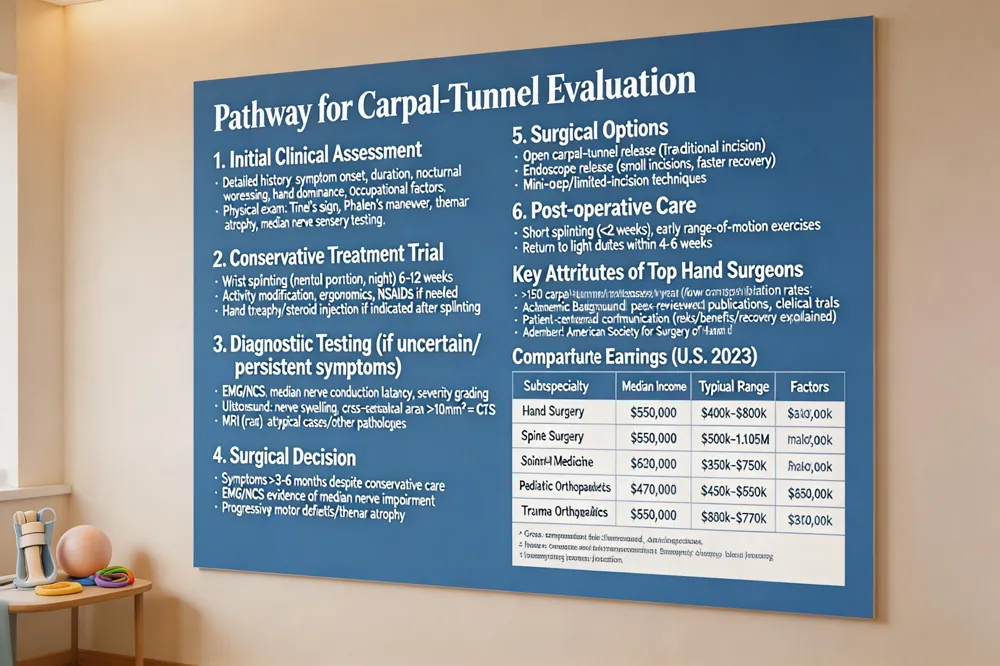 Carpal tunnel evaluation begins with a primary‑care visit for symptom review, splint trial, and possibly corticosteroid injection. Persistent numbness or weakness warrants referral to a hand‑focused orthopedic surgeon—ideally a board‑certified specialist such as Dr. Rebecca S. Yu—who can order nerve‑conduction studies, high‑resolution ultrasound, and discuss surgical release options if needed.
Top orthopedic surgeons share key attributes: fellowship training in hand or related subspecialties, board certification, a multidisciplinary team that includes certified hand therapists, pain specialists, and radiologists, and a record of evidence‑based outcomes. They leverage minimally invasive techniques, intra‑operative imaging, and coordinated postoperative rehabilitation to restore function quickly.
Earnings vary widely across subspecialties. Spine surgeons lead with average annual compensation exceeding $800,000, followed by joint‑replacement surgeons at $600,000–$700,000. Sports‑medicine and trauma orthopedists typically earn $500,000–$600,000. Hand and upper‑extremity surgeons—while earning less than the highest‑paid peers—still command $350,000–$450,000, reflecting their specialized skill set and demand for coordinated care.
What is the best doctor to see for carpal tunnel syndrome?
For mild or newly‑onset symptoms, start with your primary‑care physician, who can perform an initial evaluation and try non‑surgical measures such as splinting, medication, or steroid injections. If the pain, numbness, or weakness persists despite these first‑line treatments, you should be referred to a hand‑and‑hand‑extremity specialist. A board‑certified orthopedic hand surgeon—especially one like Dr. Rebecca S. Yu, MD, who focuses on carpal‑tunnel release—can conduct advanced diagnostics (e.g., nerve‑conduction studies, ultrasound) and discuss both non‑surgical and surgical options. When surgery is indicated, an orthopedic hand surgeon has the expertise to perform a minimally invasive release that reliably relieves median‑nerve compression. Therefore, the best doctor to see for carpal‑tunnel syndrome is a hand‑specialized orthopedic surgeon after an initial PCP assessment.
What is the highest paid type of orthopedic surgeon?
Among orthopedic subspecialties, spine surgeons command the highest average compensation, often exceeding $800,000 per year. Joint‑replacement (arthroplasty) surgeons rank second, with typical earnings in the $600,000 to $700,000 range. Sports‑medicine orthopaedists and trauma surgeons follow, generally earning $500,000 to $600,000 annually. Hand and upper‑extremity surgeons, such as Dr. Rebecca S. Yu, typically have lower but still substantial incomes, often between $350,000 and $450,000. These figures can vary based on geographic location, practice setting, and years of experience.
Moving Forward with Integrated Care
Patient empowerment lies at the heart of modern hand and upper‑extremity care. By providing clear explanations, shared‑decision‑making tools, and accessible digital portals, clinicians enable individuals to understand diagnoses, weigh surgical versus nonsurgical options, and actively participate in rehabilitation plans. Empowered patients are more likely to adhere to therapy regimens, attend follow‑up appointments, and report higher satisfaction scores. Looking ahead, multidisciplinary teams will become even more integrated through telemedicine, real‑time imaging sharing, and AI‑driven outcome dashboards. Surgeons, hand therapists, pain specialists, radiologists, and pediatric experts will collaborate virtually, reducing delays between diagnosis, surgery, and postoperative care. Emerging models such as same‑day diagnostic‑treatment hubs and bundled‑payment pathways will streamline coordination, lower costs, and improve functional recovery. As technology bridges geographic gaps, patients across the United States will benefit from coordinated expertise without multiple office visits, ushering in a new era of efficient, patient‑centered upper‑extremity treatment. These advancements promise hands and brighter futures.