Why Early Detection Matters
Hand injuries can disrupt a child’s growth, fine‑motor skills, and confidence in school and play. An untreated fracture or tendon damage may alter bone development, cause permanent loss of motion, and limit sports or musical activities. Prompt evaluation by a pediatric hand surgeon provides accurate imaging, early immobilization or surgery, and a rehabilitation plan that shortens recovery and protects the growth plate. Most injuries stem from falls onto a hand, playground collisions, or repetitive strain from gymnastics, football, or playing an instrument. Recognizing these patterns quickly ensures the child receives the care needed to heal safely and resume normal development.
Recognizing Early Signs of Pediatric Hand Injuries
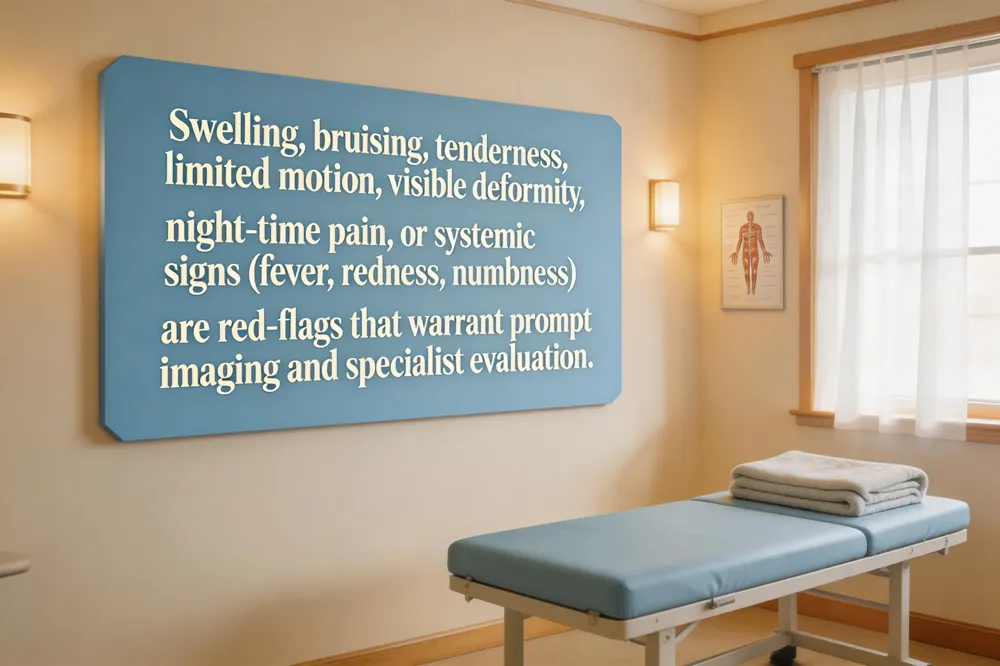 Swelling, bruising, and tenderness are often the first clues that a child's hand has been injured. If the swelling does not improve within 1–2 days, or if the child resists touching the area, an underlying fracture or soft‑tissue damage should be suspected. Limited range of motion or painful gripping—especially an inability to bend or straighten a finger or wrist—signals a more serious problem such as a fracture, tendon injury, or severe sprain. Visible deformity, a crooked finger, or a lump on the hand or wrist is a red‑flag that warrants immediate imaging and specialist evaluation. Night‑time hand pain in toddlers may stem from a minor sprain, over‑use, or growth‑plate irritation, but persistent pain that wakes the child or is accompanied by swelling, warmth, or fever should prompt a pediatric hand‑surgeon visit. Systemic red‑flag signs include fever, redness spreading from a wound, numbness or tingling, pale or cool skin, and any sign of infection; these require urgent medical care.
How do you tell if a child's hand is broken or sprained? Pain that worsens with activity or when the child tries to grasp objects is a red flag for underlying tendon or ligament injury. A fracture produces sharp, localized pain that worsens with any movement, often leaves the hand crooked or misaligned, and may be heard as a "crack" at injury. A sprain causes diffuse pain, swelling, and a "pop" sound but usually still allows some motion. Inability to bend or straighten fingers, grip objects, or bear weight points toward a fracture; limited motion with discomfort suggests a sprain. Prompt X‑ray evaluation by a hand specialist is essential.
Toddler hand pain at night can be from a minor sprain or over‑use, but if the pain persists, awakens the child, or is accompanied by swelling, redness, or fever, seek professional evaluation to rule out fracture, infection, or juvenile arthritis.
Hand, foot and mouth disease is a viral illness with mouth blisters and a non‑itchy rash on hands and feet; it is self‑limited and does not require orthopedic treatment—postpone non‑urgent hand appointments until recovery.
Child complains of pain in hands – consider fracture, sprain, infection, over‑use, or juvenile arthritis; early assessment with imaging if needed prevents long‑term deficits.
Kawasaki disease presents with fever, conjunctivitis, oral changes, and marked swelling of palms and soles. It is a medical emergency, not an orthopedic issue; urgent evaluation and IV immunoglobulin are needed to prevent coronary complications.
When to Seek Specialist Care
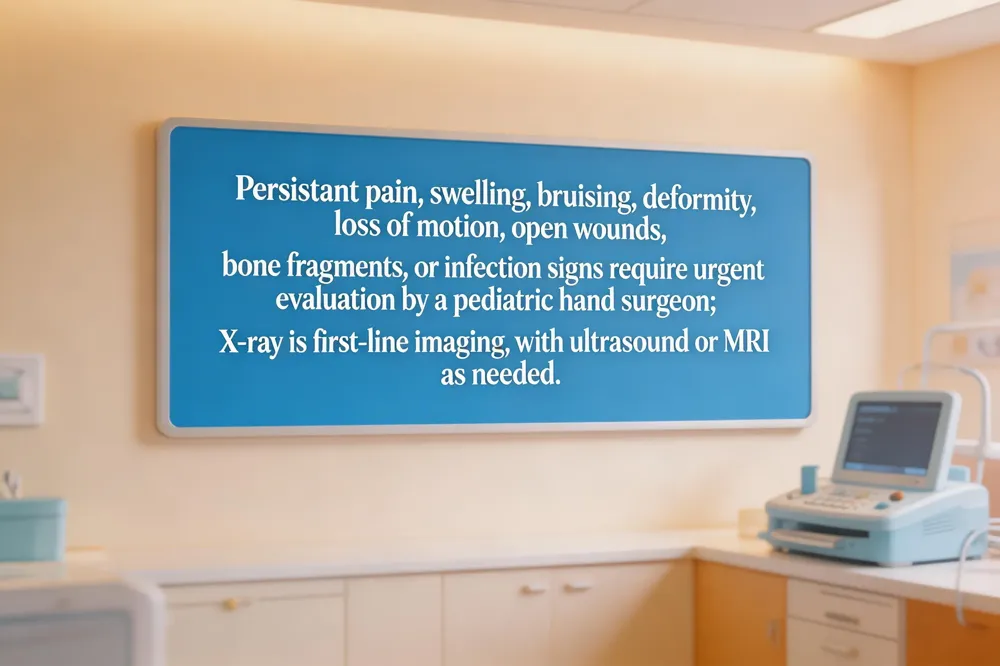 Red‑flag symptoms that need urgent evaluation – Persistent pain, swelling, bruising or a visible deformity that does not improve after 2 days; loss of finger or wrist motion; a crooked, lump or bump on the hand; numbness, tingling, or color change; open wounds, bone fragments, or a popping sound at injury (https://emersonhealth.org/from-playground-to-practice-four-ways-to-tell-if-your-childs-hand-injury-needs-more-than-ice/); and any sign of infection (redness, warmth, fever). These findings can indicate a fracture, growth‑plate injury, tendon or nerve damage and require prompt specialist assessment.
Imaging options – An X‑ray is the first‑line study for suspected fractures and growth‑plate injuries. Ultrasound can detect tendon tears or fluid collections when X‑ray is equivocal, and MRI is reserved for complex soft‑tissue or occult bone injuries.
Role of hand‑and‑upper‑extremity orthopedic surgeons – Board‑certified surgeons evaluate X‑ray/ultrasound findings, decide on splinting, casting, or surgery, and coordinate hand‑therapy to preserve growth and function.
Local specialist options – In Berkeley, Dr. Rebecca S. Yu, MD offers pediatric hand and upper‑extremity care with same‑day imaging. Nearby Oakland patients can access Dr. Andrew Stein, Dr. Orrin Franko, and Dr. Jesse Dashe at East Bay Hand & Upper Extremity Surgery, or Sutter Health’s hand team for prompt evaluation.
FAQs
- Types of hand fractures with pictures: Metacarpal “boxer’s,” phalangeal, scaphoid, hamate, and avulsion fractures are illustrated on Dr. Yu’s website with labeled X‑rays.
- Baby swollen hands allergic reaction: Red, itchy swelling with hives; treat with antihistamines or epinephrine if severe.
- Broken hand symptoms child: Severe pain, swelling, bruising, crooked finger, reluctance to grip, possible numbness or popping sound; needs X‑ray and orthopedic care.
- Can you break a bone in your hand and still move it?: Yes, non‑displaced fractures may allow limited motion but still require orthopedic evaluation.
- Hand Surgeon Oakland: Dr. Andrew Stein, Dr. Orrin Franko, Dr. Jesse Dashe, and Dr. Rebecca S. Yu, MD (Berkeley) provide board‑certified pediatric hand surgery across the East Bay; see also the Yelp directory for Berkeley hand surgeons.
Common Pediatric Hand Injuries and Their Management
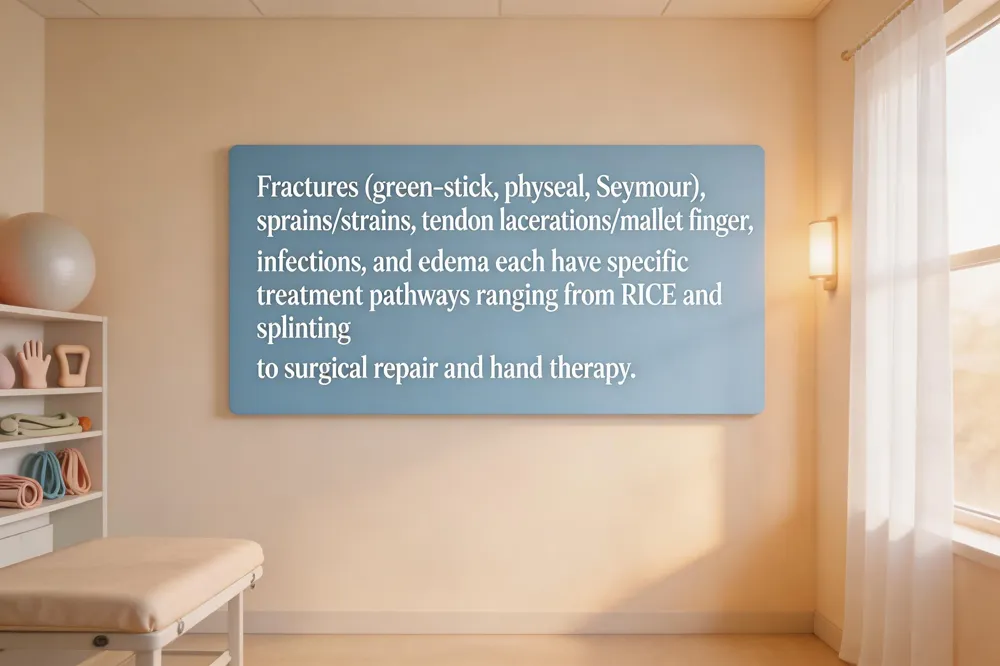 Children’s hands are vulnerable to a range of injuries that often first appear as swelling, bruising, or limited motion. Fractures are common; many are green‑stick due to flexible pediatric bone, while growth‑plate (physeal) injuries and Seymour fractures (open distal‑phalanx fractures with nail‑bed involvement) require prompt X‑ray and specialist care. Sprains and strains of ligaments and tendons cause pain, swelling, and reduced range of motion but usually heal with rest, ice, compression, elevation, and a functional splint. Tendon lacerations and mallet finger present with loss of active motion while passive motion remains intact; early splinting or microsurgical repair is essential. Infections such as paronychia and cellulitis produce redness, warmth, and possible pus; they need cleaning, warm soaks, and antibiotics when indicated. Hand edema is managed by elevation, gentle compression, intermittent ice, and treating the underlying cause; severe or rapidly worsening swelling warrants urgent evaluation.
Orthopedic surgeon Berkeley: Dr. Rebecca S. Yu, MD, is a board‑certified hand surgeon in Berkeley who treats pediatric trauma and elective hand disorders.
Best orthopedic surgeons Bay Area: Dr. Yu, Dr. Warren J. Strudwick, Jr., Dr. Michael L. Green, and Dr. James R. Smith are among the top‑rated specialists.
Red‑flag signs: severe bruising, inability to move fingers or wrist, deformity, new lumps, numbness, tingling, or loss of sensation.
Most difficult hand surgery: complex tendon repair with microsurgical grafts is considered the most challenging due to delicate anatomy and need for precise tensioning.
Special Considerations and Systemic Illnesses
 Kawasaki disease can present a painful swelling of the hands and feet, often with erythema and desquamation of the fingertips; early recognition prompts referral to a pediatric hand surgeon to rule out vasculitic injury. Allergic reactions—especially to insect stings, foods, or medications—may produce rapid hand swelling, urticaria, and pruritus; if swelling compromises circulation, urgent evaluation by an emergency physician and possibly a hand specialist is indicated. The Ten Test (TT) is a quick, equipment‑free sensory assessment that compares tactile discrimination between the injured hand and the opposite, uninjured hand; the patient identifies a series of ten lines or textures, and a discrepancy signals nerve involvement. Injuries from an outstretched‑hand fall most commonly include scaphoid fracture, wrist sprain, distal radial fracture, forearm (radius/ulna) fractures, and elbow or shoulder dislocation.
Orthopedic surgeon Orinda – Residents of Orinda can access board‑certified hand care through Dr. Rebecca S. Yu in Berkeley, who accepts most insurers and can be booked online or via the Sutter Health line (510‑204‑1844).
Ten Test for hand injury – The TT evaluates tactile threshold by having the patient differentiate ten lines or textures on the injured versus the healthy hand, providing a rapid screen for sensory loss.
Most common injury from a fall on an outstretched hand – The typical pattern includes scaphoid fracture, wrist sprain, distal radial fracture, forearm fractures, or elbow/shoulder dislocation.
Prevention, Home Care, and Follow‑Up
 Protective gear such as gloves, wrist guards, and shoulder pads should be worn for sports (football, gymnastics, skateboarding) and on playgrounds to lessen crush or impact injuries. After a minor hand bump, apply ice (15‑20 minutes, wrapped in a cloth) every hour for the first 24‑48 hours, keep the hand elevated above heart level, and use a loose compression bandage only if swelling is significant. For suspected sprains or uncomplicated fractures, a soft splint or buddy‑taping is appropriate; displaced fractures, growth‑plate injuries, or tendon ruptures require a rigid cast and orthopedic evaluation. Once immobilization ends, hand therapy—gentle range‑of‑motion exercises, grip strengthening, and fine‑motor drills—helps restore function and prevents stiffness. Schedule a follow‑up with a pediatric hand surgeon within 1‑2 weeks of injury, sooner if pain worsens, swelling persists, or the child cannot move the fingers, to ensure proper healing and timely referral for therapy or surgery if needed.
Take Action Early—Protect Your Child’s Hands
Watch the injured hand closely for swelling, bruising, persistent pain, or any loss of motion that doesn’t improve after 48‑72 hours. Use a red‑flag checklist: visible deformity, a crooked finger or lump, numbness/tingling, open wounds, or a finger that can’t be straightened. If any of these appear, arrange prompt evaluation by a pediatric hand specialist—Berkeley families can see Dr. Rebecca S. Yu or Dr. Lamont J. Cardon at local centers such as UCSF Benioff Children’s Hospital or Alto Bates Summit Medical Center. While awaiting care, follow home‑care steps: ice the hand for 15‑20 minutes every hour, keep it elevated, protect it with a soft splint or buddy‑tap, and limit activities that cause pain. Early intervention helps prevent growth‑plate injury, stiffness, or long‑term functional loss.