Why Early Detection Matters
Early detection of pediatric hand fractures is essential because children’s bones remodel and heal through a thick periosteum and active growth plates. Prompt diagnosis allows the fracture to be realigned before the physis is displaced, preserving normal growth and preventing angular deformities that cannot remodel later. Missed or delayed treatment can lead to growth‑plate arrest, malunion, joint stiffness, chronic pain, and osteoarthritis, especially when intra‑articular surfaces or rotational alignment are involved. Pediatric hand specialists—orthopedic surgeons with subspecialty training in children’s musculoskeletal anatomy—are skilled at interpreting subtle radiographic signs, performing closed reductions, and deciding when surgical fixation is necessary to protect the growth plate and ensure optimal functional recovery. Their expertise also includes coordinating follow‑up imaging and rehabilitation to monitor healing.
Key Clinical Signs and Red‑Flag Symptoms
| Sign | Typical Presentation | When to Seek Urgent Care |
|---|---|---|
| Pain & tenderness worsening with touch/movement | Persistent sharp pain, limp hand, refusal to grip | Persistent pain > 24 h or worsening |
| Swelling, bruising, discoloration | Rapid onset swelling, bluish/black skin | If swelling spreads rapidly |
| Visible deformity or abnormal alignment | Crooked finger, bent wrist, angulated bone | Any obvious deformity |
| Neurovascular compromise | Pale, cool fingers, numbness, tingling, loss of motion | Immediate evaluation |
| Open wound/compound fracture | Bone protruding through skin, bleeding | Urgent ED visit |
| Loss of finger movement | Inability to flex/extend finger | Urgent evaluation |
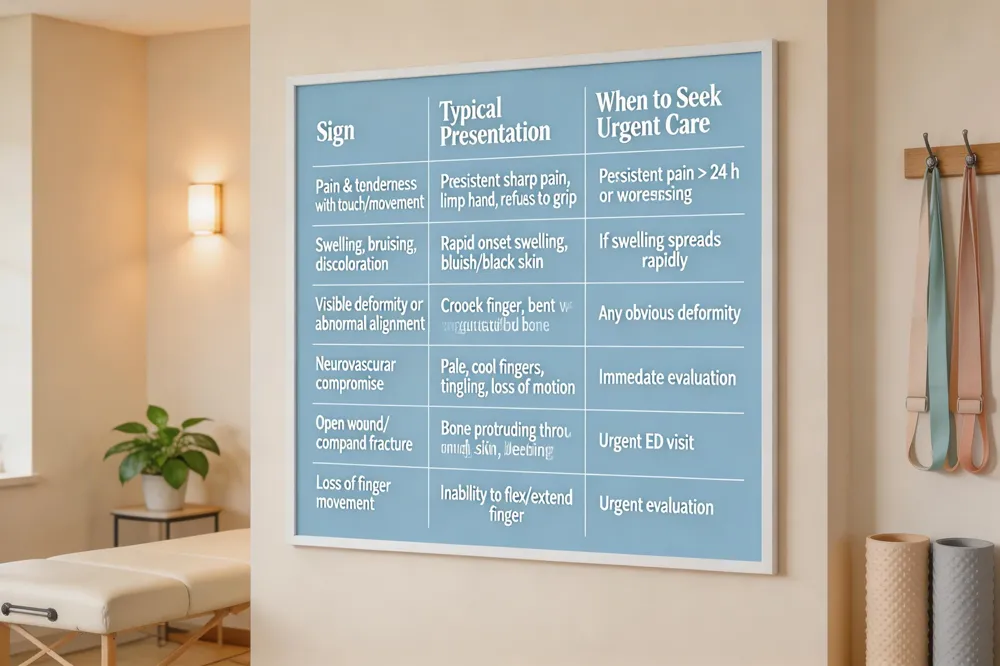 Pain and tenderness that worsens with touch or movement is the most common clue of a pediatric hand fracture; children often keep the injured hand limp or refuse to grip. Swelling, bruising and skin discoloration appear quickly, and a visible deformity or abnormal alignment (e.g., a crooked finger or bent wrist) signals a displaced break. Neurovascular compromise—pale, cool fingers, numbness, tingling or loss of motion—requires urgent evaluation, as does any open wound where bone pierces the skin (compound fracture).
Answers to common questions
- Signs of broken arm in child (NHS) – Sudden severe pain, Swelling, bruising, visible deformity, numbness, or an exposed bone; call NHS 111 or go to A&E.
- Signs of broken forearm in child – Immediate sharp pain, swelling, bruising, abnormal angle of the arm, difficulty moving the wrist/hand, or tingling.
- Broken hand symptoms child – Persistent sharp pain, swelling, bruising, crooked finger, inability to bend/straighten, or numbness.
- Red‑flag signs for pediatric fracture – Severe pain, obvious deformity, compromised blood flow, open wound, uncontrolled bleeding, or inability to move the limb.
- Child complains of pain in hands – Use rest, ice, elevation, and OTC analgesics; seek care if pain persists, worsens, or is accompanied by swelling, redness, fever, numbness, or deformity.
- How to know if my child's hand is broken – Look for persistent pain, swelling, bruising, deformity, or loss of motion; confirm with X‑ray or MRI.
- How to know if my child's hand is sprained – Pain, swelling, bruising, tender ligaments, and difficulty gripping; evaluate if pain/ swelling persist.
- Child hand swollen after fall – Apply RICE; seek orthopedic review promptly if pain resolves severe, worsens, or if there is numbness, deformity, or discoloration.
- How long should a hand hurt after a fall? – Most mild injuries improve in 7‑10 days; pain beyond a week warrants evaluation.
- Common hand injuries from falling – Sprains, strains, fractures (buckle, greenstick, displaced), dislocations, bruising, and soft‑tissue contusions.
Common Fracture Types and Typical Patterns
| Fracture Type | Typical Age | Common Location | Key Features | Initial Management |
|---|---|---|---|---|
| Buckle (torus) | 5‑12 yr | Distal radius | Cortex compressed, no displacement | Soft cast or splint 3‑4 wk |
| Greenstick | <10 yr | Forearm, phalanges | One side bent, other intact | Cast or splint 3‑4 wk |
| Salter‑Harris II | 8‑14 yr | Proximal phalanx, growth plate | Fracture through physis & metaphysis | Reduction if displaced, then cast |
| Boxer’s fracture (5th metacarpal neck) | 7‑15 yr | 5th metacarpal | Dorsal angulation, “boxer” deformity | Closed reduction ± pinning, cast |
| Seymour fracture | 4‑12 yr | Distal phalanx nail bed | Open physeal fracture, nail involvement | Irrigation, debridement, K‑wire |
| Mallet finger (Salter‑Harris III/IV) | 6‑13 yr | DIP joint | Extensor tendon avulsion | Extension splint 6‑8 wk or pinning if displaced |
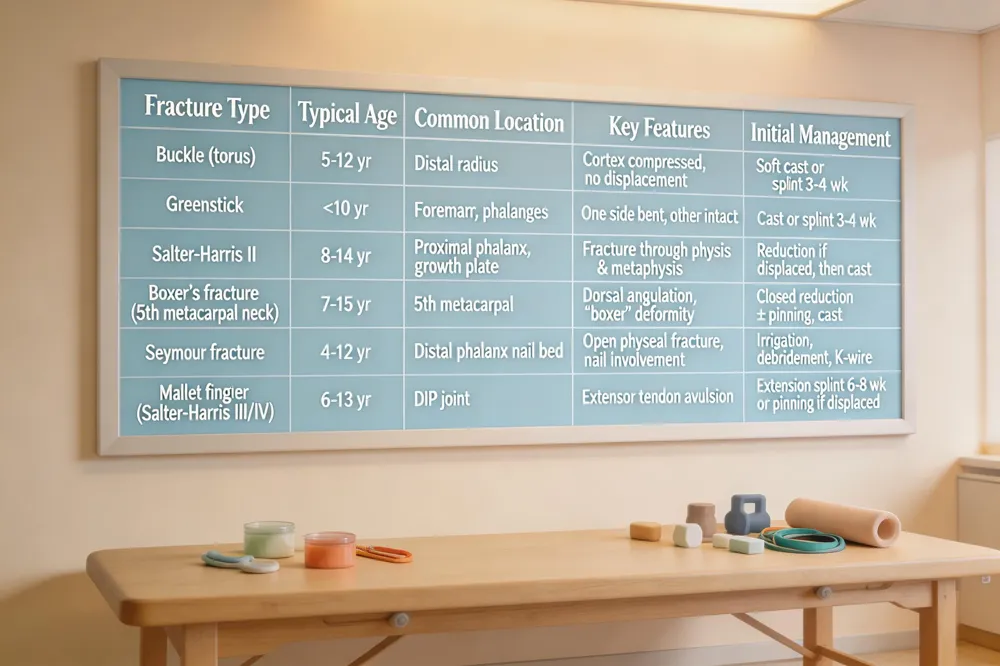 Pediatric hand fractures are a frequent cause of emergency visits, accounting for roughly 10 % of all child fractures. The most common patterns are buckle (torus) fractures of the distal radius, greenstick fractures of the forearm and phalanges, and Salter‑Harris growth‑plate injuries that threaten future bone development. Greenstick fractures, seen especially in children under ten, occur when a pliable bone bends and cracks on one side while the opposite side remains intact; they heal quickly with a cast or splint. Buckle fractures compress the cortex without breaking and also require brief immobilization.
Phalangeal fractures dominate hand injuries, often Salter‑Harris II involving the proximal phalanx. Nondisplaced injuries are managed with splinting or buddy taping, while displaced fractures need closed reduction and sometimes percutaneous pinning. Metacarpal fractures, especially the “boxer’s fracture](https://www.childrenshospital.org/conditions-treatments/broken-hand)” of the fifth metacarpal neck, follow similar principles: stable fractures are cast‑treated, unstable or rotated fractures merit reduction and pinning. Thumb fractures may be extra‑articular, Bennett, or Rolando; displaced intra‑articular fractures usually require surgical fixation to preserve joint function.
Special injury injuries include Seymour fractures—open distal phalanx physeal fractures with nail‑bed involvement—that demand urgent irrigation, debridement, and percutaneous pinning to avoid infection and growth arrest. Mallet finger injuries, often Salter‑Harris III/IV, are treated with extension splinting when the fragment is small, but larger or rotated fragments need pinning. Early recognition, appropriate imaging, and timely immobilization or surgery ensure excellent functional outcomes for most pediatric hand fractures.
Diagnosis, Imaging and When to Seek Care
| Clinical Scenario | Recommended Imaging | Red‑Flag Indicators |
|---|---|---|
| Suspected fracture (pain, swelling) | X‑ray AP + lateral (orthogonal) | Open wound, deformity, neurovascular compromise |
| Negative X‑ray but high suspicion | Ultrasound or MRI | Persistent pain > 48 h, growth‑plate involvement |
| Finger injury with possible nail bed involvement | Dedicated finger films ± X‑ray of nail bed | Open wound, nail avulsion |
| Wrist pain after FOOSH | Wrist AP, lateral, oblique | Swelling, deformity, loss of motion |
| Baby hand injury (non‑verbal) | Low‑dose X‑ray, possibly ultrasound | Inability to move hand, severe swelling |
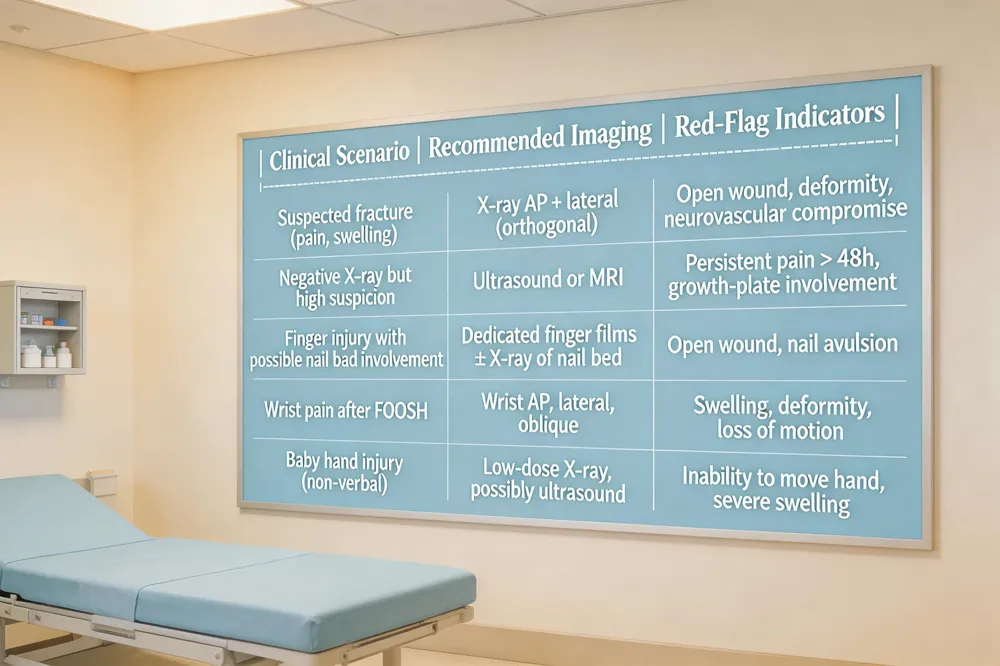 A prompt initial assessment begins with a focused history—ask about falls, sports, or repetitive use—and a physical exam checking for point tenderness, swelling, bruising, deformity, and neurovascular status. For children, plain radiographs in at least two orthogonal views (AP and lateral) are the first‑line imaging; oblique views or dedicated finger films help detect subtle phalangeal fractures. When X‑rays are negative but suspicion remains high, ultrasound or MRI can reveal occult fractures, especially scaphoid or growth‑plate injuries.
Red‑flag scenarios include open wounds, obvious deformity, loss of finger movement, neurovascular compromise, or a child who cannot use the hand at all; these require urgent emergency‑department evaluation. Telehealth can triage mild pain or bruising, but any persistent or worsening symptoms should prompt an urgent‑care visit for imaging.
Unexplained wrist pain in child – consider overuse, growth‑plate irritation, or occult fracture; obtain X‑ray or MRI if pain persists beyond a few days.
2‑year‑old wrist fracture – look for immediate pain, swelling, refusal to use the arm, or a crooked wrist; urgent X‑ray is indicated.
FOOSH injury duration – minor injuries heal in 1‑2 weeks; fractures or dislocations need 6‑8 weeks of immobilization and rehabilitation.
Baby hand fracture – swelling, tenderness, and refusal to move a finger signal a fracture; X‑ray and splinting are typical management.
Arm vs. sprain – sharp, persistent pain with deformity suggests fracture; sprain shows diffuse tenderness without misalignment—X‑ray confirms.
Foot vs. sprain – intense localized pain, inability to bear weight, or step‑off on exam points to fracture; sprain allows some weight‑bearing.
Hand sprain – ligament pain with swelling and difficulty gripping; if pain or swelling persists, imaging and pediatric orthopedic follow‑up are advised.
Management, Treatment Options and Recovery
| Injury Type | Immobilization | Typical Duration | Follow‑up Imaging | Rehab Highlights |
|---|---|---|---|---|
| Nondisplaced fracture | Buddy‑tape / splint | 3‑4 wk | X‑ray at 1‑2 wk, post‑cast removal | ROM exercises after cast |
| Displaced fracture (reduced) | Cast after closed reduction | 4‑6 wk | X‑ray at 1‑2 wk, before cast removal | Gradual strengthening, sport‑specific drills |
| Intra‑articular or growth‑plate fracture | Cast ± percutaneous K‑wire | 6‑8 wk (wire removal 4‑6 wk) | X‑ray at 1‑2 wk, after wire removal | Early ROM after immobilization, monitor growth |
| Complex fracture requiring ORIF | Surgical fixation (plate/screw) | 6‑8 wk | X‑ray at 2 wk, hardware check | Physical therapy, gradual return to activity |
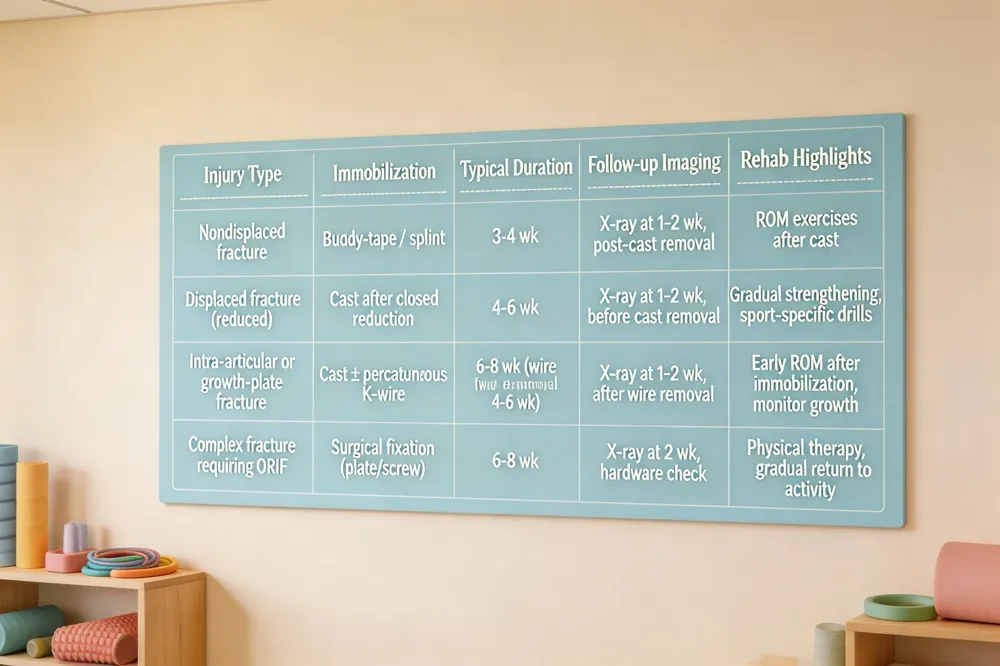 Immobilization is the cornerstone of pediatric hand fracture care. Simple, nondisplaced injuries are treated with buddy‑taping, splints, or short casts for 3‑4 weeks, while compression fractures may need a longer cast. Closed reduction under sedation is performed for displaced fractures that cannot be maintained with splinting; if reduction is unstable, percutaneous K‑wire pinning or open reduction internal fixation is used, especially for intra‑articular or growth‑plate injuries.
Healing is rapid in children, typically 3‑4 weeks for most fractures, with follow‑up X‑rays at 1‑2 weeks to confirm alignment and at cast removal. Growth‑plate fractures require longer monitoring (up to 12 months) for potential arrest.
Rehabilitation begins after immobilization, emphasizing gentle range‑of‑motion exercises, progressive strengthening, and return to sport‑specific activities by 4‑6 weeks for simple fractures and up to 8‑12 weeks after surgery.
Key Q&A
- Pediatric hand fractures orthobullets: Common, 10 % of all fractures; managed from splinting to surgical pinning based on displacement and physeal involvement.
- Pediatric metacarpal fracture orthobullets: Frequently involve the fifth metacarpal; non‑operative care preferred unless markedly displaced.
- Pediatric thumb fracture orthobullets: Extra‑articular fractures splinted; displaced Bennett/Rolando fractures need surgery.
- How long does a FOOSH injury last? Mild injuries 1‑2 weeks; fractures 6‑8 weeks immobilization plus therapy; full recovery up to 2 months.
- Red flags for a pediatric fracture: Severe pain, obvious deformity, open wound, neurovascular compromise, or inability to move the limb.
- How long should a hand hurt after a fall? Most improve in 7‑10 days; persistent pain warrants evaluation.
Practical Tips for Parents and Caregivers
| Tip | Description / Action |
|---|---|
| RICE protocol | Rest, Ice (10‑20 min q1‑2 h), Compression, Elevation |
| When to call emergency | Severe swelling, deformity, loss of motion, numbness, open wound |
| Preventive safety | Use protective gear, supervise play, secure doors/cabinets |
| Nutrition for bone health | Calcium‑rich foods, vitamin D, balanced protein & whole grains |
| Follow‑up care | Schedule orthopedic review 1‑2 wk after injury, monitor for growth disturbances |
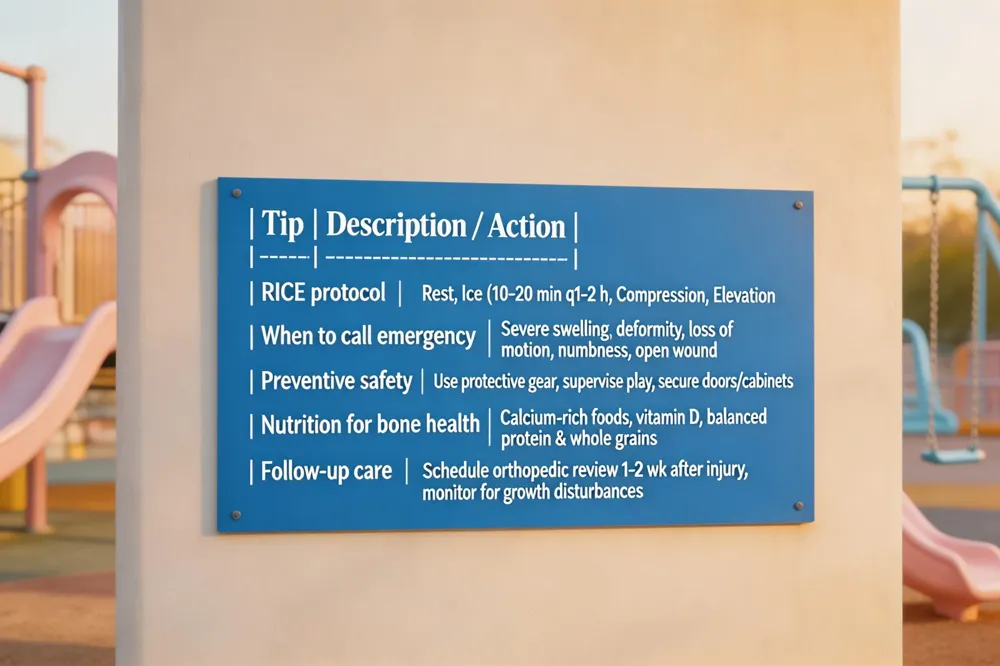 RICE protocol – After any hand injury, begin with Rest, Ice (10‑20 min every 1‑2 h, skin protected), Compression with a soft bandage, and Elevation above heart level. This reduces swelling and pain while you decide if further care is needed.
When to seek emergency care – Call for urgent evaluation if the hand is severely swollen, bruised, or deformed; if the child cannot move fingers or grip; if there is numbness, tingling, pale or cold skin; or if pain is uncontrolled despite pain medication. Open wounds, bleeding, or a visible bone fragment also require immediate attention.
Preventive measures and safety gear – Supervise play, keep doors and cabinets closed, and use protective equipment (wrist guards, padded gloves) for sports such as basketball, gymnastics, skateboarding, and roller sports. Encourage safe landing techniques on playground equipment and teach children to avoid “crush” hazards like doors.
Nutrition for bone health – Ensure adequate calcium (milk, cheese, yogurt, leafy greens) and vitamin D (sun exposure, fortified foods, supplements if needed). A balanced diet rich in protein and whole grains supports rapid bone remodeling in children.
FAQ
- Child hand swollen after fall: Apply RICE; seek orthopedic assessment if pain is severe, swelling worsens, movement is limited, or discoloration occurs.
- How to tell if a child's hand is sprained?: Expect localized pain, swelling, bruising, and tenderness without obvious deformity; persistent pain or inability to use the hand warrants a doctor’s exam.
- Toddler hand pain at night: Provide rest, elevation, cold packs, and age‑appropriate ibuprofen or acetaminophen; seek care if swelling, redness, fever, or severe pain develop.
- Common hand injuries from falling: Sprains, strains, buckle or greenstick fractures, displaced fractures, and finger joint dislocations are typical.
- How to tell if a child's foot is broken or sprained?: Fractures cause sharp, worsening pain, possible deformity, and inability to bear weight; sprains are more achy, improve with rest, and allow limited weight‑bearing. Obtain an X‑ray if doubt remains.
Take Action Early and Keep Hands Healthy
Watch for pain that worsens with touch or movement, swelling, bruising, visible deformity, a crooked finger or wrist, and any open wound or numbness. If any of these appear, especially after a fall, crush, or sports impact, seek urgent medical evaluation—plain X‑rays confirm the injury and help rule out occult fractures. A pediatric hand specialist can assess growth‑plate involvement, ensure proper alignment, and decide if closed reduction, splinting, or surgery is needed, reducing the risk of growth disturbance or joint stiffness. Prevent injuries by supervising play, using age‑appropriate protective gear (wrist guards, helmets, pads), teaching safe techniques for sports, and keeping doors or heavy objects secured. Adequate calcium and vitamin D support bone health and faster healing.