Why Hand Health Matters for Kids in Sports
Hand and wrist injuries account for a large share of youth‑sport trauma—up to 30 % of all extremity injuries in children ages 6‑14 and the most frequent sports‑related hand problems are fractures, dislocations, sprains, and tendon injuries. Because a child’s hand contains open growth plates (physes), the cartilaginous plates are weaker than the surrounding bone and are especially vulnerable to fractures and physeal injuries during falls or high‑impact plays. Damage to a growth plate can jeopardize future bone length and shape, making early recognition critical. Parents should seek prompt pediatric hand evaluation when any red‑flag sign appears—open wounds, visible bone displacement, persistent swelling, increasing pain, or loss of finger motion. Specialized pediatric hand surgeons, such as those at Children’s Health, are trained to protect growth plates, perform age‑appropriate imaging, and provide non‑surgical or surgical treatment that preserves function and promotes a safe, rapid return to sport.
Common Sports‑Related Hand and Wrist Injuries in Children
 Children involved in field sports (football, lacrosse, field hockey) and load‑bearing activities (gymnastics, cheerleading, weight training) frequently sustain hand and wrist injuries. The most common are soft‑tissue sprains and strains of wrist ligaments or finger tendons, often after a fall on an outstretched hand or repetitive gripping. Fractures are also prevalent: buckle (torus) and green‑stick fractures of the distal radius, phalangeal fractures, and growth‑plate (physeal) injuries of the radius and ulna. Tendon injuries such as “jersey‑finger” (flexor digitorum profundus rupture) occur when a sudden traction force is applied during ball‑handling. Overuse conditions, especially gymnast’s wrist (physeal impaction of the distal radius) and ulnar impaction syndrome, develop from repetitive wrist loading. Red‑flag signs — visible deformity, open wounds, inability to move a digit or wrist, swelling that does not improve within 1‑2 days, or increasing pain — should prompt prompt evaluation by a pediatric hand specialist. Most injuries respond to RICE, splinting or casting, and early rehabilitation, but displaced fractures, severe tendon ruptures, or physeal injuries may require surgical intervention to preserve growth and function.
Safety Practices Parents Should Teach
 Parents play a pivotal role in shielding their child’s hands and wrists from sports‑related injuries. First, choose sport‑specific protective gear—well‑fitting wrist guards, padded gloves, shoulder pads—or finger tap that’s in good condition and correctly adjusted before each practice or game. Regularly inspect the equipment for wear and replace it as needed. Second, instill a thorough warm‑up routine that includes dynamic wrist and forearm stretches, followed by technique drills that teach proper catching, throwing, and landing mechanics to avoid excessive wrist extension or weight‑bearing on a flexed wrist. Third, schedule regular rest periods and enforce off‑season breaks; a month off from any single sport each year—or a 3‑4‑month hiatus after a season of high‑impact play—helps prevent overuse injuries such as gymnast’s wrist or growth‑plate fractures. Fourth, ensure a safe environment: keep playing surfaces free of hazards, maintain appropriate surfacing around playground equipment, hydrate frequently, and supervise activities closely. Finally, educate children to recognize red‑flag signs—persistent pain, swelling, loss of motion, or a finger that hangs down—and to seek prompt medical evaluation if they occur.
Red‑Flag Symptoms and When to See a Specialist
 Swelling that persists or worsens after a fall is a key red‑flag sign in pediatric hand injuries. While mild bruising may resolve in 24‑48 hours, any swelling that does not start to improve within a few days—or that is accompanied by increasing pain—should prompt evaluation by a pediatric orthopedic specialist. Open wounds, visible bone displacement, a finger that hangs down or cannot be moved, and a hand that feels hot, red, or unusually tight also demand urgent assessment.
Deformity, loss of motion, numbness, or tingling are warning signals for fractures, dislocations, growth‑plate injuries, or tendon damage. If a child cannot fully bend or straighten the wrist, has a noticeable bump or bruising, or experiences weakness or loss of grip strength, a pediatric hand surgeon should be consulted promptly. Persistent swelling beyond one to two days, worsening pain with movement, or any neurological changes (numbness/tingling) are indications that imaging and specialist care are needed to prevent long‑term functional problems.
Protective Devices and Home Management
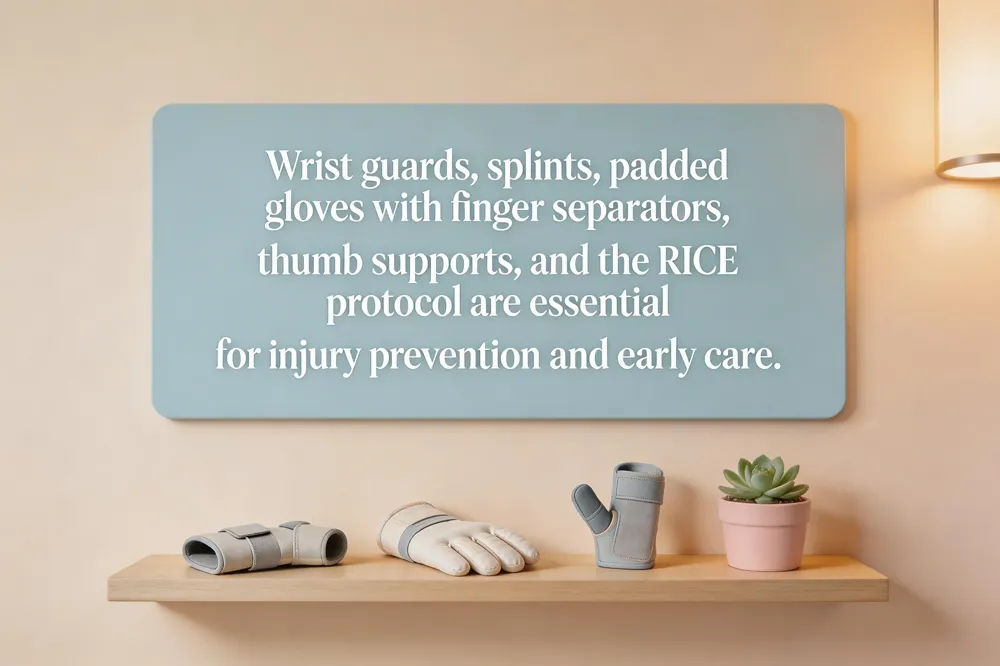 Wrist guards, splints, and custom orthoses
Neoprene‑wrapped wrist supports, rigid aluminum‑stay splints, and custom‑fit pediatric wrist orthoses provide essential protection for high‑impact sports such as skateboarding, gymnastics, and basketball. They limit excessive wrist extension and absorb impact forces.
Gloves with finger separators
Padded gloves equipped with finger separators cushion the palms and keep fingers aligned during baseball, softball, lacrosse, and similar activities, reducing lacerations and sprains.
Thumb supports and hand‑wrist covers
Glove‑style thumb orthoses or thumb abductors safeguard the thumb and thenar eminence in sports involving repetitive thumb motion (tennis, climbing). Lightweight hand‑wrist covers combine foam padding with adjustable straps for low‑impact protection in soccer, field hockey, and martial arts.
RICE protocol for minor injuries
Rest, Ice, Compression, and Elevation remain the first‑line home care for sprains, strains, and minor contusions.
What protective devices can help prevent hand and wrist injuries in youth sports?
Wrist guards or splints—such as neoprene‑wrapped wrist supports or rigid aluminum‑stay splints—are essential for sports like skateboarding, rollerblading, gymnastics, and basketball where falls or impact are common. Padded gloves with reinforced palms and finger separators provide cushioning for baseball, softball, and lacrosse while helping maintain proper hand alignment. Specialized thumb supports (e.g., glove‑style thumb orthoses or thumb abductors) protect the thumb and thenar during sports that involve gripping or repeated thumb motion, such as tennis and climbing. Lightweight, breathable hand‑wrist covers that combine soft foam with adjustable straps can be worn under jerseys for soccer, field hockey, and martial arts to absorb low‑impact blows. Finally, custom‑fit pediatric wrist orthoses—available in fabric, leatherette, or inflatable designs—offer tailored protection for children with pre‑existing conditions or those participating in high‑risk activities.
How should a toddler’s wrist injury that shows no swelling be managed at home?
Begin with the RICE protocol: keep the toddler’s wrist rested and avoid using the hand for the first 24‑48 hours. Apply a cold pack wrapped in a thin towel to the wrist for 10‑20 minutes every 2‑3 hours to control pain, and elevate the arm on a pillow when sitting or sleeping. If the child is in discomfort, give an age‑appropriate dose of acetaminophen or ibuprofen as directed. Observe the wrist for any increasing pain, bruising, loss of motion, or a bump that may suggest a fracture or ligament injury, and stop the home care if these signs appear. Seek a pediatric orthopedic evaluation promptly if pain worsens, the child refuses to use the hand, or any concerning symptoms develop.
What are the key steps in treating a sprained wrist in a child?
Treat a child’s sprained wrist first with the RICE protocol—rest the wrist, apply ice for 15‑20 minutes every 2‑3 hours, use a light elastic compression wrap, and keep the hand elevated above heart level. Give age‑appropriate NSAIDs such as ibuprofen or acetaminophen for pain and swelling control, following dosing instructions. If pain persists after 48‑72 hours, swelling is significant, or a fracture is suspected, obtain an X‑ray and immobilize the wrist with a splint or cast as directed. Once the acute phase subsides, begin gentle range‑of‑motion exercises under supervision to restore flexibility and strength. Refer to a pediatric orthopedic specialist, such as Dr. Rebecca S. Yu, for moderate‑to‑severe sprains, possible ligament tears, or if symptoms do not improve within a week.
The Role of the Pediatric Orthopedic Hand Surgeon
 Pediatric orthopedic hand surgeons evaluate and treat traumatic hand injuries, growth‑plate fractures, and chronic hand conditions in children. They use child‑friendly imaging, closed reduction, splinting or cast immobilization, and when needed minimally invasive surgery that preserves growth plates. For growth‑plate fractures, surgeons ensure proper alignment, monitor for redisplacement, and schedule follow‑up X‑rays to prevent growth arrest. Rehabilitation is coordinated with hand therapists; after immobilization, children begin range‑of‑motion and grip‑strength exercises, followed by a graduated return‑to‑play plan that typically spans 2‑8 weeks depending on injury type.
Everyday hand safety at home and school: Keep spaces well‑lit and clutter‑free, store sharp tools and chemicals out of reach, use age‑appropriate equipment, and teach proper ergonomics and safe handling. Promptly clean cuts, apply ice for swelling, and seek medical care for open wounds or loss of motion.
Sports‑related injury prevention: Ensure a thorough warm‑up with dynamic finger, wrist, and forearm stretches, fit sport‑specific protective gear (gloves, wrist guards) correctly, and schedule regular rest days and off‑season breaks. Encourage balanced nutrition, hydration, and cross‑training to reduce overuse. Parents should watch for swelling, pain, deformity, or inability to move and obtain immediate evaluation from a pediatric hand specialist.
Putting It All Together for Healthy Hands
Early recognition of hand problems is essential. Parents should watch for open wounds, visible bone displacement, swelling that persists beyond two days, or a finger that cannot move, and seek a pediatric hand specialist promptly. Consistent use of sport‑specific protective gear—properly fitted gloves, wrist guards, and finger taping—greatly reduces fracture and soft‑tissue risk. Balanced training that includes dynamic warm‑ups, strength work for forearm and intrinsic hand muscles, and scheduled rest days prevents overuse injuries such as tendonitis and growth‑plate stress. Family involvement reinforces safety: supervise play, enforce equipment checks, model correct technique, and encourage children to report pain early. Together, these habits create a safe environment that supports healthy hand development and a quicker return to sport and confidence and lifelong activity participation safely.