Why Wrist Mobility Matters
Stiff wrists limit everyday tasks such as typing, cooking, and gripping tools, leading to frustration and increased injury risk. A structured home‑exercise program—daily stretches, tendon glides, and progressive strengthening—restores range of motion, reduces pain, and improves grip strength. Dr. Rebecca S. Yu, a board‑certified hand surgeon in Berkeley, guides patients with evidence‑based protocols and personalized supervision to ensure safe, effective recovery.
Post‑operative Wrist Flexion and Mobility Foundations
Post‑operative Wrist Flexion & Mobility Timeline
| Phase | Time Frame | Key Exercises | Hold / Reps | Progression Notes |
|---|---|---|---|---|
| Early Passive | Days 1‑14 (after plates/screws) | Passive flexion/extension, radial/ulnar deviation, pronation/supination | Hold 5‑6 sec, 8‑12 reps each | Pain‑free only; no active contraction |
| Splint Removal | Weeks 4‑6 | Tendon‑glide drills, side‑to‑side stretches | Hold 5‑6 sec, 8‑12 reps | Begin gentle active motion after splint removal |
| Light Resistance | Weeks 6‑8 | Soft ball squeeze, light dumbbell (≤ ½ lb) wrist curls | 10‑15 reps, 2‑3 sets | Do not lift > cup‑of‑tea weight until cleared |
| Strengthening | Weeks 8‑12 | Progressive resistance (light band or 1‑2 lb weight) | 8‑12 reps, 3 sets | Increase load only if pain‑free |
Always consult your therapist or Dr. Rebecca S. Yu if pain or swelling increase.
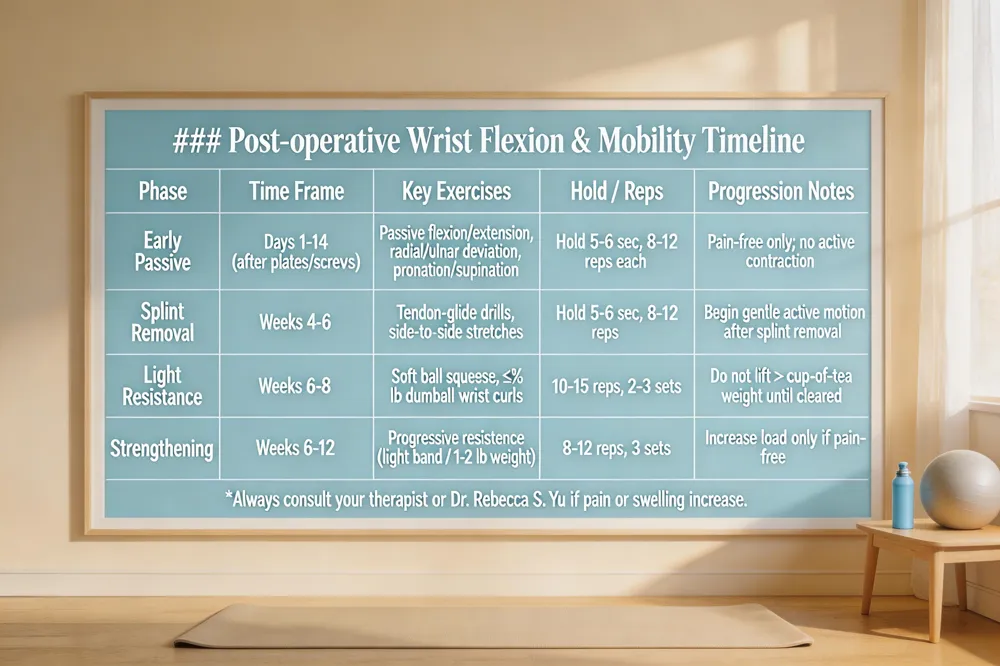 Safety with plates and screws – After the first 10‑14 days, start pain‑free passive motion (flexion/extension, radial/ulnar deviation, pronation/supination) holding each position 5‑6 seconds, 8‑12 repetitions. When the splint is removed (≈4‑6 weeks), add tendon‑glide drills and gentle side‑to‑side stretches, progressing to light resistance (soft ball or light dumbbell) after 2‑3 weeks, never lifting more than a cup of tea until cleared.
Fracture‑specific mobility drills – Post‑cast, perform passive fist‑to‑open hand, hand‑flip (palm‑up/palm‑down), and radial/ulnar deviation holds of 5‑6 seconds, 8‑12 reps. Advance to mild flexor/extensor stretches (15‑30 seconds, 2‑4 reps) and resisted wrist flexion/extension under therapist guidance. All exercises should stay within a pain‑free range; contact Dr. Rebecca S. Yu or your therapist if symptoms worsen.
Hand & Wrist Exercise Resources from Dr. Yu’s Practice
Printable & Digital Resources
| Resource | Format | Content Highlights | How to Obtain |
|---|---|---|---|
| Wrist Home Exercise Program | Hand‑wrist stretches, ROM drills, grip squeezes, weighted deviations | Email, portal download, or front‑desk request | |
| Arthritis Exercise Handout | Low‑impact stretches, tendon glides, isometric strengthening, “prayer stretch” | Patient portal after visit | |
| Wrist Strengthening Exercises | Wrist curls, grip squeezes, finger extensions, pronation/supination | Front desk or secure portal | |
| Video Library | Online videos (YouTube) | Finger spreads, tendon glides, thumb drills, arthritis‑friendly routines | Practice website & Arthritis UK YouTube link |
All PDFs are free and can be requested via phone, portal, or in‑person.
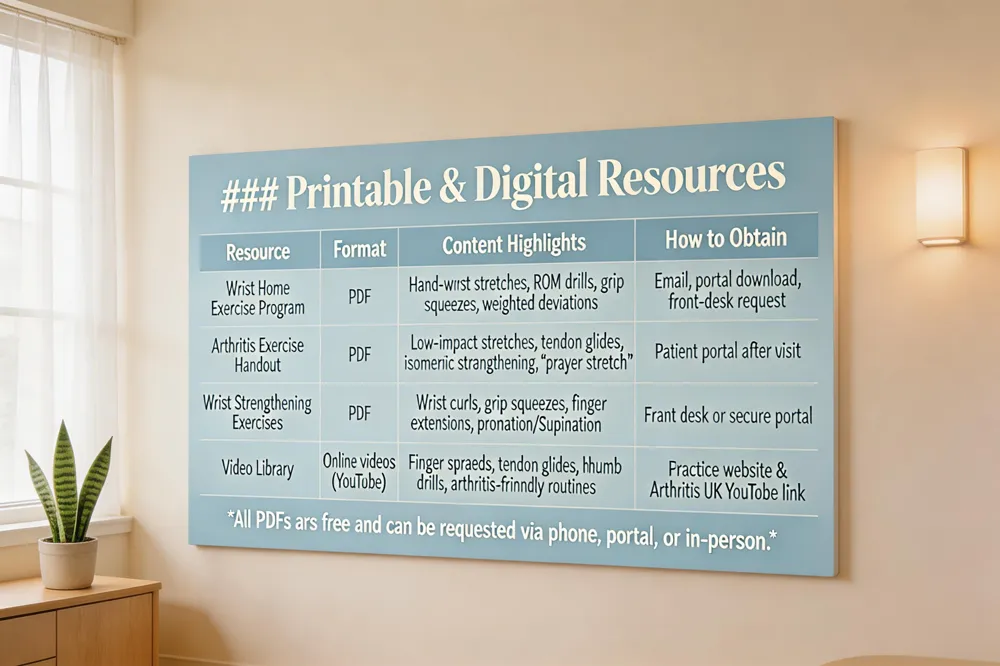 Can I get a printable Wrist Home Exercise Program from Dr. Yu’s clinic? Yes. After your initial evaluation at the Berkeley Hand & Upper Extremity Center, the clinic emails you a PDF or provides a download link on the practice website. The printable Wrist Home Exercise Program includes hand‑wrist stretches, range‑of‑motion drills (flexion, extension, supination/pronation), and strengthening moves such as grip squeezes and weighted deviations. You can request the file by calling the office, using the online patient portal, or emailing the staff.
Are there PDF handouts for wrist arthritis exercises? Yes. A downloadable PDF outlines low‑impact arthritis‑friendly movements: gentle stretches, tendon glides, isometric strengthening, and the “prayer stretch” stretch. The handout incorporates evidence‑based guidance from reputable sources and can be requested during your visit or downloaded from the patient portal after your appointment.
Can I get a PDF of hand and wrist strengthening exercises? Yes. The clinic offers a printable PDF listing wrist curls, grip squeezes, finger extensions, forearm pronation/supination, and more. It is available at the front desk, via secure portal, or email on demand.
Are there videos demonstrating hand exercises for arthritis? Yes. The practice website hosts short, free videos showing finger spreads, tendon glides, wrist stretches, and thumb drills. Links to Arthritis UK’s YouTube tutorial are also provided for step‑by‑step guidance.
Managing Osteoporosis and Wrist Health
Osteoporosis & Wrist Health Checklist
| Item | Recommendation | Frequency / Dose |
|---|---|---|
| Calcium | 1,200 mg daily (dairy, fortified plant milks, leafy greens) | Daily |
| Vitamin D | 800‑1,000 IU daily (sunlight, supplements) | Daily |
| Weight‑Bearing Exercise | Brisk walking, light jogging, resistance training | ≥ 3 times/week |
| DEXA Screening | Women > 65, Men > 70, or any with risk factors | As advised by physician |
| Bone‑Strengthening Medication | Bisphosphonates, denosumab (if prescribed) | Follow clinician’s regimen |
| Fall‑Prevention | Ergonomic breaks, safe footwear, home safety audit | Ongoing |
If you notice sudden wrist pain or swelling after a minor bump, seek evaluation promptly.
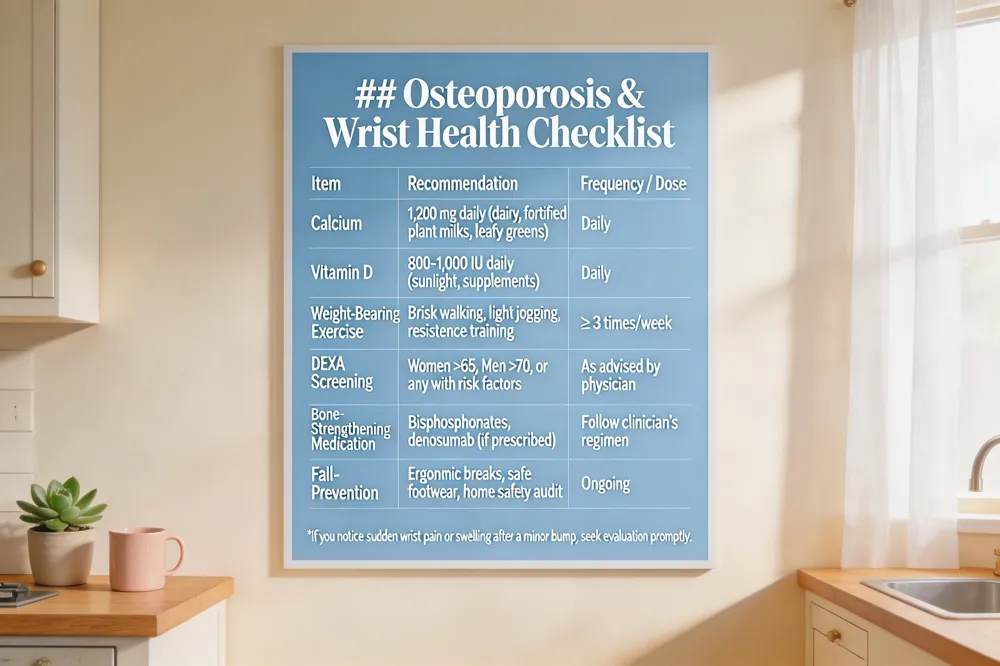 Osteoporosis reduces bone density and makes the distal radius and other carpal bones porous and brittle, so even a minor fall onto an outstretched hand can cause a fracture. Risk factors include post‑menopausal status, low calcium or vitamin D intake, sedentary lifestyle, smoking, and a family history of low bone mass. Screening with a dual‑energy X‑ray absorptiometry (DEXA) scan is recommended for women over 65, men over 70, and anyone with risk factors or a prior low‑impact fracture. Early detection allows clinicians to start bone‑strengthening medications (e.g., bisphosphonates, denosumab) and to tailor safe exercise programs.
Nutrition and lifestyle play a pivotal role: aim for 1,200 mg of calcium and 800–1,000 IU of vitamin D daily through dairy, fortified plant milks, leafy greens, and safe sunlight exposure. Incorporate weight‑bearing activities such as brisk walking, light jogging, or resistance training at least three times a week, and avoid smoking and excessive alcohol.
Can osteoporosis affect my wrists? Yes—osteoporosis can weaken the bones in your wrist, most often the distal radius, making them prone to fractures even from low‑impact falls or everyday stresses. If you notice sudden wrist pain, swelling, or loss of function after a minor bump, seek prompt evaluation to rule out a fracture.
Physical Therapy and Structured Mobility Programs
Core PT Wrist Mobility Routine
| Motion | Position | Hold | Reps | Sets | Daily Frequency |
|---|---|---|---|---|---|
| Flexion / Extension | Seated, forearm supported | 5‑10 sec | 10‑15 | 2‑3 | 2‑3 × day |
| Radial / Ulnar Deviation | Same as above | 5‑10 sec | 10‑15 | 2‑3 | 2‑3 × day |
| Pronation / Supination | Same as above | 5‑10 sec | 10‑15 | 2‑3 | 2‑3 × day |
| Static Stretches (Prayer, Flexor, Extensor) | Standing or seated | 15‑30 sec | 2‑4 | — | After mobility work |
| Dynamic Drills (Wrist circles, Figure‑eight, Side‑to‑side tabletop) | Open hand | — | 10‑15 reps | — | 2‑3 × day |
| CrossFit Load‑Bearing | Kettlebell halos, Farmer’s carries, Wall‑walks | — | 30‑60 sec holds or 8‑12 reps | — | Post‑warm‑up, 2‑3 × week |
All exercises should be pain‑free; adjust range as needed.
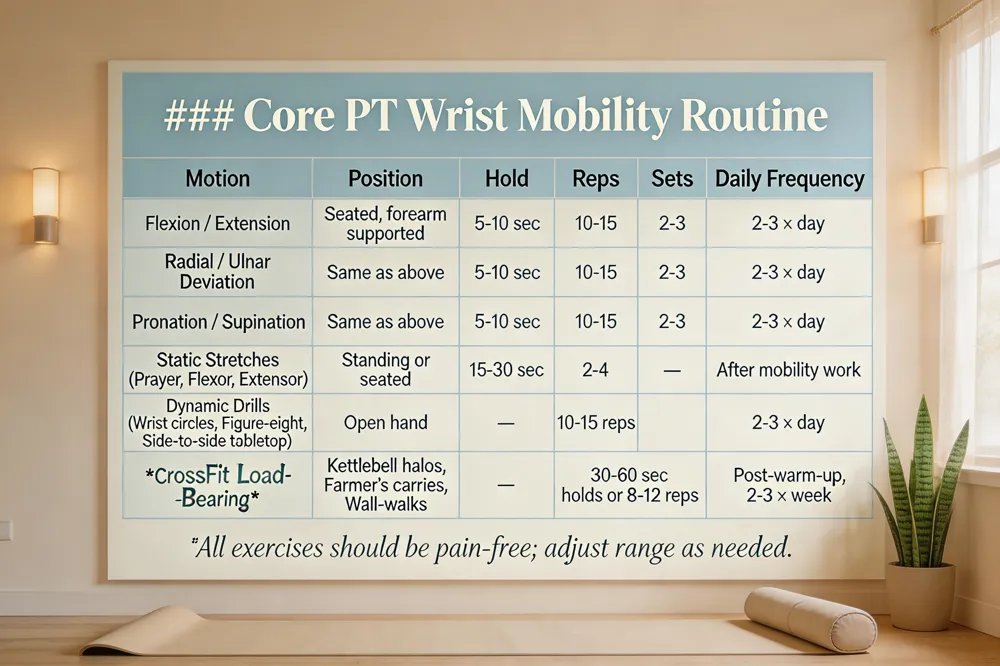 Core PT wrist motions include flexion, extension, radial/ulnar deviation, and pronation‑supination. Each is performed slowly, held 5‑10 seconds, 10‑15 repetitions, 2‑3 times per day. Static stretches (prayer stretch, flexor, extensor, raised‑fist) hold 15‑30 seconds, 2‑4 repetitions, while dynamic drills (wrist circles, side‑to‑side tabletop, figure‑eight) promote joint glide. For CrossFit athletes, add load‑bearing moves such as kettlebell halos, farmer’s carries, and wall‑walks after a warm‑up of circles and prayer‑wave to build endurance and stability. Arthritis‑friendly routines start with a warm‑up (tennis‑ball roll or putty), then low‑impact stretches and tendon‑glide sequences, followed by light resistance (rubber band, stress ball) 10‑15 reps 2‑3 times per day. What wrist mobility exercises are recommended in physical therapy? Combine active range‑of‑motion (flexion, extension, deviation, pronation‑supination) with gentle static stretches and dynamic circles; add tendon‑glides and seated clenched‑fist holds. What’s the best way to increase wrist mobility? Consistent daily routine of prayer stretch, flexor/extensor stretches, then active circles and side‑to‑side motions, progressing gradually without pain. Are there home‑based wrist mobility exercises? Yes—simple circles, raised‑fist, towel‑squeeze, and stress‑ball squeezes performed 2‑4 sets daily. Do wrist mobility exercises differ for CrossFit athletes? Yes—include high‑intensity dynamic warm‑ups and load‑bearing exercises to match sport demands. What are the best wrist exercises for arthritis? Warm‑up with putty, low‑impact stretches, tendon‑glides, and light resistance band work, all pain‑guided.
Strengthening Weak Wrists and Building Grip
Grip & Wrist Strength Progression
| Level | Exercise | Load | Reps / Holds | Sets | Progression Cue |
|---|---|---|---|---|---|
| Isometric Intro | Wrist flexion/extension hold (opposite hand resists) | Body‑weight | 5‑10 sec | 10‑12 each direction | 2‑3 × day |
| Functional Loading | Towel pull, garden weeding, vegetable chopping | Light everyday objects | 10‑15 reps | 2‑3 | Use heavier objects only when pain‑free |
| Light Resistance | 1‑2 lb dumbbell curls, resistance band extensions | 1‑2 lb or Light band | 8‑12 | 3 | Increase weight by 0.5 lb when 12 reps feel easy |
| Dead Hangs | Body‑weight hang from bar | Body‑weight | 10‑15 sec | 3‑5 | Add 5 sec each week, use thicker grip if needed |
| Gym Grip Work | Barbell wrist curls, reverse curls, Farmer’s walks | 5‑15 lb (start low) | 12‑15 (curls) / 30‑60 sec (walk) | 3‑4 | Add ≤ 10 % load weekly |
Stop if pain, swelling, or excessive fatigue occurs; consult a hand‑specialized surgeon if symptoms worsen.
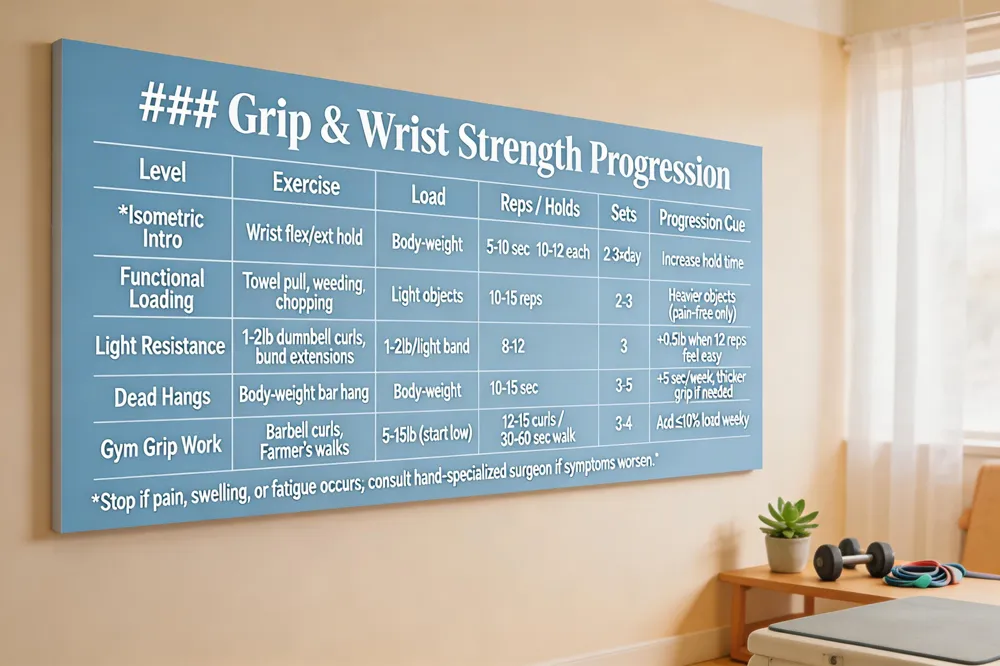 How can I fix extremely weak wrists? Begin with simple isometric wrist contractions: hold the forearm neutral, use the opposite hand to resist flexion and extension for 5‑10 seconds, repeat 10‑12 times each direction, 2‑3 times daily. Add functional loading such as gripping a towel while pulling weeds or chopping vegetables, and gentle stretches (finger‑back pull, wrist‑over‑edge extension, supination/pronation) to keep flexibility. Progress to light resistance bands or a 1–2 lb hand‑weight for wrist curls and extensions, increasing load gradually. If pain or swelling worsens, consult a hand‑specialized orthopedic surgeon.
Do dead hangs strengthen wrists? Yes. Dead hangs load the wrist flexors, extensors, and stabilizers isometrically. Start with 10‑15 seconds, gradually extending duration while keeping shoulders engaged to protect the joint. Use a thicker grip if compressive stress feels high. Combine with mobility work for balanced development.
How can I improve wrist strength at the gym? Warm up with wrist circles, flexor/extensor stretches, and wrist rotations. Perform barbell wrist curls (flexors) and reverse curls (extensors) or dumbbell equivalents, 3‑4 sets of 12‑15 reps with light‑to‑moderate weight. Add grip‑centric lifts—farmer’s walks, plate pinches, thick‑bar holds—progressing weight or hold time ≤10 % weekly. Finish with a brief cool‑down stretch.
What are effective hand exercises for rheumatoid arthritis with pictures? Gentle grip squeezes with a therapy ball, loose‑fist stretch, finger rolls, thumb‑to‑finger opposition, and wrist rotations. Perform each slowly, hold 2‑5 seconds, repeat 5‑10 times per hand daily. Visual step‑by‑step illustrations (starting position, movement, return to neutral) aid proper technique and prevent strain. Warm hands first with a compress or soak, then follow the sequence: wrist circles, finger lifts, O‑shape, L‑shape, and finger stretch. Consistent practice under Dr. Rebecca S. Yu’s guidance maintains joint flexibility, reduces stiffness, and improves grip strength.
Comprehensive Wrist Rehab for Sprains, Arthritis, and Daily Life
Seven‑Exercise Daily Routine (Home)
| Exercise | Description | Reps | Sets | Notes |
|---|---|---|---|---|
| Knuckle Bends | Bend middle joints of each finger, keep knuckles straight | 10‑15 per hand | 1 | Slow, pain‑free |
| Gentle Fist Stretch | Make a loose fist, then fully open hand | 10‑15 | 1 | Improves flexor/extensor length |
| Thumb Stabilization | Curve thumb around fingers, hold | 10‑15 | 1 | Enhances pinch grip |
| Finger‑Walks | Slide each finger toward thumb on flat surface | 10‑15 | 1 | Good for fine motor control |
| Grip Squeeze (Soft Ball) | Squeeze a soft ball, hold | 10‑15 | 1 | Light resistance, avoid pain |
| Pron‑/Supination with Light Hammer | Rotate forearm holding a lightweight hammer/rod | 10‑15 each direction | 1 | Control motion, avoid jerking |
| Micro‑Break Routine | Every 30‑45 min: roll tennis ball, wrist circles, prayer stretch | 15‑30 sec each | — | Reduces cumulative strain |
Perform the sequence once or twice daily; discontinue any movement that provokes sharp pain.
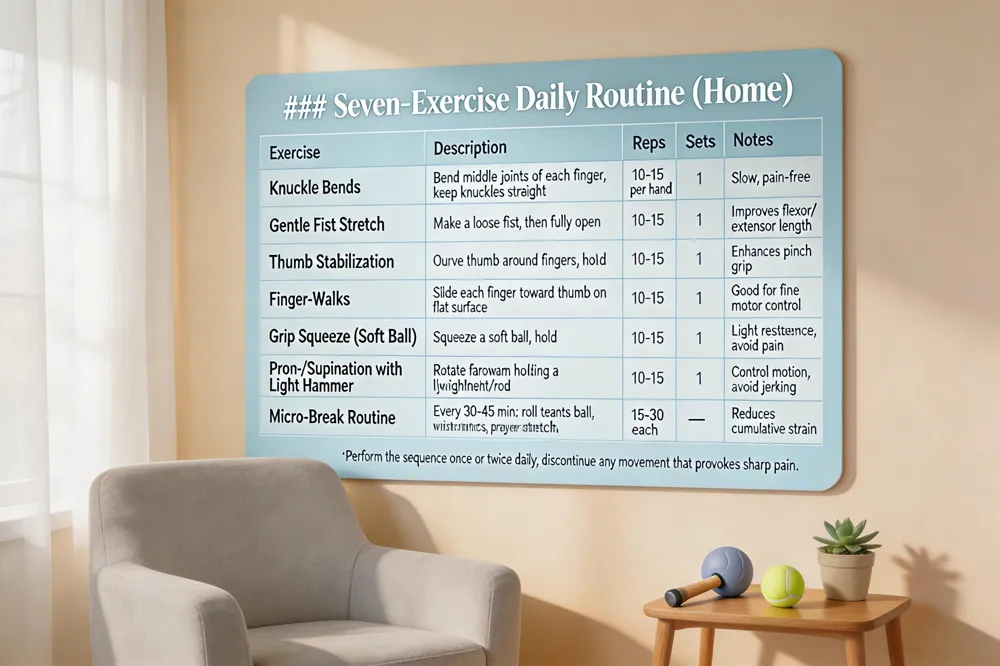 A seven‑exercise hand‑arthritis routine can be done at home with minimal equipment. Begin with knuckle bends (slowly bend the middle joints of each finger while keeping the knuckles straight), then perform a gentle fist stretch and reopen the hand. Follow with thumb‑stabilization (curving the thumb around the fingers) and fingertip‑to‑thumb touches. Add finger‑walks—slide each finger toward the thumb on a flat surface—and finish with a grip squeeze using a soft ball. Finally, rotate the forearm (pronation and supination) with a lightweight hammer or rod. Perform each movement 10‑15 times, once or twice daily, and stop if pain occurs.
For wrist sprain rehabilitation, start with gentle range‑of‑motion stretches (flexion, extension, and side‑to‑side “handshake” motions) in 3 sets of 10 reps, holding each stretch ~5 seconds once sharp pain subsides. Add tendon‑glide and forearm pronation/supination drills, then introduce resistance band work: wrist extension, flexion, radial and ulnar deviation, and forearm rotations, 8‑12 reps per set with a 2‑second lift and 5‑second return. Progress to light wrist curls or a therapy ball for 2‑3 sets of 10‑15 reps, always staying pain‑free.
Integrate ergonomic breaks throughout the day: every 30‑45 minutes, pause work, roll a tennis ball in the palm, and perform wrist circles or the prayer stretch for 15‑30 seconds. This micro‑break routine reduces cumulative strain, improves circulation, and supports the long‑term success of both arthritis and sprain rehab programs.
Putting It All Together for Long‑Term Wrist Health
A daily routine performed pain‑free and gradually intensified is the cornerstone of lasting wrist health. Schedule regular check‑ins with Dr. Rebecca S. Yu to confirm progress and adjust exercises. Complement rehab with adequate protein, vitamin D, hydration, smoking cessation, ergonomic workstations, and low‑impact activities such as walking or gentle yoga and stretching for wrist resilience daily mindfulness.