Overview
A realistic goal‑setting approach is essential after hand surgery because it boosts motivation, improves adherence to therapy, and aligns patient expectations with the biological healing timeline. Rehabilitation is traditionally divided into three phases:
- Protection (0‑2 weeks) – focus on pain control, edema reduction, and gentle passive/active‑assisted finger motion to maintain circulation without stressing the repair.
- Range‑of‑motion (2‑6 weeks) – progressive active motion, tendon‑gliding, and scar‑management to prevent adhesions as swelling subsides.
- Strengthening/Functional training (6‑12+ weeks) – graduated resistance exercises, fine‑motor drills, and task‑specific training once tendon healing is confirmed. Patients should anticipate gradual milestones—pain‑free motion by week 4, functional use of daily activities by 8‑12 weeks, and full strength by 3‑6 months—while recognizing that individual factors (age, health, surgery complexity) will shape the exact timeline.
Early Phase: Protection and Mobility
Early Phase – Key Interventions
| Intervention | Frequency / Reps | Duration / Hold | Notes |
|---|---|---|---|
| Elevation | 24‑7 days, continuously above heart level | – | Reduces edema; combine with intermittent cryotherapy |
| Cryotherapy | 15‑20 min, 3‑4 times /day | – | Apply ice packs; avoid direct skin contact |
| Passive ROM | 5‑10 reps per movement, several times /day | Full finger extension, tabletop, claw | Begin within 24 h; protect surgical repair |
| Six‑Pack Hand Drills | 5 times / day | Full finger extension, tabletop, claw, fist, in‑and‑out, thumb‑to‑tip | Use opposite hand for assistance |
| Wrist Flexion/Extension | After surgeon clearance (weeks 2‑4) | 6‑12 reps per set, 2‑3 sets | Light stretch; avoid resistance |
| Forearm Rotation | After clearance (weeks 2‑4) | 6‑12 reps per set, 2‑3 sets | Gentle pronation/supination |
| Soft‑Fist Stretch | 4 times / day | 30‑60 s hold | Part of full hand routine |
| Soft Ball Squeeze | 10‑15 reps, 3 times / week | – | Improves grip strength |
| Thumb‑Extension Band | 4 reps, 30‑60 s hold | – | Progression after early phase |
| Tendon‑Glide | 4‑5 sessions / day | – | Hook → Straight → Full fist sequence |
| Rest Between Strengthening | Every 48 h | – | Prevent over‑use |
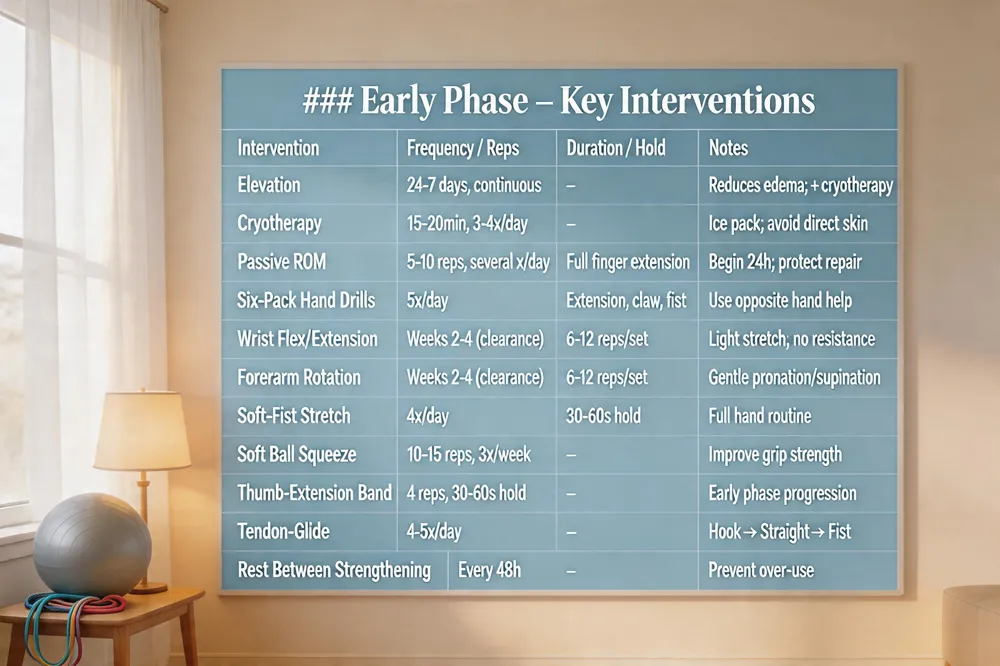 Swelling control – Elevating the hand above heart level for the first 3‑7 days and apply intermittent cryotherapy (15‑20 min) to reduce edema. Compression garments or gentle massage can be added after the first week if tolerated.
Passive range of motion – Begin gentle passive finger and thumb movements within 24 hours (full finger extension, tabletop, claw) to maintain circulation and prevent joint stiffness while the surgical repair is protected.
Initial exercises – Perform the “six‑pack” hand drills (full finger extension, tabletop, claw, fist, in‑and‑out, thumb‑to‑tip) five times daily, using the opposite hand to assist if needed. Light wrist flexion/extension and forearm rotation stretches are introduced once the surgeon clears the protective phase (typically weeks 2‑4).
Full hand exercise
A full routine starts with a soft‑fist stretch (30‑60 s) and a wide‑hand opening, repeated four times. Follow with finger‑stretch on a flat surface, claw stretch, then grip and pinch work using a soft ball (10‑15 reps, three times/week). Finish with thumb‑extension band, flexion, and thumb‑to‑finger “O” holds (30‑60 s, four repetitions).
Post hand surgery exercises
Begin with gentle ROM drills (full extension, tabletop, claw) 5‑10 reps several times daily, keeping any splint in place. Add a tight‑fist and finger‑to‑finger “O” motions for grip, progressing to a soft ball as tolerated. Include thumb‑to‑tip, finger‑tap, wrist flexion/extension, and forearm rotation stretches. Increase repetitions gradually over 6‑8 weeks and consult a hand therapist before advancing.
Hand therapy after wrist surgery
Protect the repair while preventing finger stiffness. For the first two weeks, perform the six‑pack hand exercises five times daily, assisted passively if needed. Light wrist motions can start after clearance (usually week 3‑4) with 6‑12 reps per set. Avoid lifting >1 cup, pushing, pulling, or driving for 2‑6 weeks. Consistent daily practice plus formal physiotherapy is essential for regaining strength and function.
Hand exercises at home
Start with a soft fist hold (30‑60 s), finger spread, and finger‑straightening on a flat palm. Strengthen with a soft ball squeeze or foam block pinch (10‑15 reps). Incorporate tendon‑glide patterns (hook fist → straight hand → full fist) and thumb‑band extensions. Perform 4‑5 sessions per day, resting 48 h between strengthening, and stop any motion that causes pain.
Middle Phase: Strengthening and Functional Training
Middle Phase – Strengthening Overview
| Target Group | Exercise | Tool / Resistance | Sets × Reps | Frequency | Progression Criteria |
|---|---|---|---|---|---|
| Adults | Soft‑ball squeeze | Soft ball | 2‑3 × 10‑15 | 2‑3 times / week | Pain ≤3/10, no swelling |
| Therapy putty pinch | Putty (light) | 2‑3 × 10‑15 | 2‑3 times / week | Increase putty firmness | |
| Hook‑hand isometric hold | Body weight | 5 × 10‑15 ones | 2‑3 times / week | Maintain grip endurance | |
| Wrist curls (flexion) | Light dumbbell (0.5‑1 kg) | 2‑3 × 10 | 2‑3 times / week | No pain, smooth motion | |
| Reverse wrist curls | Light dumbbell | 2‑3 × 10 | 2‑3 times / week | Same as above | |
| Seniors | Wrist flexion/extension | Body weight | 3 × 10 | 2‑3 times / week | Gentle, slow tempo |
| Knuckle bends | Body weight | 5‑10 slow reps | 2‑3 times / week | No joint pain | |
| Towel‑squeeze hold | Towel roll | 3 × 10‑15 s | 2‑3 times / week | Pain ≤2/10 | |
| Hook‑hand isometric | Body weight | 5 × 10‑15 s | 2‑3 times / week | Maintain grip dexterity | |
| General | SMART goal tracking | – | – | Ongoing | Measured by goniometry/dynamometer |
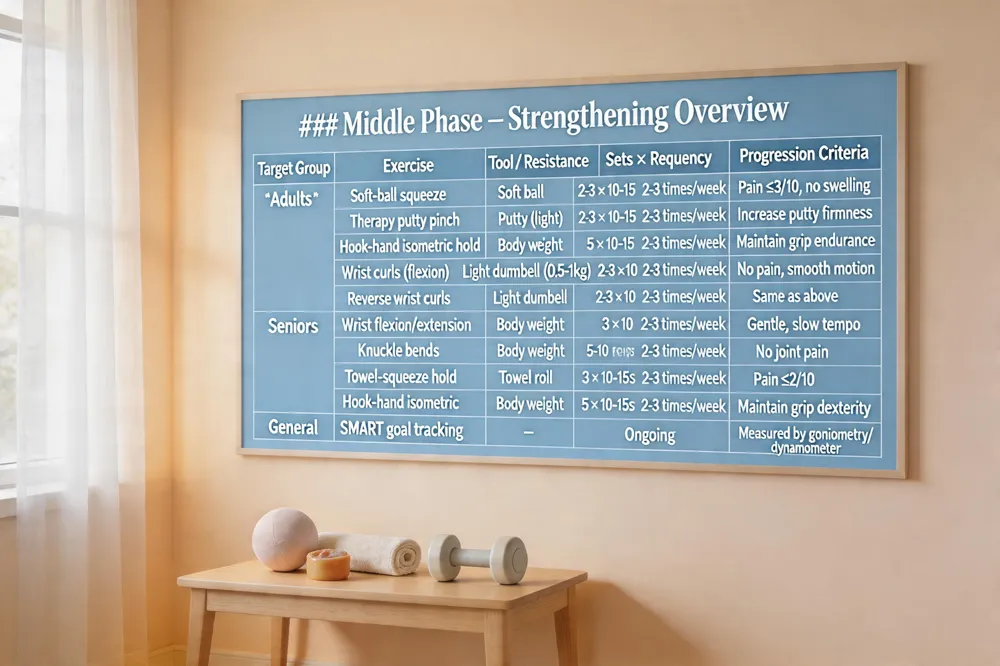 Hand strengthening exercises for adults
Adults can progress from early ROM to targeted strengthening once the surgeon confirms tendon healing (typically 6‑8 weeks). Begin with low‑resistance tools: soft‑ball squeezes, therapy putty pins, and “hook‑hand” isometric holds. Perform 10‑15 repetitions of each, 2‑3 times per week, gradually increasing resistance as pain stays ≤3/10. Include wrist curls and reverse curls with a light dumbbell or resistance band to engage forearm stabilizers.
Hand strengthening exercises for seniors
Seniors benefit from gentle, low‑impact drills that protect joints while rebuilding grip. Start with wrist flexion/extension (3 sets × 10), knuckle bends, and towel‑squeeze holds. Isometric “hook‑hand” and fingertip opposition improve dexterity without heavy load. Repeat 5‑10 slow reps, 2‑3 sessions weekly, and consult a hand surgeon such as Dr. Rebecca S. Yu before advancing.
Hand strengthening exercises PDF
A downloadable PDF provides a step‑by‑step protocol: passive finger glides, active thumb‑to‑tip, and progressive grip‑strengthening using putty, balls, and hand‑grippers. Each exercise is illustrated with recommended repetitions and timing (3‑4 times daily, 5‑10 minutes). The hand can be obtained free from reputable hand‑therapy sites or directly from Dr. Yu’s office.
Hand therapy after wrist surgery
During weeks 6‑12 the focus shifts to controlled wrist motion and grip recovery. Begin “six‑pack” hand drills (full extension, tabletop, claw, fist, in‑and‑out, thumb‑to‑tip) five times daily, adding light wrist flexion/extension and radial‑ulnar deviation once cleared. Avoid lifting >1 kg and monitor swelling.
SMART goal setting
Set Specific, Measurable, Achievable, Relevant, Time‑bound goals: e.g., “increase grip strength to 30 % of the contralateral hand by week 10” or “perform 15‑minute hand‑exercise routine 5 days/week for 4 weeks.” Regular objective measures (goniometry, dynamometer) keep progress on track and boost motivation.
Return to Work and Daily Activities
Return‑to‑Work Timeline & Accommodations
| Job Type | Expected Return Window | Typical Accommodations | Key Milestones |
|---|---|---|---|
| Sedentary (office, computer) | 2‑4 weeks (simple procedures) → 6‑14 weeks (most hand surgeries) | Ergonomic keyboard, voice‑to‑text, splint if needed | Pain‑free typing, full ROM by week 4 |
| Light‑impact manual (light assembly, retail) | 4‑8 weeks | Modified duties, reduced gripping, protective splint | Ability to lift ≤1 kg, perform basic pinch |
| Heavy manual labor (construction, carpentry) | 3‑6 months | Gradual duty progression, supportive brace, buddy‑system | Grip strength ≥90 % of contralateral hand, no pain during lifting |
| Broken wrist (distal‑radius fracture) | 2‑4 weeks (sedentary) → 6‑12 weeks (physically demanding) | Cast/splint removal, ergonomic tools, PT | Fracture union confirmed, ROM >80 % of normal |
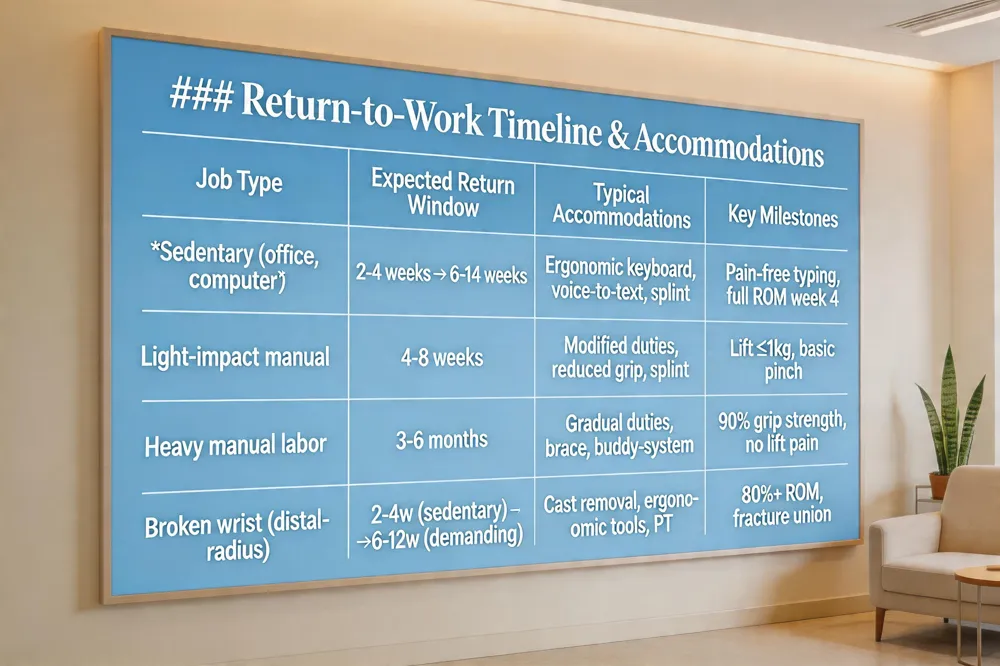 A successful return to work after hand or wrist surgery depends on realistic goal setting, appropriate workplace accommodations, and a phased timeline that matches the patient’s healing stage.
Workplace accommodations – Use splints or ergonomic keyboards, voice‑to‑text software, and modified duties that avoid gripping or repetitive wrist motion during the early phases. Light‑impact jobs can often resume with these adjustments after 2–4 weeks, while heavier manual labor may require a temporary shift to less demanding tasks until strength and range of motion improve.
Timeline for job types – Most patients return to light office work within 6 to 14 weeks after hand surgery; simple procedures such as carpal‑tunnel release or trigger‑finger excision may allow computer work as early as 2 to 4 weeks and full duties by 6 weeks. More extensive surgeries (tendon, ligament, or fracture repair) typically need 3 to 6 months before heavy manual labor is safe.
Average time off work with a broken wrist – A distal‑radius fracture in a cast or splint usually heals in 6–8 weeks. Sedentary workers can often return after 2–4 weeks if the cast does not impede typing or driving; physically demanding occupations usually wait 6–12 weeks, with additional physical‑therapy weeks to regain strength.
Occupational‑therapy hand exercises – Free therapist‑approved PDFs (e.g., University of Washington Medical Center) provide step‑by‑step active and passive drills for fingers, thumb, wrist, and forearm, supporting both early motion and later strengthening.
Hand exercises after trigger‑finger surgery – Begin gentle finger motion as soon as the incision is clean, using the tendon‑gliding sequence (full extension, tabletop, claw, fist, in‑and‑out, thumb‑to‑tip) 5‑10 reps, 3‑4 times daily. Elevate, ice, and avoid heavy lifting for the first 2–6 weeks; stop any exercise that causes sharp pain.
Managing Complications and Monitoring Progress
Complication Warning Signs & Immediate Actions
| Warning Sign | Possible Issue | Immediate Action |
|---|---|---|
| Increasing redness, warmth, pus | Infection | Contact surgeon; start antibiotics if prescribed |
| Fever >38 °C, chills | Systemic infection | Seek urgent medical care |
| Rapidly expanding hematoma | Bleeding/compartment syndrome | Elevate hand, apply pressure, call surgeon immediately |
| New blue or white skin discoloration | Vascular compromise | Urgent evaluation; possible surgical exploration |
| Persistent numbness/tingling >24 h | Nerve irritation or neuroma | Notify therapist/surgeon; consider nerve conduction study |
| Sharp, burning pain unrelieved by meds | Complex regional pain syndrome | Early referral to pain specialist; initiate desensitization |
| Swelling >1 kg after 2 weeks | Inadequate elevation/compression | Increase elevation, add compression sleeve, reassess PT plan |
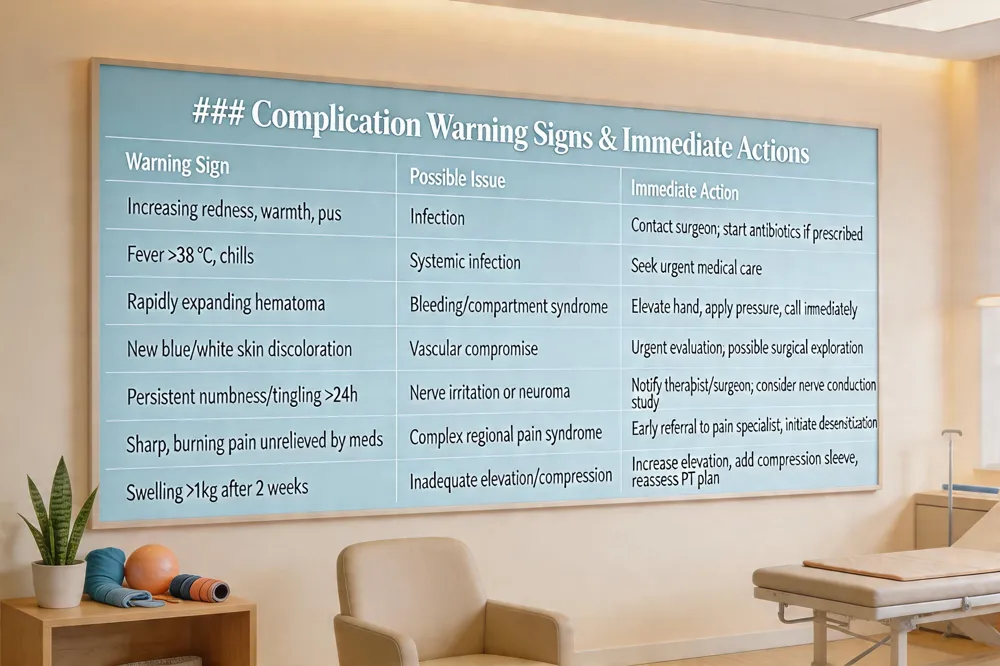 Effective post‑operative care hinges on three core pillars: pain management, swelling control, and vigilant monitoring for warning signs. Early analgesia—scheduled NSAIDs, short‑course opioids, cryotherapy, and elevation—keeps pain at a tolerable level (≤3/10) and reduces inflammation, allowing patients to begin gentle finger motions within 24‑48 hours. Swelling is most pronounced in the first two weeks; keeping the hand above heart level, using compression sleeves, and intermittent ice (15 minutes three times daily) are standard measures.
Warning signs that demand immediate medical attention include increasing redness, warmth, pus, fever, or a rapidly expanding hematoma; any change in skin color (blue or white), new numbness or tingling that does not resolve within 24 hours, or uncontrolled burning pain suggest infection, compartment syndrome, or complex regional pain syndrome.
Complications after hand surgery can range from nerve injuries (neuroma, sensory deficits) and tendon problems (irritation, rupture, adhesions) to joint stiffness, contractures, infection, hardware irritation, and, rarely, compartment syndrome. Early recognition and prompt intervention—such as splint adjustment, desensitization, or surgical revision—are essential to preserve function.
Speeding up healing involves protecting the repair (splint or brace for 1‑2 weeks), consistent elevation, progressive hand‑therapy exercises (passive range of motion, tendon‑gliding, graded strengthening with therapy putty or balls) under a certified hand therapist, and adequate nutrition (≈1.2 g protein/kg body weight). Adhering to a structured home‑exercise program (2‑3 sessions daily) and avoiding smoking or excessive alcohol further accelerates recovery.
Hand pain after wrist surgery is typical in the early weeks and usually improves with the measures above. Persistent, worsening, or sharp pain, especially when accompanied by swelling, drainage, or numbness, should be reported promptly to the surgeon for evaluation.
Advanced Phase: Long‑Term Maintenance and Special Cases
Advanced Phase – Advanced Exercises & Timelines
| Phase | Exercise | Tool / Resistance | Sets × Reps | Frequency | Goal |
|---|---|---|---|---|---|
| Weeks 3‑6 | Scar massage | Hands (silicone gel optional) | 5‑10 min | Daily | Reduce adhesions, improve pliability |
| Weeks 6‑12 | Therapy putty progressive pinch | Putty (medium‑hard) | 2‑3 × 10‑15 | 3‑4 times / week | Achieve 50 % pre‑injury grip strength |
| Weeks 12‑24 | Weighted ball squeeze | 0.5‑1 kg ball | 2‑3 × 10‑15 | 3 times / week | Reach 90‑100 % grip strength |
| Thumb surgery | Thumb abduction & opposition (palm‑down) | No tool | 10 s hold × 5 | 5 times / day (weeks 4‑6) | Full ROM by week 8 |
| Thumb‑up lifts with light weight | 0.5 kg | 2 × 10 | 5 times / day (weeks 6‑8) | Strengthen thenopponens pollicis | |
| Trapeziectomy | Thumb‑away movement | No tool | 5 × 10‑15 | 5 times / day (weeks 4‑6) | Maintain opposition |
| Bottle‑top turn | Light bottle | 2 × 10 | 5 times / day (weeks 6‑8) | Improve rotational control | |
| Wrist plate removal | Gentle finger/elbow motion | – | 10‑15 reps | 2‑3 times / day (weeks 2‑4) | Prevent stiffness |
| Supervised physio for wrist ROM | Resistance band | 2‑3 × 10‑15 | 3 times / week (weeks 4‑6) | Full ROM by week 8 |
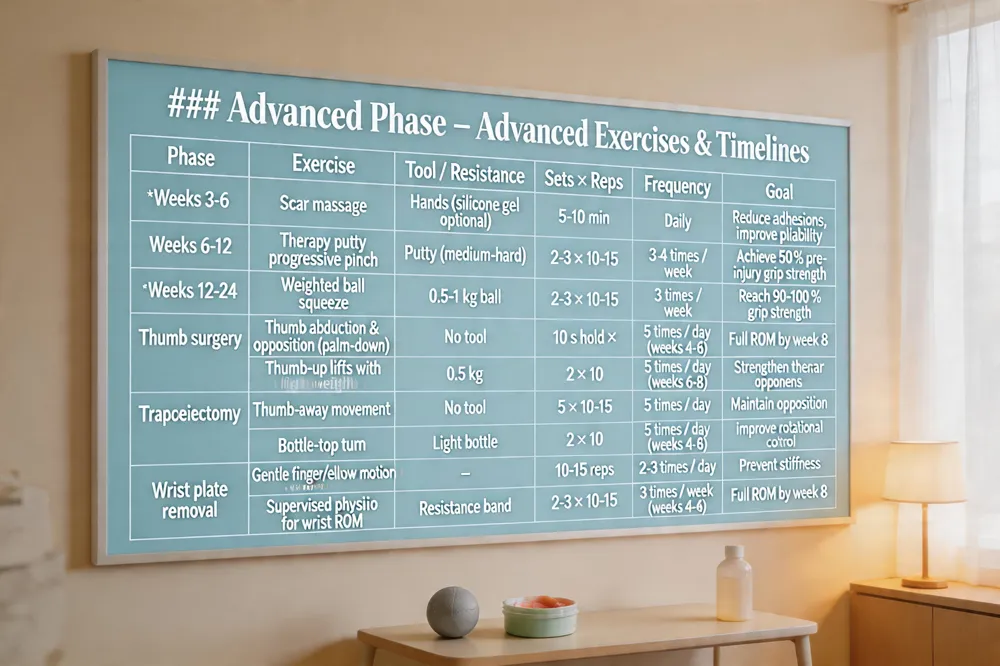 Scar Management – From weeks 3‑6 scar tissue peaks; daily massage, silicone gel sheets, and controlled motion, keep adhesions minimal and skin pliable. Continue these measures for at least 12 weeks, adjusting intensity as pain allows.
Advanced Exercises – After the early protection phase (0‑2 weeks) and range‑of‑motion work (2‑6 weeks), introduce resistance training (therapy putty, weighted balls) and functional drills (pinch‑to‑thumb, pen rotation). Progress 2‑3 times weekly, aiming for 90‑100 % pre‑injury grip strength by 3‑6 months.
Specific Surgeries
- Thumb Surgery: Begin therapist‑guided ROM once the splint is removed (~week 4), five times daily. Early moves: palm‑down thumb abduction and opposition (10 s hold) with a soft ball. Weeks 6‑8 add thumb‑up lifts, screw‑top turning, wrist flexion‑extension; week 8+ slide thumb along each finger, 10‑15 reps, increasing resistance with putty.
- Trapeziectomy: Remove splint around week 4, perform thumb‑away movements and fingertip‑to‑thumb squeezes five times daily. Weeks 6‑8 add thumb‑off‑flat‑surface lifts, bottle‑top turns, “O”‑shapes; after week 8, expand to thumb‑to‑finger slides across the palm.
- Wrist Plate Removal: Home same day, sling for 1‑2 weeks, gentle finger/elbow motion. At 2 weeks start supervised physio for ROM and strength. Light office work by 2 weeks; heavy labor 4‑6 weeks. Full strength may take up to 6 months.
Rehabilitation Timelines – Goal‑setting (SMART) aligns milestones: pain‑free ROM by week 4, 50 % grip strength by week 6, 90 % by month 3, return to ADLs 8‑12 weeks. Regular therapist follow‑up ensures safe progression.
Final Thoughts
Key takeaways from the postoperative hand‑surgery journey are that early controlled motion, swelling control, and progressive strengthening are essential for restoring function. Pain and edema are managed with elevation, cryotherapy, and prescribed analgesics, while scar‑management techniques such as silicone sheets and massage reduce adhesions. Setting SMART, measurable milestones keeps patients motivated and aligns therapy with daily‑activity goals. Adherence to both therapist‑guided sessions and a diligent home‑exercise program dramatically accelerates recovery and lowers the risk of stiffness or re‑injury; studies show compliant patients meet functional milestones weeks earlier. Partnering with Dr. Rebecca S. Yu, MD, ensures that surgical repair, rehabilitation timing, and individualized goal‑setting are coordinated, providing a seamless pathway from the operating room to full, pain‑free hand use.