Why Structured Rehabilitation Matters
Early motion after hand surgery is crucial because gentle range‑of‑motion exercises prevent joint stiffness, promote tendon gliding, and reduce swelling, all of which protect the repair while encouraging circulation. A multidisciplinary hand‑therapy program—coordinated among orthopedic surgeons such as Dr. Rebecca S. Yu, certified hand therapists, and occupational therapists—delivers customized splinting, scar‑massage, edema control, and progressive strengthening that are tailored to the specific procedure and healing stage. Patient adherence amplifies these benefits: consistent home exercises, proper elevation, and timely reporting of pain or swelling accelerate functional recovery and lower the risk of complications. When patients follow the prescribed regimen, they achieve greater range of motion, grip strength, and return to daily activities in fewer weeks. It also builds confidence and motivation daily.
Early Motion and Edema Management
Early Motion & Edema Management – Quick Reference
| Goal | Exercise / Action | Reps / Hold | Frequency | Notes |
|---|---|---|---|---|
| Reduce swelling | Elevate hand on pillow/wedge | – | ≥ 3 × daily, ≥ 30 min each | Keep hand above heart level |
| Gentle joint motion | Passive full‑finger extension (splinted) | 5‑10 reps | Hourly | Use opposite hand for support |
| Increase range | Active claw, fist, in‑and‑out positions | 10 reps | 3 × day | Hold 5‑10 sec per position |
| Thumb‑to‑finger coordination | Thumb touches each finger | 10 reps | 3 × day | Progress once pain‑free |
| Pain monitoring | Check for increasing pain, redness, warmth, drainage, fever, color change | – | Ongoing | Stop activity & contact surgeon if present |
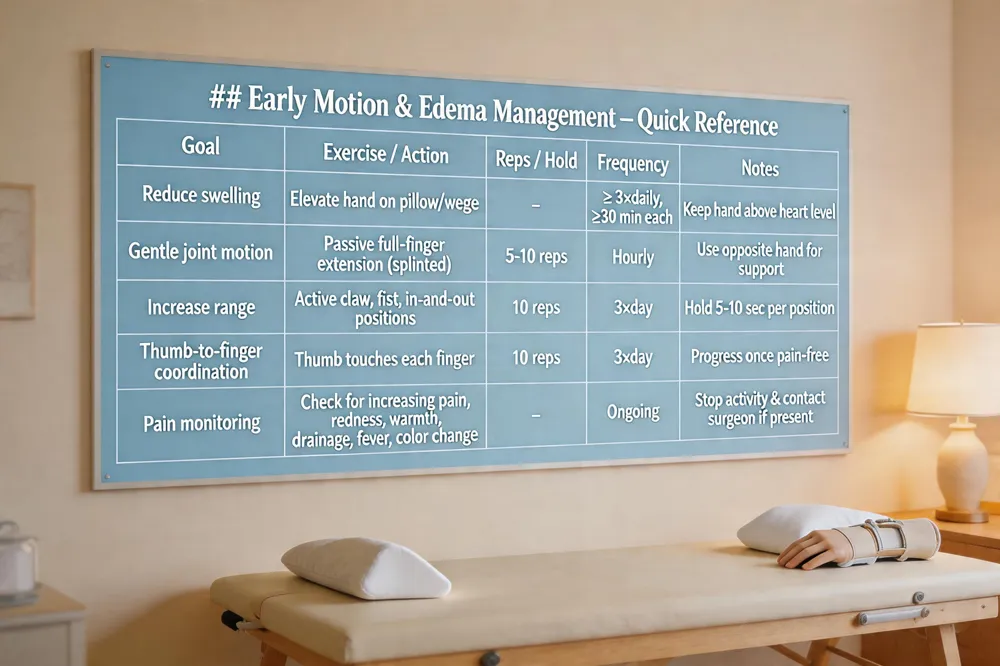 Warning signs after hand surgery: increasing pain, redness, warmth, drainage, fever, color changes in fingers, or swelling that does not improve with elevation should prompt immediate medical contact.
Targeted Finger and Thumb Exercises
Targeted Finger & Thumb Exercises – Summary Table
| Exercise | Target Area | Technique | Reps / Hold | Progression |
|---|---|---|---|---|
| Pinky PIP bend | Pinky middle joint | Hand flat, other fingers supported, flex PIP | 6 sec hold, 8‑12 reps | Add PIP extension, DIP tip bends, MP straightening |
| Thumb abduction & opposition | Thumb base | Slide thumb away on flat palm, hold 10 sec | 10 sec hold, repeat 5‑10× daily | Add soft‑ball squeezes, bottle‑cap rotations, O‑shape slides |
| Dupuytren’s finger bends | All fingers | Gentle bend & straighten, 5 sec hold | 5 reps, 5 sec hold | Add hook‑fist release (10 reps, 10 sec hold) and knuckle flexes |
| General finger therapy | Whole hand | Passive full‑finger extension (splinted) → active claw/fist → thumb‑to‑finger touches | 5‑10 reps hourly → 3 sets of 10 reps multiple times/day | Increase hold to 5‑10 sec, stop if pain |
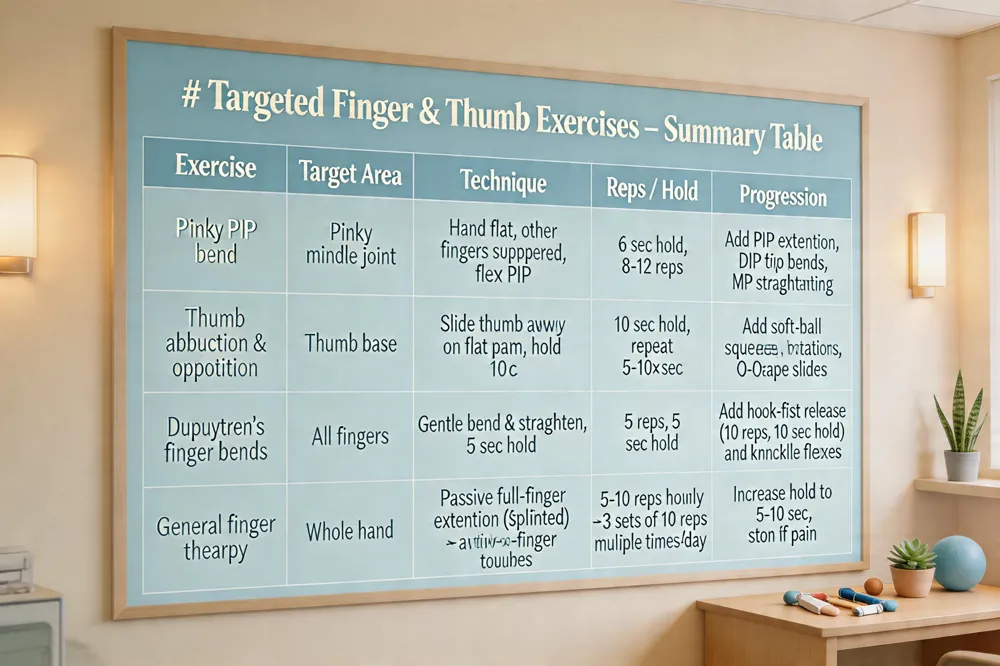 Effective hand‑surgery rehab relies on specific, low‑stress movements that restore joint glide and prevent stiffness.
Pinky finger exercises after surgery – Begin with isolated PIP‑joint bends: place the hand flat, support the other fingers, slowly flex the pinky middle joint, hold six seconds, then straighten; repeat 8‑12 times. Follow with PIP extension using the opposite hand for stabilization, and add DIP‑tip bends and MP‑joint straightening to improve fingertip and base‑joint mobility.
Hand exercises after thumb surgery – Once the splint is removed, practice gentle thumb abduction and opposition: slide the thumb away from the fingers on a flat palm, hold ten seconds, return, and repeat several times daily. Progress to functional drills such as soft‑ball squeezes, bottle‑cap rotations, and O‑shape slides, while incorporating wrist flexion/extension and forearm rotations.
Hand exercises after Dupuytren’s surgery – After wound healing, perform daily finger‑bending and straightening sets (5 reps, 5‑second hold), hook‑fist release (10 reps, 10‑second hold), and knuckle flexes. Use the opposite hand to gently press the operated fingers into full fist or flat positions, holding each stretch for a minute, three times per day.
General finger therapy strategies – Start with passive full‑finger extension and tabletop positions while splinted, 5‑10 reps hourly. Advance to active claw, fist, and in‑and‑out positions, then thumb‑to‑finger touches, increasing hold times to 5‑10 seconds and aiming for three sets of 10 reps multiple times a day. Stop any exercise that causes pain and follow your surgeon or therapist’s timeline.
Strengthening and Functional Training
Strengthening & Functional Training – Quick Guide
| Exercise | Primary Muscles | Movement | Reps / Hold | Frequency |
|---|---|---|---|---|
| Wrist flexion/extension & radial‑ulnar deviation | Wrist flexors/extensors, forearm stabilizers | Gentle bends, then deviation | 10 reps each direction | 2‑3 × day |
| Forearm rotation (pronation/supination) | Pronator & supinator muscles | Elbow tucked, turn palm down/up | 8‑10 reps | 2‑3 × day |
| Grip reinforcement | Finger flexors, thenar | Light squeeze with stress ball/putty | 10‑15 sec hold, 10 reps | 3‑4 × day |
| Pinch drills | Thumb & index finger flexors | Pinch towel or small object | 10‑12 reps | 3‑4 × day |
| Tight‑fist‑and‑release (Q: Best exercise) | Flexor‑extensor balance | Make tight fist, release slowly | 10 reps, 5‑10 sec hold | 3‑4 × day |
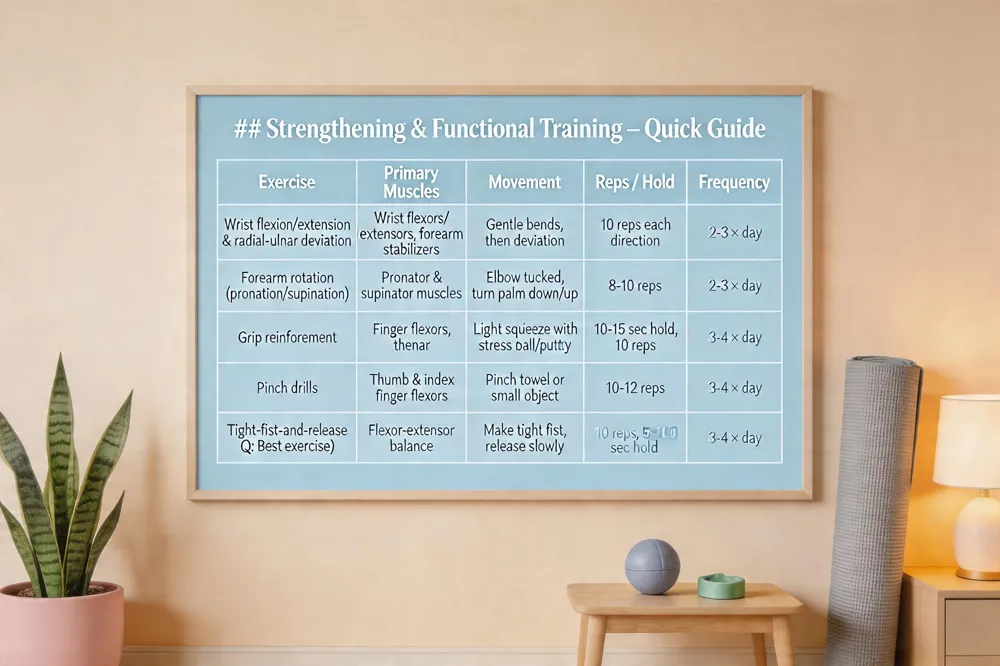 Wrist movements: gentle flexion/extension followed by radial‑ulnar deviation, 10 repetitions each, improve wrist mobility and forearm balance.
Forearm rotation: with the elbow tucked to the side, turn the palm down (pronation) then up (supination) and hold briefly; repeat 8‑10 times to restore forearm strength and elbow stability.
Grip and pinch reinforcement: use a stress ball or therapy putty for light squeezes, progressing to pinch drills with a towel or small object.
Q: What is the best exercise after hand surgery? The tight‑fist‑and‑release is the most effective first exercise, rebuilding flexor‑extensor balance and joint mobility.
Q: How to straighten finger after hand surgery? Perform active‑extension or passive‑extension using the opposite hand, holding each stretch 5‑10 seconds, 5‑10 reps hourly, progressing to tabletop drills as swelling subsides.
Q: Hand exercises after tendon surgery? Start with therapist‑prescribed passive flexion/extension (5 reps, 5‑second hold, hourly) in weeks 1‑2, add active tabletop and fist positions in weeks 3‑4, then incorporate wrist bends, finger‑to‑thumb touches, and grip work after four weeks, always stopping if pain or swelling increase.
Recovery Timeline, Return to Activities and Safety
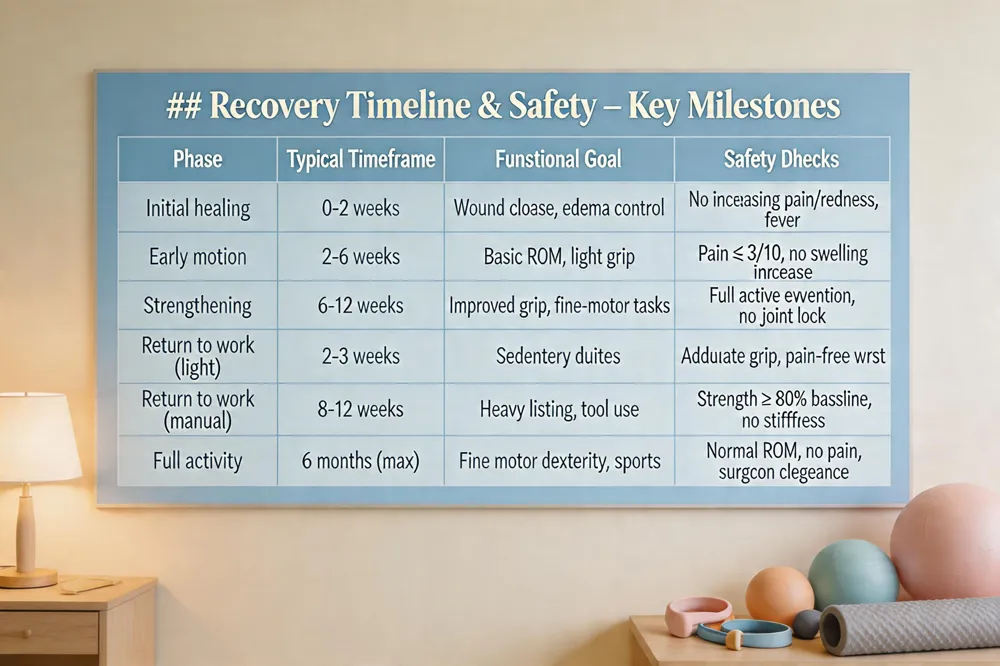
Recovery Timeline & Safety – Key Milestones
| Phase | Typical Timeframe | Functional Goal | Safety Checks |
|---|---|---|---|
| Initial healing | 0‑2 weeks | Wound closure, edema control | No increasing pain/redness, fever |
| Early motion | 2‑6 weeks | Basic ROM, light grip | Pain ≤ 3/10, no swelling increase |
| Strengthening | 6‑12 weeks | Improved grip, fine‑motor tasks | Full active extension, no joint lock |
| Return to work (light) | 2‑3 weeks | Sedentary duties | Adequate grip, pain‑free wrist |
| Return to work (manual) | 8‑12 weeks | Heavy lifting, tool use | Strength ≥ 80 % baseline, no stiffness |
| Full activity | 6 months (max) | Fine motor dexterity, sports | Normal ROM, no pain, surgeon clearance |
 What is the average recovery time for hand surgery?
Most patients achieve basic healing and functional use in 6–8 weeks, but full strength and fine‑motor dexterity often require up to 6 months. Simple procedures such as carpal‑tunnel release may permit a return to normal activities within 2–4 weeks, whereas fracture fixation, tendon repair, or joint reconstruction usually need 3–6 months of progressive therapy.
What is the average recovery time for hand surgery?
Most patients achieve basic healing and functional use in 6–8 weeks, but full strength and fine‑motor dexterity often require up to 6 months. Simple procedures such as carpal‑tunnel release may permit a return to normal activities within 2–4 weeks, whereas fracture fixation, tendon repair, or joint reconstruction usually need 3–6 months of progressive therapy.
How long after hand surgery can I drive? Driving depends on procedure complexity, anesthesia, and pain‑medication use. For minor soft‑tissue repairs, many resume driving in 1–2 weeks once grip strength is adequate, wrist motion is pain‑free, and narcotics are stopped. More extensive repairs often require 4–6 weeks or longer, especially if the dominant hand was operated on. Clearance from Dr. Yu or your surgeon is essential.
How long after hand surgery can I return to work? Light‑duty or sedentary jobs may be resumed in 2–3 weeks, while manual labor typically needs 8–12 weeks. Most patients are cleared for full duties between 6 and 14 weeks, guided by therapist assessment of swelling, strength, and range of motion.
Complications after hand surgery Watch for increasing pain, redness, swelling, or drainage that could signal infection. Other risks include delayed wound healing, scar adhesions, joint stiffness, nerve irritation, and, rarely, Complex Regional Pain Syndrome or deep‑vein thrombosis. Prompt reporting to your surgeon is critical.
Duration of hand therapy A structured hand‑therapy program usually starts within the first week and continues for 4–6 weeks of active mobilization, followed by progressive strengthening for an additional 2–4 months, tailored to individual healing and functional goals.
Practical Tips and Resources for Patients
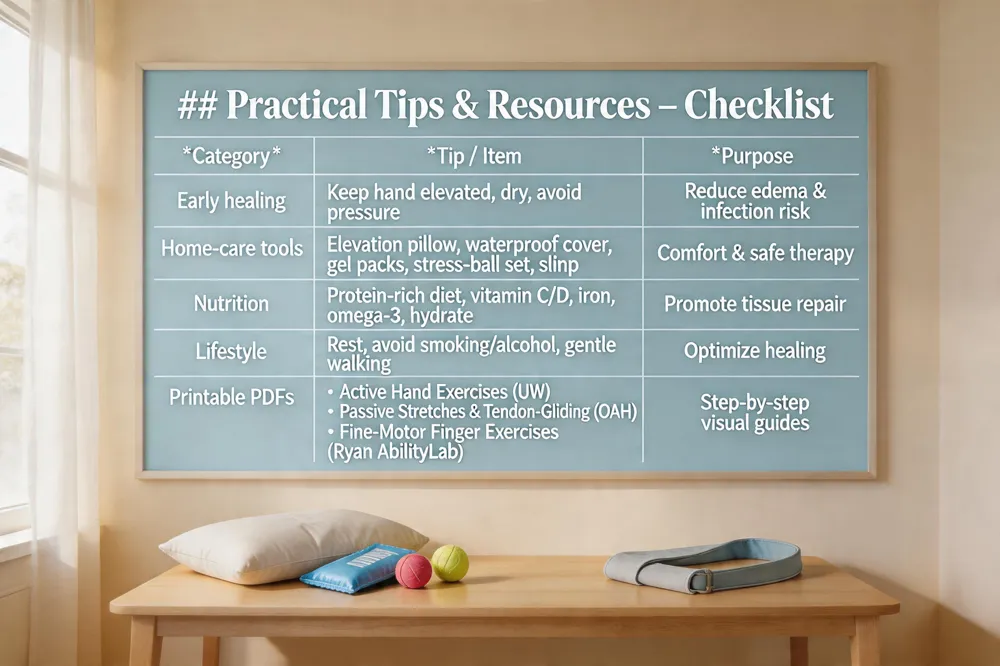
Practical Tips & Resources – Checklist
| Category | Tip / Item | Purpose |
|---|---|---|
| Early healing | Keep hand elevated, dry, and avoid pressure | Reduce edema & infection risk |
| Home‑care tools | Elevation pillow, waterproof cover, gel packs, stress‑ball set, sling | Comfort & safe therapy |
| Nutrition | Protein‑rich diet, vitamin C/D, iron, omega‑3, hydrate | Promote tissue repair |
| Lifestyle | Rest, avoid smoking/alcohol, gentle walking | Optimize healing |
| Printable PDFs | • Active Hand Exercises (UW) • Passive Stretches & Tendon‑Gliding (OAH) • Fine‑Motor Finger Exercises (Ryan AbilityLab) | Step‑by‑step visual guides |
Things to Avoid During Early Healing
- Do not bump, pressure, or lift the operated hand while it is still in a cast, splint, or bandage.
- Keep dressings, casts, and splints dry; moisture can cause skin irritation and infection.
- Do not ignore fever, increasing swelling, redness, drainage, tingling, or numbness—contact your surgeon immediately.
- Do not remove or adjust any orthosis without your surgeon’s approval, and do not skip prescribed hand‑therapy sessions.
Helpful Items and Home‑Care Tools
- Elevation pillow or wedge to keep the hand above heart level.
- Waterproof cast/sling cover for safe showers.
- Reusable hot‑and‑cold gel packs for pain and edema control.
- Soft‑grip stress‑ball set for early finger and forearm exercises once cleared.
- Lightweight sling or Blue‑Carter pillow for comfort while resting.
Nutrition and Lifestyle for Optimal Healing
- Eat a protein‑rich diet with vitamin C, vitamin D, iron, and omega‑3 fatty acids.
- Stay well‑hydrated, get plenty of rest, and avoid smoking and excess alcohol.
- Incorporate gentle movement (short walks, prescribed therapist exercises) to boost circulation.
Printable Hand‑Therapy PDFs
- University of Washington: Active Hand Exercises
- Orthopaedic Hand Clinic: Passive Stretches & Tendon‑Gliding
- Ryan AbilityLab: Fine‑Motor Finger Exercises These resources provide step‑by‑step instructions, repetitions, and safety tips for a smooth recovery.
Putting It All Together for Optimal Healing
Successful hand‑surgery recovery hinges on daily, disciplined practice of the prescribed exercises—cast touches, finger taps, tight‑fist releases, wrist and forearm motions, and swelling‑control measures such as elevation and gentle compression. Each session reinforces tendon gliding, prevents joint stiffness, and builds the grip strength needed for functional tasks. Equally vital is ongoing communication with Dr. Yu and the certified hand therapists overseeing the program; reporting any new pain, swelling, or functional limitation lets the team adjust intensity, modify splinting, or introduce adjunct modalities before complications arise. When patients remain consistent and collaborative, they experience faster return to daily activities, reduced scar formation, and lasting improvements in dexterity, strength, and overall hand health, laying the foundation for long‑term functional independence.