Why Modern Imaging Matters in Hand Trauma
Intra‑operative imaging has moved from basic C‑arms to flat‑panel detectors, cone‑beam CT, and hybrid OR systems, delivering up to 75 % lower radiation dose and 3‑D visualisation of fracture reduction. This evolution enables surgeons to verify hardware placement and bone alignment in real time, dramatically reducing mal‑positioned implants and the need for revision surgery. By combining high‑resolution ultrasound, CT with 3‑D reconstruction, and MRI, clinicians can map tendon, ligament and nerve injury before entering the OR, plan patient‑specific guides, and rehearse complex reconstructions on printed models. In California’s trauma network—where Dr. Rebecca S. Yu practices—the seamless integration of these modalities with low‑dose fluoroscopy, navigation software and intra‑operative cone‑beam CT shortens operative time, protects staff from radiation, and improves functional outcomes measured by DASH scores. The multimodal workflow thus translates technological advances into safer, more precise hand‑trauma care across the state.
Fundamentals of Hand and Wrist Imaging
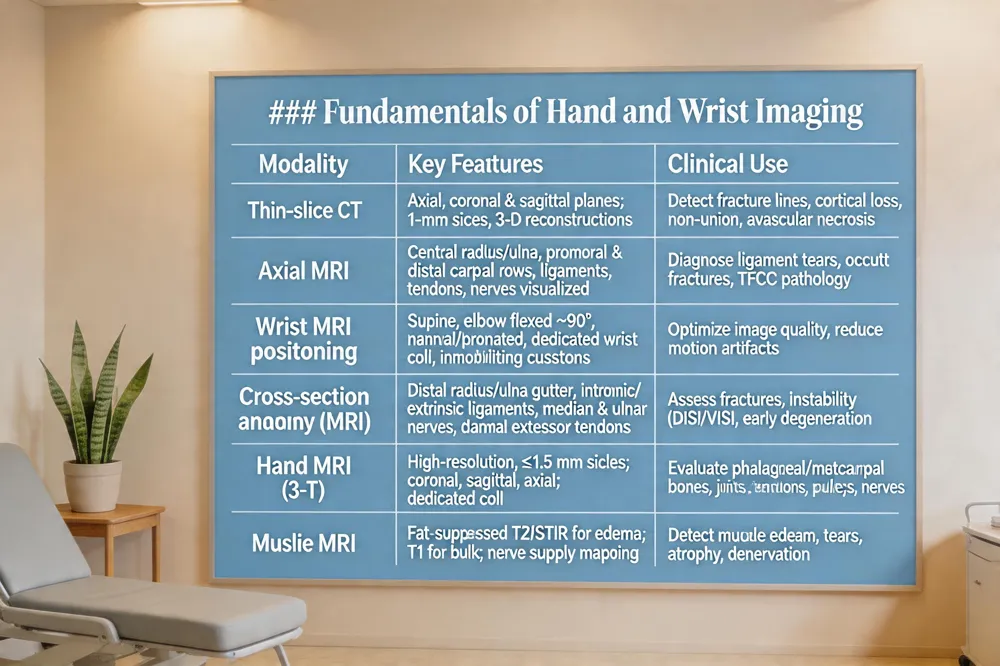
Fundamentals of Hand and Wrist Imaging
| Modality | Key Features | Clinical Use |
|---|---|---|
| Thin‑slice CT | Axial, coronal & sagittal planes; 1‑mm slices; 3‑D reconstructions | Detect fracture lines, cortical loss, non‑union, avascular necrosis |
| Axial MRI | Central radius/ulna; proximal & distal carpal rows; ligaments, tendons, nerves visualized | Diagnose ligament tears, occult fractures, TFCC pathology |
| Wrist MRI positioning | Supine, elbow flexed ~90°, hand neutral/pronated, dedicated wrist coil, immobilizing cushions | Optimize image quality, reduce motion artifacts |
| Cross‑section anatomy (MRI) | Distal radius/ulna gutter, intrinsic/extrinsic ligaments, median & ulnar nerves, dorsal extensor tendons | Assess fractures, instability (DISI/VISI), early degeneration |
| Hand MRI (3‑T) | High‑resolution, ≤1.5 mm slices; coronal, sagittal, axial; dedicated hand coil | Evaluate phalangeal/metacarpal bones, joints, tendons, pulleys, nerves |
| Muscle MRI | Fat‑suppressed T2/STIR for edema; T1 for bulk; nerve supply mapping | Detect muscle edema, tears, atrophy, denervation |
 CT hand anatomy – Thin‑slice CT produces axial, coronal, and sagittal images that delineate the distal radius/ulna, eight carpal bones, five metacarpals and all phalanges. Joint spaces (radiocarpal, intercarpal, carpometacarpal, distal radio‑ulnar) and landmarks such as Lister’s tubercle are clearly visible, allowing detection of fracture lines, cortical loss, non‑union or avascular necrosis.
Wrist axial MRI anatomy – In the axial plane the radius and ulna lie central, with the proximal carpal row (scaphoid, lunate, triquetrum) just distal. The distal row (pisiform, trapezium, trapezoid, capitate, hamate) surrounds the TFCC and distal radioulnar joint. Ligaments (scapholunate, lunotriquetral, palmar radiocarpal) and tendon sheaths, median and ulnar nerves are visualized, aiding diagnosis of ligament tears and occult fractures.
Wrist MRI positioning – Patient is supine, elbow flexed ~90°, forearm on the table, hand neutral and slightly pronated on a dedicated wrist coil. Cushions immobilize the wrist; a three‑plane localizer confirms centering before diagnostic sequences.
Wrist cross‑section anatomy – Axial cross‑sections show the distal radius/ulna forming a gutter, proximal carpal row (scaphoid, lunate, triquetrum, pisiform) and distal row (trapezium, trapezoid, capitate, hamate). Intrinsic intercarpal ligaments, extrinsic volar/dorsal ligaments, median nerve in the carpal tunnel, ulnar nerve/artery in Guyon’s canal, and dorsal extensor tendons are all present.
Wrist joint anatomy MRI – MRI depicts the distal radioulnar joint, radiocarpal and midcarpal compartments, intrinsic ligaments (scapholunate, lunotriquetral), extrinsic ligaments, TFCC, cartilage, and capsular fluid, allowing assessment of fractures, instability (DISI/VISI), and early degeneration.
Hand MRI anatomy – High‑resolution 3‑T hand MRI shows phalangeal and metacarpal bones, interphalangeal joints, flexor/extensor tendons, pulleys, collateral ligaments, digital nerves and vessels, and the triangular fibrocartilage complex in coronal, sagittal and axial planes.
Hand muscle anatomy, MRI – Intrinsic thenar, hypothenar, interosseous groups and extrinsic flexor‑extensor muscles are visualized with thin (≤1.5 mm) slices. Fat‑suppressed T2/STIR highlights edema or tears, while T1 images demonstrate bulk and anatomy; nerve supply (median, ulnar, radial) is appreciated for diagnosing atrophy or denervation.
Clinical Imaging for Diagnosis and Decision‑Making
Clinical Imaging for Diagnosis and Decision‑Making
| Modality | Indications | Typical Findings |
|---|---|---|
| Plain X‑ray (3‑view) | Initial assessment of hand/wrist pain, suspected fracture, arthritis | Joint‑space loss, sub‑chondral sclerosis, osteophytes (OA); symmetrical narrowing, marginal erosions (RA) |
| CT (thin‑slice, 3‑D) | Suspected occult fracture, complex intra‑articular injury | Precise fracture mapping, step‑offs, cortical interruption, 3‑D reconstructions |
| MRI (3‑T, dedicated coil) | Soft‑tissue, ligament, nerve pathology; cartilage assessment | Ligament tears, TFCC injury, tendon pathology, bone‑marrow edema |
| Ultrasound (high‑frequency) | Dynamic tendon evaluation, nerve entrapment, superficial fluid collections | Real‑time tendon gliding, A1 pulley catching, nerve morphology |
| AI‑assisted analysis | Rapid screening for distal radius fractures, alignment measurement | Automated fracture detection (~93 % accuracy), auto‑measurement of bone alignment |
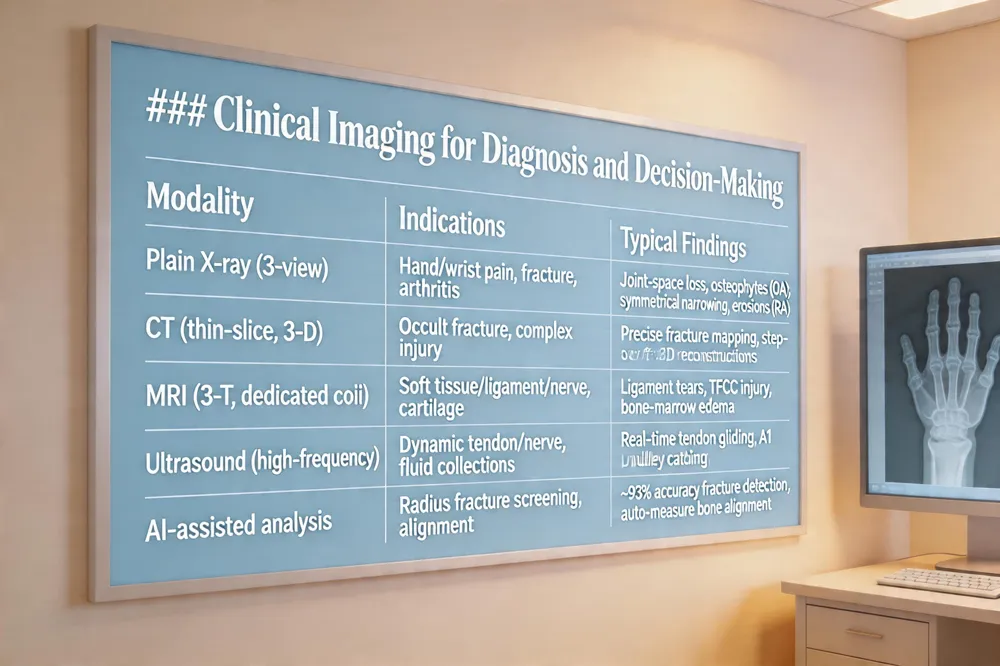 Radiologic evaluation of hand arthritis – Plain X‑rays reveal joint‑space loss, sub‑chondral sclerosis and osteophytes in osteoarthritis, especially at the DIP joints, thumb CMC, and carpal articulations. Rheumatoid arthritis shows symmetrical narrowing, marginal erosions and juxta‑articular osteopenia without prominent spurs.
Normal wrist X‑ray vs broken – A normal study displays smooth Gilula arcs, uniform 1‑2 mm joint spaces and proper radius‑lunate‑capitate alignment. Fractures interrupt cortical lines, produce step‑offs in the arcs, widen or irregular joint spaces and may displace fragments; scaphoid waist breaks often need oblique or ulnar‑deviation views.
Imaging hierarchy for hand and wrist injuries – First‑line is a three‑view radiograph series. Persistent suspicion of occult or complex fractures warrants thin‑slice CT with 3‑D reconstructions. Soft‑tissue, ligament or nerve pathology is best assessed with high‑resolution MRI (3‑T, dedicated hand coil) or, when MRI is unavailable, high‑frequency ultrasound.
Definition and timing of trauma imaging – Trauma imaging comprises rapid X‑ray, ultrasound, CT and MRI studies performed within the emergency window to identify fractures, dislocations, vascular injury or occult bone injury. Low‑dose protocols and point‑of‑care ultrasound reduce radiation, especially in pediatric patients.
Radiology assistance tools and AI – Real‑time dosimeters, protective shielding and lead aprons safeguard staff during intra‑operative cone‑beam CT or fluoroscopy. AI algorithms now detect distal radius fractures on radiographs with ~93 % accuracy and can auto‑measure hand‑bone alignment, shortening diagnosis and guiding surgical planning.
Fast‑track answers to common questions – • X‑ray of hand/wrist with arthritis: shows space loss, sclerosis, osteophytes (OA) or erosions and osteopenia (RA). • Normal vs broken wrist X‑ray: compare Gilula arcs, cortical continuity, joint‑spacing. • Best imaging for hand pain: MRI for soft‑tissue detail; ultrasound for dynamic tendon assessment. • Best imaging for wrist injury: start with X‑ray, then CT for bone detail or MRI for ligament/cartilage. • Best imaging for hand injury: X‑ray first, MRI (or US) next for soft tissue. • MRI of hand/wrist shows bone marrow, cartilage, ligaments, tendons, nerves and vascularity. • Trauma imaging: rapid, multimodal imaging to guide definitive care within the golden hour. • Golden hour: first 60 minutes after severe injury critical for hemorrhage control and definitive treatment. • MRI wrist radiology assistant: guides positioning, coil use, protocol selection and real‑time quality control to improve diagnostic accuracy.
Advanced 3‑D and Intra‑operative Imaging Technologies
Advanced 3‑D and Intra‑operative Imaging Technologies
| Technology | Resolution / Features | Typical Applications |
|---|---|---|
| Flat‑panel detector C‑arm | Up to 60 000 grey levels; pixel size ≈100 µm; low‑dose | Real‑time fluoroscopy, pediatric imaging, intra‑operative guidance |
| Cone‑beam CT (CBCT) – O‑arm | Rotating flat‑panel; volumetric dataset; 3‑D reconstructions | Hand/wrist fracture reduction verification, screw trajectory planning |
| Fixed floor‑based CBCT (Siemens Artis zeego) | Integrated 3‑D imaging & navigation; sub‑mm accuracy | Hybrid OR, complex carpometacarpal reconstructions, pelvis & spine imaging |
| Intra‑operative 3‑D imaging | Immediate verification of reduction & hardware placement | Reduce revision surgeries, guide microsurgical tendon grafting |
| Augmented‑reality navigation | Overlay of imaging data onto surgical field | Precision screw placement, complex ligament reconstruction |
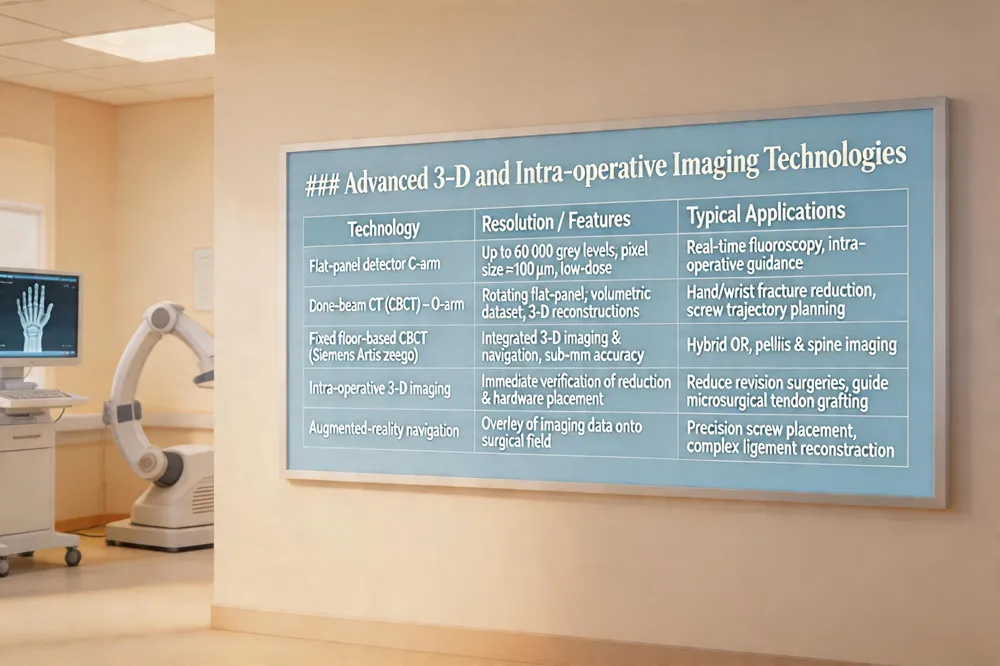 Flat‑panel detectors have replaced conventional C‑arms in many trauma suites, delivering up to 60,000 grey levels and pixel sizes as small as 100 µm. This higher spatial resolution yields clearer fluoroscopic images while lowering radiation exposure by up to 75 % in pediatric studies, and a mobile 43 × 43 cm detector can capture the entire pelvis in a single shot.
Cone‑beam computed tomography (CBCT) rotates a flat‑panel detector around the patient to create a volumetric dataset that can be reconstructed into multiplanar or volume‑rendered images. The O‑arm (Medtronic) is the most common mobile CBCT system; it is routinely used for spine surgery and, when combined with navigation, assists hand and wrist fracture reduction and implant positioning. Fixed floor‑based systems such as the Siemens Artis zeego in hybrid operating rooms integrate 3‑D imaging and navigation, allowing sub‑millimetre placement of screws in the pelvis, wrist, and complex carpometacarpal reconstructions.
Intra‑operative 3‑D imaging instantly verifies fracture reduction and hardware placement, dramatically decreasing the need for secondary revision surgeries caused by malpositioned implants. For complex hand injuries—displaced intra‑articular metacarpal or carpal fractures, scaphoid non‑unions, severe ligamentous dissociation, or nerve transections—these technologies guide precise reduction, screw trajectory, and navigation‑assisted tendon grafting.
What hand injuries require surgery? Surgery is indicated for displaced or unstable fractures, joint surface collapse, severe ligament injuries such as scapholunate dissociation, complete flexor or extensor tendon ruptures, complex nerve injuries with motor loss, advanced carpometacarpal arthritis, and refractory trigger finger, Dupuytren’s contracture, or carpal tunnel syndrome.
What is the most complicated hand surgery? Toe‑to‑finger transplantation—requiring microsurgical replantation of bone, tendons, vessels, and nerves, plus advanced nerve grafting—represents the most technically demanding hand operation.
What are the innovations in hand surgery? Innovations combine high‑resolution ultrasound , 3‑D MRI, and intra‑operative CBCT with biologics (PRP, stem‑cell scaffolds), robotic assistance, AI‑driven planning, augmented‑reality navigation, and tele‑rehabilitation platforms.
What are the advances in hand surgery? Key advances include high‑resolution imaging, minimally invasive arthroscopy, WALANT anesthesia, biologic adjuncts, and patient‑specific 3‑D‑printed surgical guides.
MRI hand with contrast – Gadolinium contrast is reserved for cases where vascularity, inflammation, or tumor perfusion must be highlighted; routine musculoskeletal assessments of ligaments, tendons, cartilage, or occult fractures are adequately performed without contrast, keeping scan time short and safe for most patients.
Ultrasound, Dynamic Imaging, and Emerging Techniques
Ultrasound, Dynamic Imaging, and Emerging Techniques
| Technique | Spatial Resolution | Clinical Use |
|---|---|---|
| High‑resolution ultrasound (22 MHz) | ~30 µm | Visualize fascicles of digital nerves, arterial wall layers, fine tendons |
| Ultrahigh‑frequency probes (13‑70 MHz) | ≤30 µm | Diagnose peripheral neuropathies, partial tendon tears, vascular injury |
| Dynamic ultrasound | Real‑time video during motion | Assess tendon gliding, A1 pulley catching (trigger finger), ECU subluxation |
| Contrast‑enhanced ultrasound (CEUS) | Enhanced vascular contrast | Differentiate complete vs partial extensor tendon ruptures, localize tendon ends |
| Point‑of‑care ultrasound (POCUS) | Portable, bedside | Rapid assessment of tendon integrity, foreign bodies, fluid collections |
| AI‑driven segmentation | Automated image analysis | Pre‑operative planning, fixation strategy recommendation, reduces decision‑time by ~20 % |
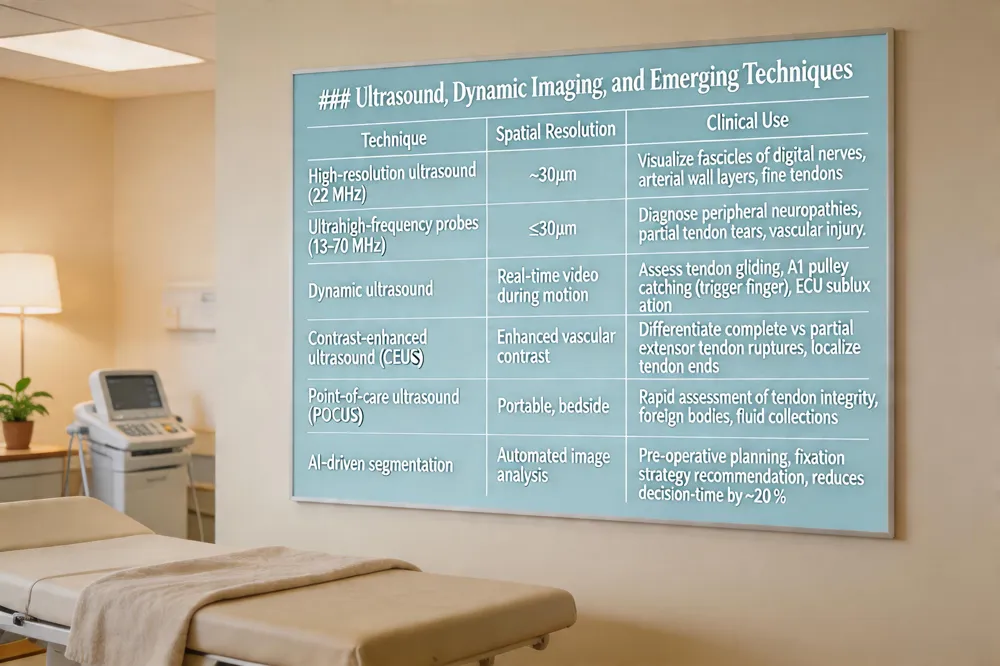 High‑resolution ultrasound (up to 22 MHz) and ultrahigh‑frequency probes (13‑70 MHz) provide spatial resolution down to 30 µm, allowing surgeons to see individual fascicles of digital nerves, arterial wall layers, and fine tendon structures. This level of detail improves the diagnosis of peripheral neuropathies, partial tendon tears, and vascular injury in acute hand trauma.
Dynamic imaging adds a functional dimension: real‑time videos capture tendon gliding, A1 pulley catching in trigger finger, and ECU tendon subluxation during pronation‑supination. Contrast‑enhanced ultrasound (CEUS) further differentiates complete from partial extensor tendon ruptures and precisely localizes tendon ends, guiding percutaneous repair.
Point‑of‑care ultrasound (POCUS) has become a bedside staple in emergency departments. Portable hand‑held devices enable rapid assessment of tendon integrity, foreign bodies, and fluid collections without radiation, expediting triage and surgical referral.
Artificial‑intelligence algorithms now assist image analysis, achieving ~93 % accuracy in detecting distal radius fractures on radiographs and automatically measuring hand‑bone displacement. AI‑driven segmentation speeds pre‑operative planning and can suggest optimal fixation strategies, cutting decision‑making time by roughly 20 %.
Frequently asked questions
- Does your whole body go in for a hand MRI? No. A hand MRI uses a dedicated coil that surrounds only the hand (or wrist), keeping the rest of the body outside the scanner. The exam is focused, quicker, and more comfortable than a full‑body study.
- Does your whole body go in for wrist MRI? No. A wrist MRI images just the wrist and adjacent distal forearm with a specialized coil; the remainder of the body is not scanned.
- What to expect for a hand MRI? After check‑in and removal of metal, you lie on a padded table; your hand is placed in a small coil while the table slides into the scanner. The study lasts 20‑30 minutes (≈40 minutes with contrast), is non‑invasive, and involves loud tapping noises protected by hearing pads.
- How long is an MRI for the wrist? Scanning time is typically 20‑30 minutes; total appointment time, including setup and post‑scan paperwork, is about one hour.
Patient Experience, Safety, and Post‑operative Care
Patient Experience, Safety, and Post‑operative Care
| Aspect | Recommendation | Rationale |
|---|---|---|
| Radiation protection | Lead aprons, thyroid collars, real‑time dosimeters, low‑dose protocols | Minimize staff and patient exposure, especially in pediatric cases |
| Intra‑operative imaging safety | Staff exits room or stands behind shielding during scans | Reduce unnecessary radiation dose to personnel |
| Post‑surgery wound care | Keep dressings dry, cover with sealed bag when showering | Prevent infection, maintain sterile environment |
| Early mobilization | Elevate hand, begin gentle ROM as prescribed | Reduce swelling, prevent stiffness, promote functional recovery |
| Pain management | Scheduled analgesics with food, monitor for numbness/tingling | Optimize comfort, detect early complications |
| Telehealth follow‑up | Virtual visits, wound photo sharing, wearable sensor data | Reduce travel burden, enable continuous monitoring of healing |
| Golden hour awareness | Imaging and definitive care within first 60 minutes of severe injury | Improves survival and limb preservation outcomes |
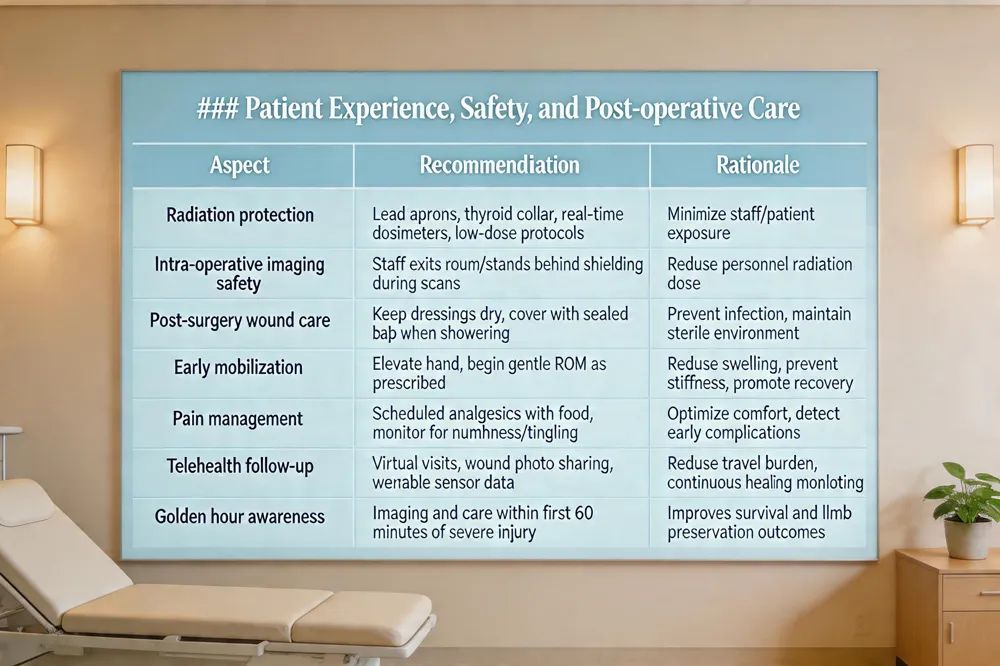 Radiation safety and protective measures are essential during intra‑operative imaging. Staff should stand behind a protective wall or leave the room while scans are performed, wear lead aprons, thyroid collars, and goggles, and use real‑time dosimeters to monitor exposure. Modern flat‑panel C‑arms and cone‑beam CT systems operate with low‑dose protocols that can cut patient dose by up to 75 % in pediatric cases, while distance and shielding keep staff exposure well below regulatory limits.
Real‑time dosimetry adds another layer of protection. Portable dosimeters alert the team when cumulative dose approaches preset thresholds, prompting a pause or a change in technique. This data can be recorded for quality‑control audits and to fine‑tune protocol parameters across the operating suite.
Recovery guidelines after hand surgery focus on protecting the surgical site while restoring function. Keep dressings clean and dry; cover them with a sealed plastic bag when showering. Elevate the hand above heart level for the first few days using a sling or pillow to reduce swelling. Begin gentle range‑of‑motion and finger‑wiggle exercises as prescribed, and avoid lifting or weight‑bearing until cleared by the surgeon. Take pain medication on schedule, preferably with a small meal, and report any persistent numbness, tingling, or severe pain. Follow therapist‑directed programs that may include splinting, heat, massage, or occupational therapy.
Telehealth follow‑up and remote rehabilitation are increasingly common. After discharge, patients can attend virtual visits, share wound photos, and receive real‑time feedback from surgeons. Wearable sensor gloves and smartphone apps record joint motion and grip strength, allowing therapists to adjust exercises without an in‑person visit. This model reduces travel burden while maintaining close monitoring of healing and functional progress.
Trauma imaging, a rapid set of radiologic studies (X‑ray, ultrasound, CT, MRI), evaluates injuries from accidents. It enables surgeons to plan precise interventions, especially when advanced low‑dose CT or cone‑beam CT provides three‑dimensional detail intra‑operatively.
The "golden hour" of trauma surgery denotes the first 60 minutes after severe injury, when rapid assessment, hemorrhage control, and definitive care dramatically improve survival and limb preservation.
For a hand MRI, patients remove metal objects, change into a gown, and are positioned in a dedicated hand coil. The scan lasts 20‑30 minutes, is non‑ionizing, and may include gadolinium contrast if ordered. Results are interpreted by a radiologist and forwarded to the orthopedic surgeon for surgical planning.
Moving Forward with Informed, Image‑Guided Care
The modern hand trauma workflow thrives on a seamless blend of multimodal imaging and surgical expertise. Flat‑panel fluoroscopy, cone‑beam CT and high‑resolution ultrasound now provide real‑time three‑dimensional feedback that lets surgeons verify fracture reduction and hardware placement before the incision is closed, dramatically lowering revision rates. In Berkeley, Dr. Rebecca S. Yu leverages this imaging suite—plain radiographs for rapid triage, thin‑slice CT with 3‑D reconstruction for complex carpometacarpal fractures, and point‑of‑care ultrasound for tendon integrity—to tailor each operation to the patient’s anatomy and functional goals, resulting in shorter operative times and higher DASH scores. Looking ahead, artificial‑intelligence algorithms will auto‑segment bone fragments and suggest optimal fixation plans, while augmented‑reality overlays will project pre‑operative CT or MRI data onto the surgical field. Coupled with patient‑specific 3‑D‑printed implants and guides, these technologies promise even more precise, personalized hand trauma care.