Why a Structured Approach Matters
Hand injuries account for roughly 20‑30 % of U.S. emergency visits, making them one of the most common traumatic presentations. Prompt neurovascular and imaging assessment reduces the risk of missed fractures, nerve injury, and compartment syndrome, leading to faster healing and fewer long‑term deficits. The Trauma Care Checklist—rooted in the ABCDE primary survey and a systematic neurovascular exam—ensures that critical steps such as elevation, splinting, tetanus prophylaxis, and early specialist referral are never omitted, improving functional outcomes and streamlining care.
Immediate First‑Aid and Emergency Response
| Step | Action |
|---|---|
| RICE/PRICE | Protection, Rest, Ice (20 min/hr for 24‑48 h), Compression, Elevation (above heart) |
| Primary Survey (ABCDE) | Airway (c‑ical protection), Breathing (oxygen as needed), Circulation (bleeding control, pulses, capillary refill), Disability (neuro exam), Exposure (full hand view, prevent hypothermia) |
| Red‑Flag Signs | Severe pain, deformity, numbness/pallor/blue nail, loss of motion, infection (redness, warmth, pus) |
| WHO Emergency Checklist | Adapted Trauma Care Checklist for acute hand emergencies |
| Key Questions | Call 911 if life‑threatening, apply pressure, clean, splint, ice, seek imaging/tetanus if needed |
| Safety Facts | Hands most injured, most preventable, manual‑handling strains common, sharp tools cause cuts, lockout/tagout saves lives |
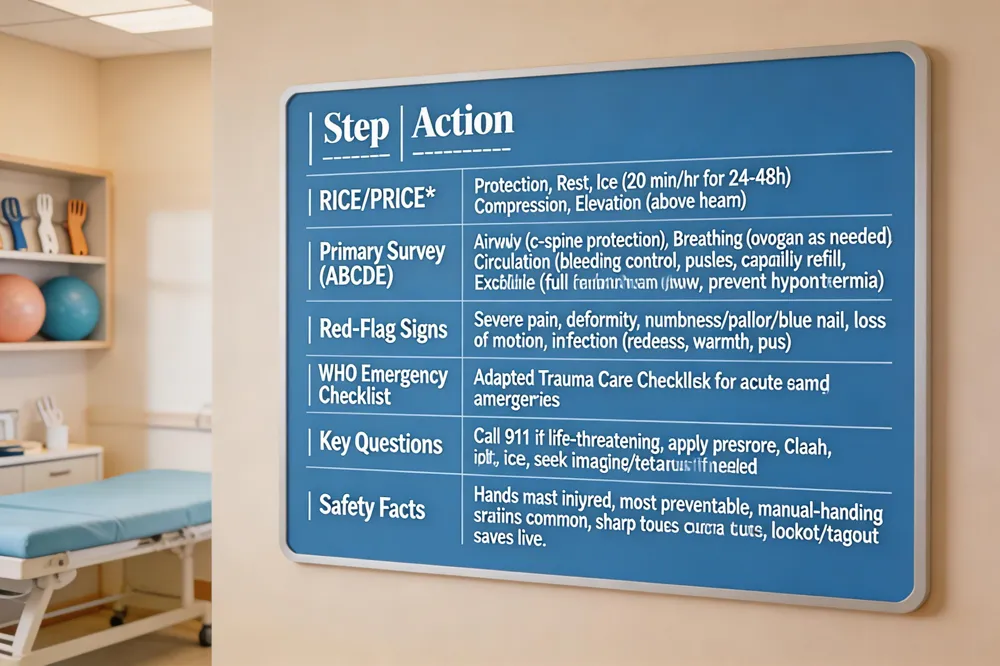 RICE/PRICE protocols – Begin with Protection, Rest, Ice, Compression, and Elevation. Remove the patient from the activity, keep the injured hand immobilized with a splint or padded rigid material, apply ice wrapped in a cloth for 20‑minutes every hour for the first 24‑48 hours, and elevate above heart level to curb swelling.
Primary survey (ABCDE) for trauma – Follow the ABCDE sequence: Airway (ensure patency with cervical spine protection), Breathing (assess ventilation and give oxygen as needed), Circulation (control bleeding, check radial/ulnar pulses, capillary refill), Disability (quick neuro exam for consciousness and limb movement), Exposure/Environment (fully expose the hand while preventing hypothermia).
Recognition of red‑flag signs – Watch for severe pain, deformity, numbness, pallor, a blue nail bed, loss of motion, or signs of infection (redness, warmth, pus). These require urgent medical evaluation.
WHO Medical Emergency Checklist – Developed by the WHO Global Emergency Care Systems Network, this checklist adapts the WHO Trauma Care Checklist for acute medical conditions and can be customized for any emergency‑care setting.
Key questions answered: First‑aid for hand injuries includes calling 911 for life‑threatening injuries, applying pressure, cleaning, splinting, icing, and seeking professional care for any limits in movement, infection signs, or need for imaging/tetanus prophylaxis. The primary survey’s five components are Airway, Breathing, Circulation, Disability, Exposure. Five hand‑safety facts: hands are most often injured, most injuries are preventable, manual‑handling strains are common, sharp tools cause most cuts, and lockout/tagout saves lives.
Systematic Examination and Assessment
| Component | Checklist Items |
|---|---|
| Hand Exam | Hand hygiene, identity verification, consent, expose hand/wrist, inspect dorsal/palmar/lateral surfaces, compare sides |
| Palpation | Temperature, radial/ulnar pulses, thenar/hypothenar bulk, each joint (MCP, PIP, DIP, CMC), anatomical snuffbox, tender points |
| ROM & Strength | Active ROM of fingers, wrist, thumb; grip & pincer strength |
| Sensory Testing | Median, ulnar, radial nerve distribution |
| Special Tests | Tinel’s, Phalen’s, Finkelstein’s (as indicated) |
| Documentation | Record all findings for baseline and follow‑up |
| Physiotherapy Assessment | Subjective history, posture, deformities, palpation, neuro screen, ROM, dynamometer grip, orthopedic tests |
| Fall‑Related Injuries | Look for FOOSH signs: bruises, sprains, fractures (scaphoid, metacarpal), tendon lacerations, dislocations |
| Palm Cut Healing | Superficial 5‑7 days; deeper stitches 10‑14 days + 2‑4 weeks for strength; scar remodeling months |
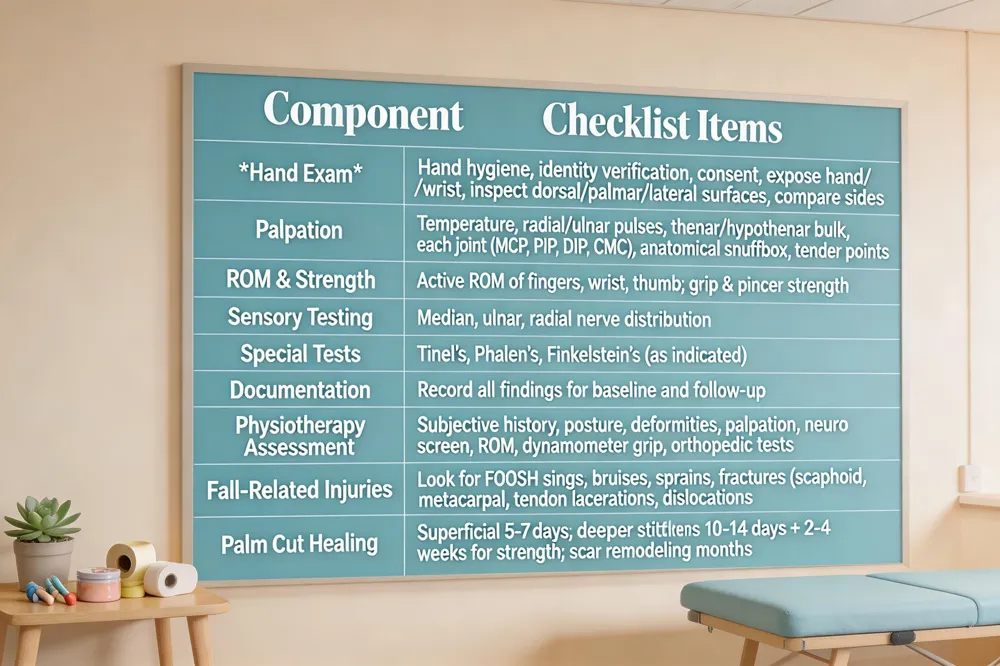
Hand examination checklist
Wash hands, introduce yourself, confirm name/DOB, obtain consent, expose hands/wrists. Inspect dorsal, palmar, lateral surfaces for swelling, deformity, skin changes, scars, bruises, compare sides. Palpate temperature, radial/ulnar pulses, thenar/hypothenar bulk, each joint (MCP, PIP, DIP, CMC), anatomical snuffbox, and tender areas. Test active ROM of fingers, wrist, thumb; assess grip and pincer strength. Perform sensory testing of median, ulnar, radial nerves and special tests (Tinel’s, Phalen’s, Finkelstein’s) as indicated. Document findings.
Hand and wrist examination checklist
After hand hygiene and PPE, verify identity, explain exam, and expose hands, wrists, elbows. Look for swelling, scars, deformities on dorsal/palmar surfaces and forearms. Feel temperature, pulses, thenar/hypothenar bulk, and tenderness in the snuffbox. Test nerve sensations (median, ulnar, radial) and joint stability. Observe active motion: wrist flexion/extension, radial/ulnar deviation, finger extension/abduction, grip, pinch. Conclude with special orthopedic tests and summarize.
Hand Assessment physiotherapy
Begin with a detailed subjective history (mechanism, pain, numbness, function). Observe posture, deformities, and functional use. Palpate bony landmarks, tendons, soft tissue; perform neurological screen. Measure active/passive ROM, grip strength (dynamometer), and specific orthopedic tests (Finkelstein’s, Watson’s). Document to guide rehabilitation and surgical planning.
Hand injury from fall
A FOOSH impact can cause bruises, sprains, fractures (scaphoid, metacarpal), tendon lacerations, or dislocations. Look for severe pain, swelling, deformity, numbness. Prompt evaluation, imaging, splinting or surgery, and early therapy are essential to prevent malunion and stiffness.
Cut on palm of hand healing time
Superficial cuts heal in 5‑7 days; deeper lacerations with stitches need 10‑14 days for closure plus 2‑4 weeks for tissue strength. After stitch removal, keep wound clean, dry, elevated, and begin gentle ROM. Full scar remodeling may take months, especially if tendons were involved.
Recovery, Rehabilitation, and Follow‑Up
| Injury Type | Typical Recovery Timeline |
|---|---|
| Soft Tissue (sprains/strains/contusions) | Few weeks with RICE + protected immobilization |
| Ligament/Tendon Repair (surgical) | 3‑6 months structured rehab; remodeling up to 2 years |
| Simple Fractures | 3‑6 weeks splint/cast, then therapy for motion |
| Moderate Strains | 2‑4 weeks (minor) or 6‑8 weeks (moderate) |
| Complex Fractures/ligament/Tendon | 3‑6 months or longer, depending on severity and compliance |
| Common Hand Injuries (12) | Sprains/strains, fractures, contusions, cuts/lacerations, burns, dislocations, tendinitis, bursitis, plantar fasciitis, concussions, over‑use conditions, fingertip amputations |
| Top 3 Injuries | Severed fingertips, finger/metacarpal fractures (e.g., boxer’s fracture), distal‑radius/scaphoid wrist fractures |
| Follow‑Up | Regular clinical review, functional assessment, adjust rehab protocol as needed |
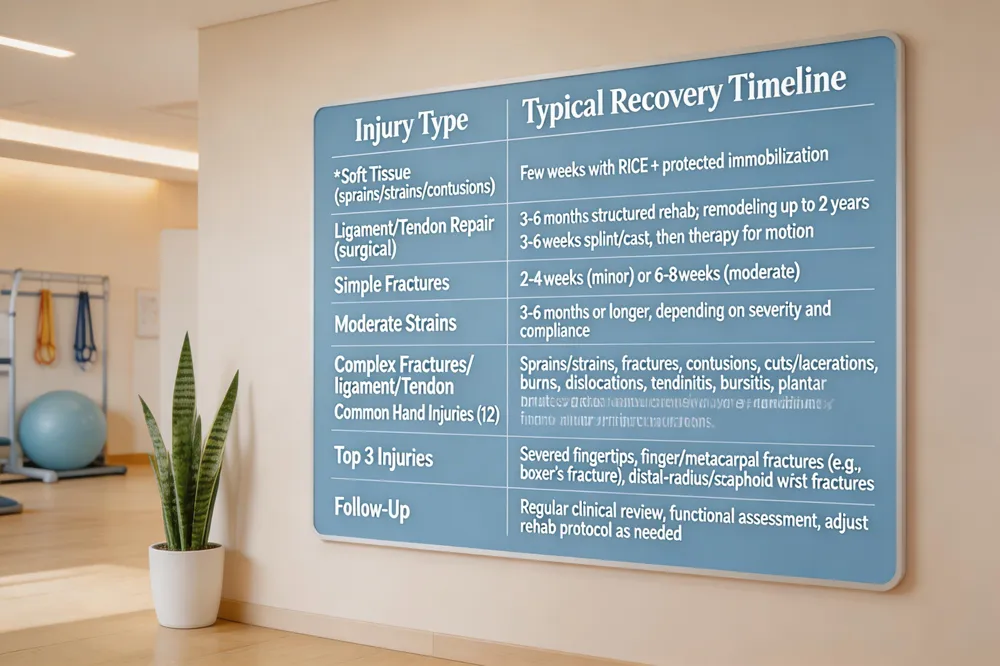 Soft tissue damage hand recovery time – Sprains, strains, and contusions usually improve within a few weeks with RICE (Rest, Ice, Compression, Elevation) and protected immobilization. More severe ligament or tendon injuries, especially those needing surgical repair, may require 3–6 months of structured rehab; the remodeling phase can continue up to two years, though most functional gains occur in the first 3–6 months.
Hand injury recovery time – Simple fractures need 3–6 weeks of splinting/casting, then therapy to regain motion. Minor strains heal in 2–4 weeks; moderate strains 6–8 weeks. Complex fractures, ligament tears, or tendon repairs can extend rehab to 3–6 months or longer, depending on age, health, and adherence.
Types of hand injury – Injuries involve bones (phalanges, metacarpals, carpal bones), joints (dislocations, sprains), tendons (flexor/extensor tears, mallet finger), nerves, ligaments (Skier’s thumb), skin lacerations, and crush/compartment injuries. Each category follows specific treatment pathways.
What are the 12 common injuries? – Sprains/strains, fractures, contusions, cuts/lacerations, burns, dislocations, tendinitis, bursitis, plantar fasciitis, concussions, over‑use conditions (tennis/golfer’s elbow), and fingertip amputations.
What are the top 3 hand injuries? – Severed fingertips, finger/metacarpal fractures (e.g., boxer’s fracture), and distal‑radius/scaphoid wrist fractures. Prompt assessment, elevation, and early controlled motion are essential to prevent stiffness and optimize healing.
Special Considerations and Surgical Options
| Issue | Key Points |
|---|---|
| Deep Lacerations | Pressure to stop bleeding, elevate, irrigate, antibiotic ointment, sterile dressing; evaluate for tendon/nerve/joint involvement |
| Tendon Reconstruction | Limited blood supply, requires microsurgical technique, precise tensioning, often grafting or staged repairs |
| Osteoarthritis Surgery | Joint fusion (pain elimination) or arthroplasty (motion preservation) of CMC, MCP, PIP, DIP; arthroscopic debridement possible |
| Outcome Measures | Michigan Hand Questionnaire (MHQ) – assesses function, pain, aesthetics, satisfaction |
| Traumatic Experiences Checklist (TEC) | Screens 29 events, records age/impact, provides severity scores for trauma‑related stress assessment |
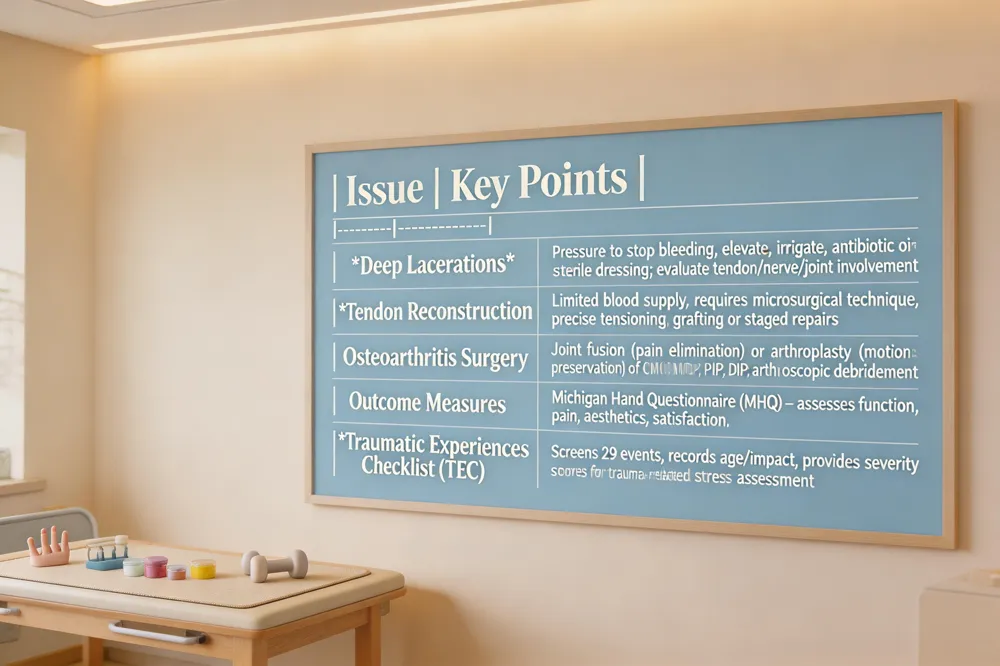 Management of deep lacerations begins with firm pressure to stop bleeding, elevation, and thorough irrigation. After cleaning, a thin antibiotic ointment is applied and the wound is covered with a sterile dressing. Because deep cuts may involve tendons, nerves, or joints, prompt evaluation by a hand‑specialty surgeon is essential for suturing, tissue glue, or imaging.
Complex hand surgery challenges are epitomized by tendon reconstruction. Tendons have limited blood supply, requiring precise microsurgical technique, exact tensioning, and often grafting or multi‑stage repairs. This makes tendon reconstruction the most technically demanding hand surgery.
Osteoarthritis surgical options for the hand include joint fusion (arthrodesis) to eliminate painful motion and joint replacement (arthroplasty) of the CMC, MCP, PIP, or DIP joints to preserve movement. Arthroscopic debridement or osteophyte removal may also be employed when conservative measures fail.
Outcome measurement tools such as the Michigan Hand Questionnaire (MHQ) assess function, pain, aesthetics, and satisfaction. A printable PDF is available from the University of Michigan Orthopaedic Research website, and many clinics adapt it to electronic platforms.
The Traumatic Experiences Checklist (TEC) screens for 29 potentially traumatic events, documenting occurrence, age, and impact. It provides reliable severity scores that guide further assessment and treatment planning for trauma‑related stress disorders.
Patient Education, Safety, and Follow‑Up
| Topic | Recommendation |
|---|---|
| PRICE Protocol | Rest, Ice (10‑15 min every 2‑3 h, 48‑72 h), Compress (elastic wrap), Elevate (above heart); NSAIDs if appropriate |
| Red‑Flag Monitoring | Persistent pain/swelling, numbness/tingling, limited motion, visible deformity/open wound, systemic symptoms |
| Appointments | Call 970‑419‑7050 or schedule online; telehealth for non‑operative follow‑up |
| Hand Safety | Wear gloves, keep work area clear, remove rings before swelling, follow lockout/tagout protocols |
| Osteoarthritis Surgery | Joint fusion (arthrodesis) or replacement (arthroplasty) of CMC, MCP, PIP, DIP; arthroscopic debridement if needed |
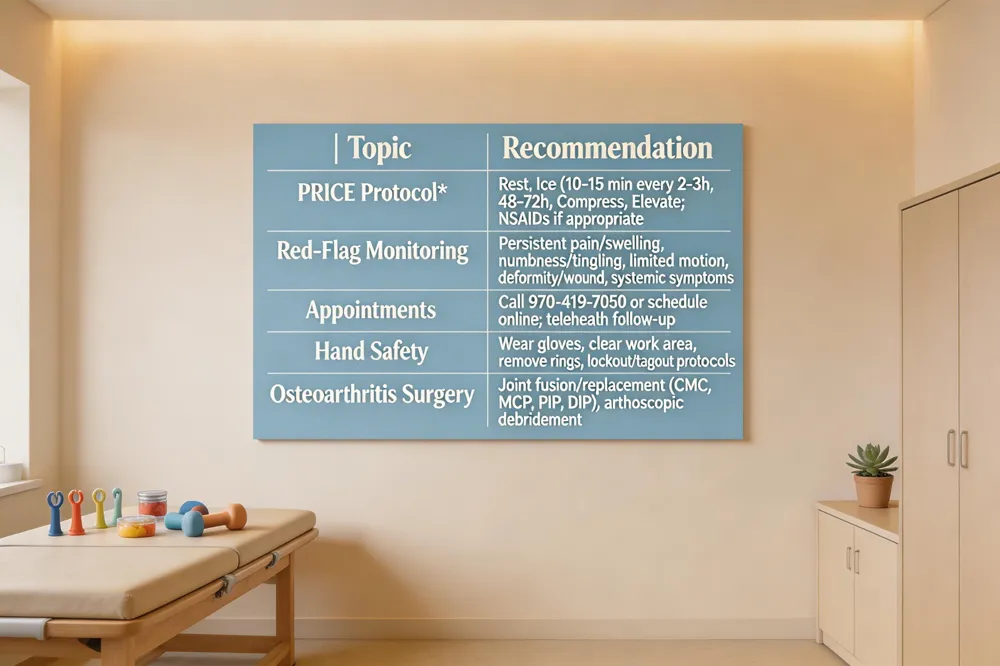 Managing swelling with PRICE – After a hand injury, follow the PRICE protocol: Rest the limb while keeping the shoulder, elbow, and fingers gently moving, Ice for 10‑15 minutes every 2‑3 hours for the first 48‑72 hours, Compress with an elastic wrap or compression glove, and Elevate above heart level whenever possible. Over‑the‑counter NSAIDs such as ibuprofen can reduce pain and inflammation, but verify contraindications with your physician. Continue gentle range‑of‑motion exercises after the first two days to prevent stiffness and keep the skin clean to avoid infection.
Red‑flag monitoring after injury – Watch for any of these five warning signs: (1) persistent pain or swelling that does not improve, (2) numbness, tingling, or loss of sensation, (3) limited motion or inability to move the joint without severe pain, (4) visible deformity, deep bruising, or an open wound suggesting fracture, (5) systemic symptoms such as headache, dizziness, or worsening pain hours later. Promptly contact your doctor if any occur.
Appointment scheduling and telehealth – For mild symptoms, call an online appointment: appointment 970‑419‑7050 or use the Orthopaedic & Spine Center of the Rockies website. Telehealth visits are appropriate for follow‑up of non‑operative injuries, medication adjustments, and splint education.
Hand safety best practices – Five key safety facts: 1) Hands are the most frequently injured body part, 2) most injuries are preventable, 3) manual‑handling strains are common, 4) sharp tools cause the majority of cuts, 5) lockout/tagout procedures save lives. Wear appropriate gloves, keep work areas clear, and remove rings before swelling occurs.
Hand surgery for osteoarthritis – When conservative care fails, surgical options include joint fusion (arthrodesis) or joint replacement (arthroplasty) of the thumb CMC, MCP, PIP, or DIP joints, as well as arthroscopic debridement. A hand specialist will tailor treatment to the affected joint, severity, and functional goals.
Putting the Checklist Into Practice
Begin with the ABCDE primary survey, then protect the injured hand, control bleeding, and immobilize with a splint in the functional position. Perform a thorough neurovascular exam—check pulses, capillary refill, sensation, and motor function of the median, ulnar, and radial nerves. Apply ice, elevate above heart level, and give OTC pain relievers. Obtain AP, lateral, and oblique X‑rays promptly. Arrange urgent referral to a board‑certified hand surgeon; Dr. Rebecca S. Yu’s online appointment form lets patients secure a next‑day consult.